



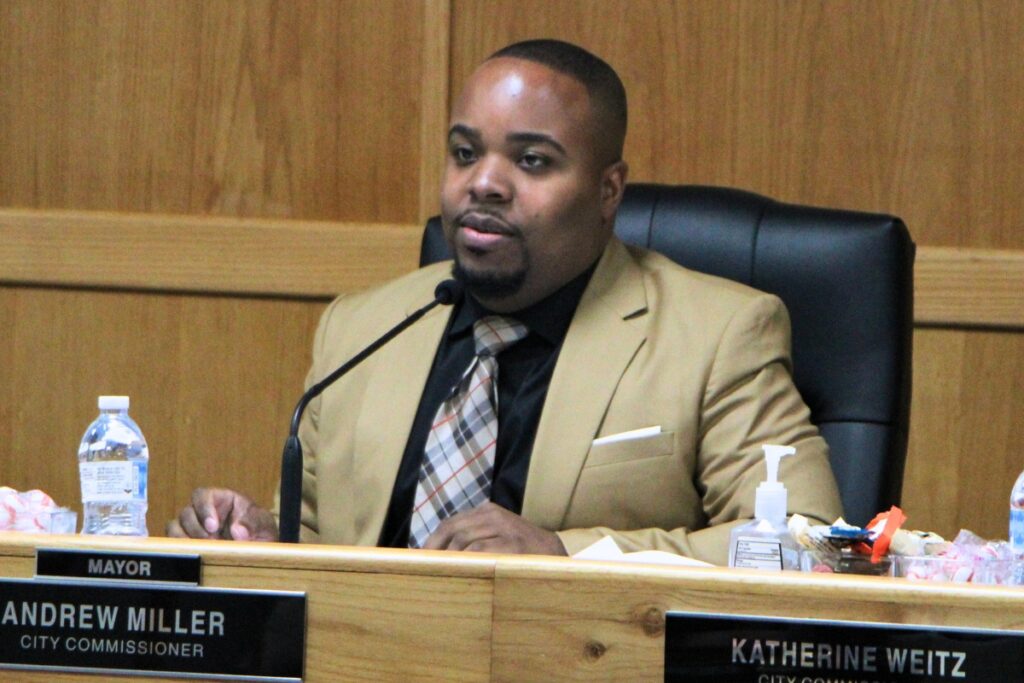
The High Springs City Commission experienced highs and lows during its regular meeting on Thursday, with a swearing-in following last week’s election, before staff presented an unexpected bill of nearly $900,000 for the city’s sewer project.
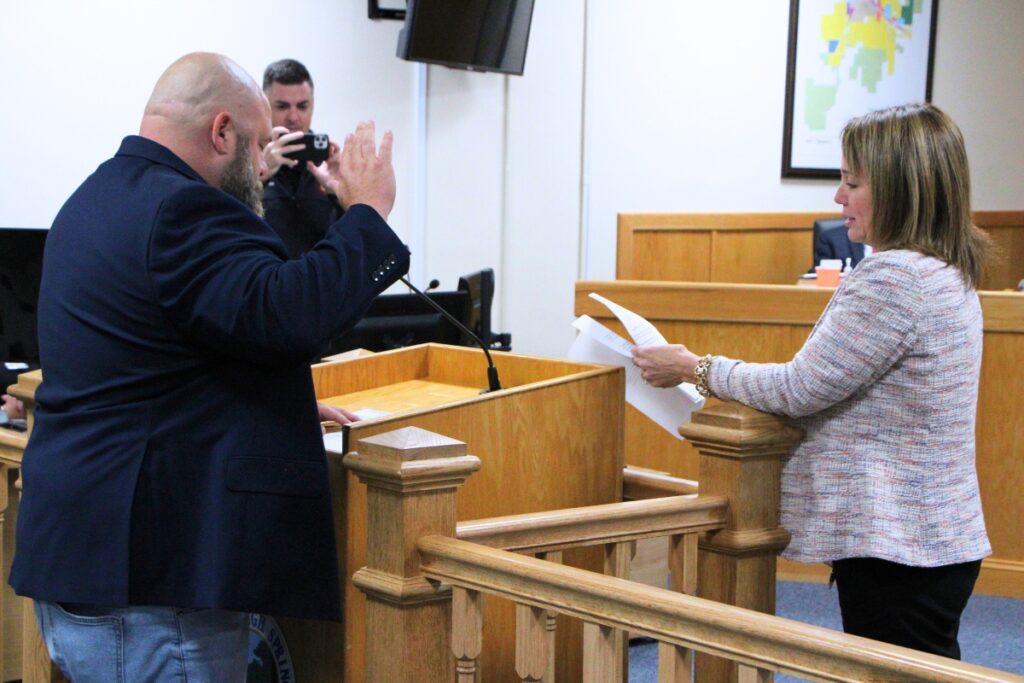
Commissioner and former mayor Tristan Grunder slipped into a dress jacket as City Clerk Angela Stone swore him back onto the commission for another three-year term.
Grunder secured almost 68% of the votes cast during the Nov. 4 election to defeat Seat 3 challenger and High Springs Planning and Historic Preservation Board member and former Charter Review Board member Julie Ann Tapia-Ruano, 587 to 279.
He thanked his family for their support and the citizens of High Springs for trusting him. Grunder will also serve as chair of the Community Redevelopment Agency board alongside Commissioner Chad Howell as vice chair.
“This town is a very amazing, wonderful, beautiful place to live,” Grunder said. “We’ve got our problems, but we’ve got better people and that was decided. I feel so honored to represent this town for a second term and I will do absolutely everything and anything I can.”
The dais reshuffled again after Grunder made a motion to elect commissioner and former Vice Mayor Andrew Miller as mayor, which the commission unanimously approved.
The commission also approved Commissioner Katherine Weitz’s nomination for Commissioner Wayne Bloodsworth Jr. as vice mayor.
Miller and Bloodsworth Jr.’s terms on the City Commission end in 2026.
“I would like to say thank you for trusting me for being mayor this upcoming year,” Miller said. “I’m excited to see the city move forward in a positive way.”
Thursday’s agenda was amended earlier in the week when staff added an item to discuss, consider and act on paying an $896,861.35 bill from Evoqua Water Technologies. The commission did act to pay the bill, but not without discussion and consideration.
The invoice comes from the city’s new wastewater treatment facility project, specifically for the construction of a treatment tank and rehabbing the system’s old tank.
Even though purchase orders for the project were approved at the start of the project almost three years ago, staff explained the city just recently received the Evoqua invoice on Sept. 22 because that part of the project had to be completed first.
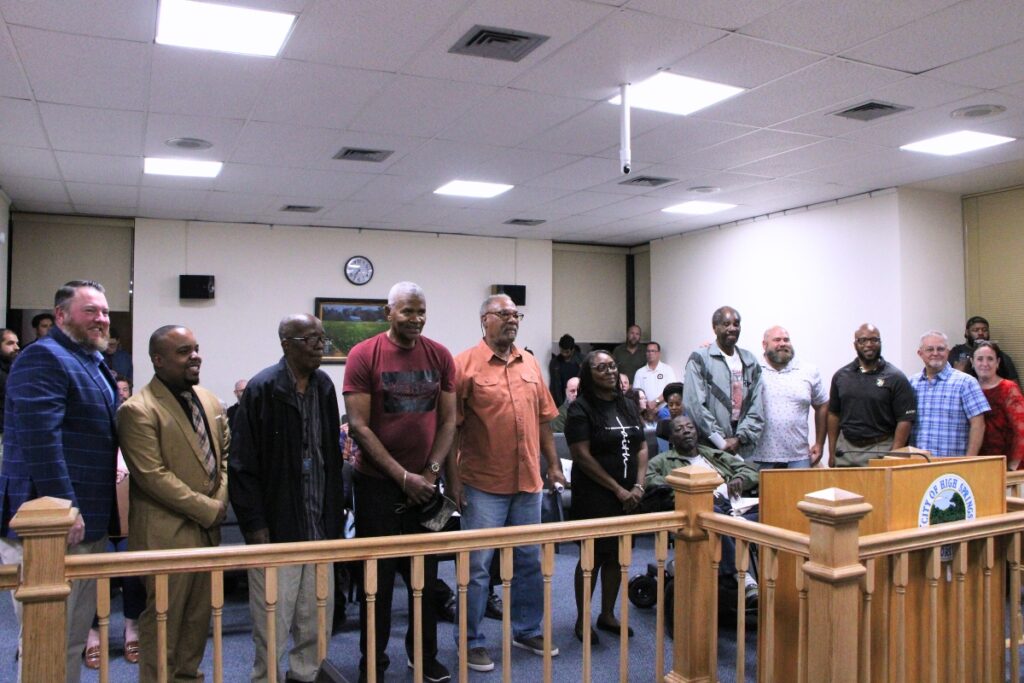
City Manager Jeremy Marshall said he wanted to bring the invoice before the commission to be transparent about why so much money would now be leaving the city and that staff were negotiating a late fee, which could bring the bill up to $910,314.27 since it wasn’t paid by Oct. 10.
Emergency cash funds will pay the invoice from the city’s infrastructure fees account, which funds projects like roads, water and sewer lines.
Finance Director Diane Wilson said the account has over $1 million in it and that while this bill would drain most of it, chunks of cash from revenues, like property taxes, would start coming in this month to replenish it.
Wilson said this is the kind of incident she’s been nervous about happening since the city already faces a $723,000 deficit. She said it further emphasized the need for long-term solutions to build reserves.
“I don’t know how many other ways to say it, we are in a spot, and I’ve been saying it and now it’s happened,” Wilson said. “This just solidifies that we need to speed up our short long-term planning.”
Wilson and Marshall said they’ve been having to do a lot of digging to figure out how the approved purchase order failed to show up in the city’s software system for any staff or external auditors to find.
Marshall said the tracing efforts had been particularly difficult since the city’s last few audits were late.
Wilson, who was in and out of administrative leave when the purchase order was approved, said it would’ve been in the system since orders get printed out and that it probably came across her desk at some point.
“I’m not going to make excuses, because the reality is, you guys all know what a complete disaster communication was back then,” Wilson said. “There was a lot I did not know, but it was my responsibility to know, even though I was new.”
Although they did not name her, Weitz and Wilson said the incident seemed to be another example of spending without proper communication from Marshall’s predecessor, Ashley Stathatos, who resigned in November 2023.
Weitz recalled a conversation where she disagreed with Stathatos about receiving advanced impact fees to fund projects. Now, she said it appeared that approach had been pursued regardless of her opposition.
Weitz also said that when the city approved a new elevator, an electrician was hired without the commission’s approval and money was spent to fix it following months of unauthorized use.
Weitz said the commission didn’t find out the project went 100% over budget until well after it was finished.
Marshall said he is launching an investigation into the wastewater project. He said he will search through emails from his predecessor as well as other former staff members like the public works director to figure out how the misplacement of the bill happened and who needs to be held accountable.
Despite the concerns, no one was accused of illegal activity during the meeting.
Apart from the weight of having to pay the bill, the commission, staff and some citizens agreed it was good to have transparency, unlike in the past.
“What you have now that you didn’t have three years ago, two years ago, we’re having honest conversations here, and that’s what the people of this community deserve,” Weitz said. “And we, the five of us, are going to have to figure it out. That’s why we’re here.”
Editor’s note: This story was underwritten by a grant from the Rural Reporting Initiative at the Community Foundation of North Central Florida. To learn more or get involved, click here.
Editor’s note: This story was updated with current information about Julie Tapia-Ruano’s board member status. A second update provided additional detail on the commission’s discussion.
Suggested Articles
No related articles found.
Thanks for being a positive force that makes social media actually worthwhile
High Springs just emptied its emergency reserves to cover a $900,000 surprise bill—a catastrophic hit for a small city. Meanwhile, Alachua County commissioners rake in revenue from the second-highest property taxes in Florida and sit on $84 million in taxpayer funds. Yet instead of helping a city in crisis, the county just spent $2 million on AI cameras to spy on employees and citizens. When it comes to priorities, small towns pay the price while the county plays Big Brother.
Only in Ron’s Florida, maga land.
Smaller government right? Lol
Surprise! Surprise! Well GA-AH-ALI! Typical, angry partisan.
A Florida county can give money to one of its cities, but only if the expenditure is for a “public purpose” and not for private gain, according to Article VII, Section 10 of the Florida Constitution and Section 166.021(2) of the Florida Statutes. For example, funds can be used for shared projects, economic development, or to support a service that benefits residents of unincorporated areas but is provided by a city.
A Florida county can loan money to a city, but only under specific circumstances and with limitations, primarily for projects that serve a county or public purpose, as defined by Florida law. A county cannot simply lend money to a city without a legal basis; the loan must be for a specific purpose, such as community redevelopment, and the funds must be properly appropriated.
High Springs doesn’t have a $110 billion budget — but the real problem is the one no one wants to talk about. The State of Florida’s own CFO says the county is sitting on more than $84 million in “excessive, wasteful spending.” That’s money collected from taxpayers that didn’t need to be spent, even after accounting for inflation and population growth.
Meanwhile, small towns across Alachua County are scraping by, living within their means, and sometimes coming up short. They don’t have the luxury of bloated reserves or layers of new staff positions. They don’t have million-dollar line items tucked into a budget approaching $1 billion. They simply have to make do.
If the state can identify tens of millions in excess, residents deserve to see the full breakdown of where that waste is hiding. And if there’s room to cut taxes without hurting essential services, the public deserves that relief too.
It’s simple: small towns tighten their belts. The county should be held to the same standard.
Love how 🌟 you turn everyday moments into meaningful lessons for all of us
Why did you not included the evidence Sue Weller brought forward at the commission meeting in public comments proving the City of High Springs received multiple email invoices for remittance of balance due rebukeing the Financial Director claims she never recieved them. Tristan asked why a citizen had more details and evidence than the City Manager. Please review the live video.
I think High Springs has to focus on building its commercial tax base in order to manage its budget.
I appreciate Main Street News for their coverage of High Springs Commission meetings. Listening to the meeting, my take-away was that previous manager, Ashley Stathatos, was first involved in this issue. Many of us remember the frustrations of citizens who could not get answers to any issues from her. She deferred to Asst City Mgr Bruce Gillingham and her other department managers to answer questions. I trust that City Manager Jeremy Marshall will do a deep dive into all aspects of this issue.
Let’s not ignore the fact that this bill was made public AFTER the election. This was by design
This is what happens when the city does not have their own contract contract administration program. This means no construction engineers and inspection team.