



- Janice Garry filed a Florida Bar complaint against lawyer Aleksandra Kravets for ethics concerns over ADA lawsuits targeting small businesses.
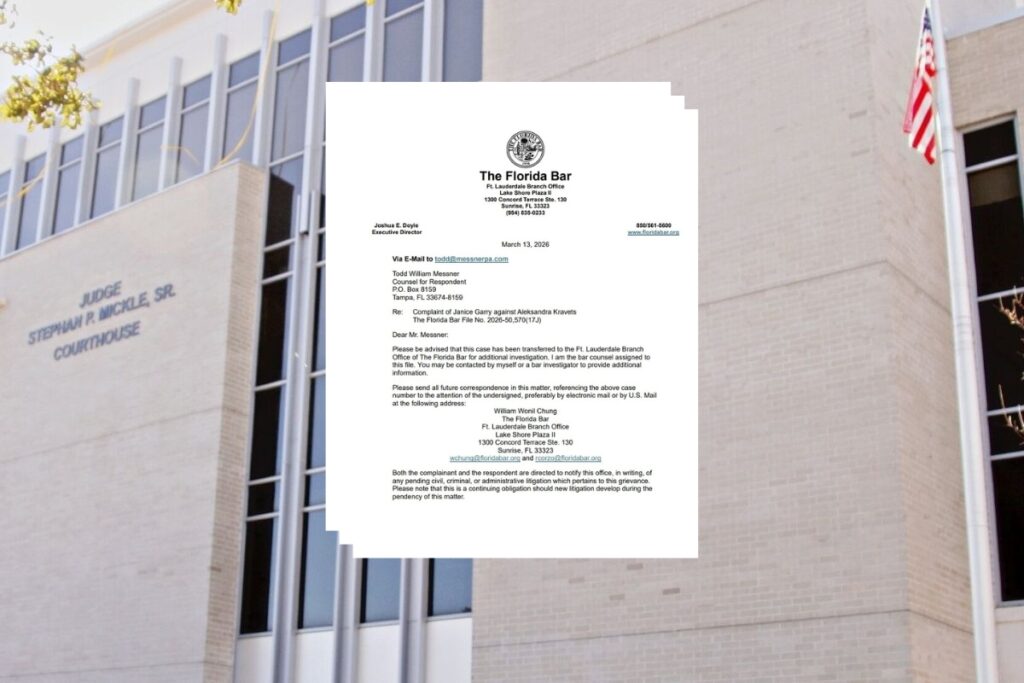
- The Florida Bar advanced Garry's complaint to its Fort Lauderdale Office for further investigation after initial filings and rebuttals.
- Aleksandra Kravets represented 8.8% of Florida's ADA website compliance lawsuits, filing 220 cases mostly between 2024 and 2025.
- Two bills, H.R. 7328 and H.R. 6453, propose giving website owners 180 and 30 days respectively to fix ADA issues before facing lawsuits.
A single lawyer filing hundreds of nearly identical lawsuits against Florida businesses seemed unethical to Gainesville resident Janice Garry.
Garry previously served as president of the League of Women Voters of Alachua County, and after stepping down, she continued speaking out on local and national issues.
Now, she’s co-chair of the What You Can Do campaign, promoting 10-minute activism. The Americans with Disabilities Act (ADA) lawsuits against Gainesville businesses, revealed in a December report by Mainstreet Daily News, were included as part of the initiative, with recommendations to shop local, donate to an impacted business and share the information with small business owners.
But Garry’s personal efforts stretched into hours and weeks as she worked to file a Florida Bar complaint against Aleksandra Kravets, the lawyer representing Makeda Evans in the dozens of local ADA website compliance lawsuits.
Last week, The Florida Bar sent the complaint to its Fort Lauderdale Office for additional investigation into the claims. The additional investigation will come after Garry’s initial complaint, a rebuttal by Kravets’s lawyer and a final rebuttal by Garry.
In a letter to both Garry and Kravets, Bar Counsel William Chung said the investigation will look for enough evidence to clear the Florida Supreme Court’s requirement of clear and convincing evidence.
“Most complaints, even those referred to the branch, are closed at the staff level,” Chung said.
Garry said she based the legal arguments on a different complaint filed with The Florida Bar against Kravets. But the main thrust of her complaint is ethics, not law.
She opened her rebuttal saying just that, and before highlighting how Kravets and her plaintiffs sued local and regional chains instead of national chains with corporate budgets to fight litigation.
“Instead, Ms. Kravets chose small businesses for whom making a quick settlement is less costly than hiring an attorney,” Garry said. “I am not addressing this matter from the perspective of a law that would require federal action to correct; I am addressing it from the perspective of ethics.”
Attorney Todd Messner serves as Kravets’s legal representation before The Florida Bar for the complaints. Kravets did not return a request for comment.
Addressing Garry’s complaint from a legal perspective, Messner said none of her arguments, even in the most favorable light, constitute violations of the Bar’s rules and standards.

The ADA law that Kravets practices often results in “vitriolic hostility,” Messner said, quoting a 1996 decision from the Southern District of Florida. He said the complaint seems to arise from the emotions that accompany litigation, but not from actual violations.
In fact, he said Kravets is fulfilling ADA law the way the federal government intended and that she only represented 8.8% of the total ADA Title III lawsuits filed in Florida from 2024 and 2025.
Kravets filed 220 ADA lawsuits during that time—mostly on website compliance—versus 2,500 total lawsuits. Kravets worked on behalf of a few clients, with Makeda Evans in Gainesville filing 52 suits, Jonathan Drummond in Jacksonville filing 75 suits and Andree Campbell and Zephyrin Victor in South Florida filing 52 and 46 suits, respectively.
When speaking with Mainstreet in December, Kravets said the lawsuits followed the system the federal government put in place to address ADA compliance. People may disagree with the system and recommend changes, but until the U.S. Congress takes action, the ADA lawsuit window (or loophole, according to Garry) remains open.
Potential changes could come following two active bills addressing ADA compliance.
Missouri Congressman Sam Graves filed H.R. 7328 in February. The bill would require potential plaintiffs to give website owners 180 days to fix ADA compliance issues before suing.
The second bill (H.R. 6453) would require 30 days to fix certain ADA compliance issues. It was filed by New York Congressman Michael Lawler.
Until those bills make progress through Washington, D.C., though, the law remains put.
“Attorneys complying with the letter of the law in their enforcement of the law is not a violation of the Rules Regulating The Florida Bar,” Messner said. “In fact, it is precisely this sort of attorney-driven compliance that has ensured enforcement of the law itself.”
Garry sent a list of questions for The Florida Bar to consider about Evans, Kravets, their motivations and where the money from the settlements had gone. She included praise of Satchel’s Pizza, which was sued by Evans, as a community anchor and said she hopes the complaint gets under the people’s skin to make everyone reconsider the ethics of ADA lawsuits that come without warning.
“The integrity of the legal system has certainly been marred by using a loophole that has not allowed prior notice or remediation of a website, but instead slaps hard-working small business owners with a lawsuit,” Garry said in the complaint. “Ask the involved business owners if the legal system is working for them.”
Suggested Articles
No related articles found.
Glad to hear something is being done about this unethical attorney.
Kravatz gives all lawyers a bad name,
It’d help if the article showed us comparisons of a non-compliant and compliant websites. It’s a big mystery to me.
Also, you can bet Congress will include a new loophole to help lawyers in the future, their true friends. Future lawyers could send out mass produced postcards seeking 180 days to comply, knowing nobody reads junk mail. Instead, the “complaints” should be served by a sheriffs deputy and signed by the person served.
The problem is that there isn’t a codified standard for web accessibility that’s written into the law. All we have to go on is a set of accessibility recommendations.
I wrote a blog post recently that lightly covers the issue: https://www.brucefloyd.com/ada-website-accessibility-a-simple-checklist-for-gainesville-florida-small-businesses/
Glad to see this moving forward! Although I’m a proponent of web accessibility, there should be some consideration for unwitting small businesses so they can fix glaring issues, some of which are quite easy to manage.
I wrote a blog post about this issue: https://www.brucefloyd.com/ada-website-accessibility-a-simple-checklist-for-gainesville-florida-small-businesses/
My concern in addition to penalizing small businesses is that the rest of the ADA code is getting a black eye by this horrible litigation. Often code officials ask businesses to do something that makes a space more accessible and not cause unnecessary expense to the owner. Usually 20% of the remodel budget. How many of the small businesses that have been sued are going to be willing to work with codes now? I wouldn’t work with anyone who asked for extra compliance now. Very frustrating and frankly makes me mad that this loophole ever got passed in the first place.