


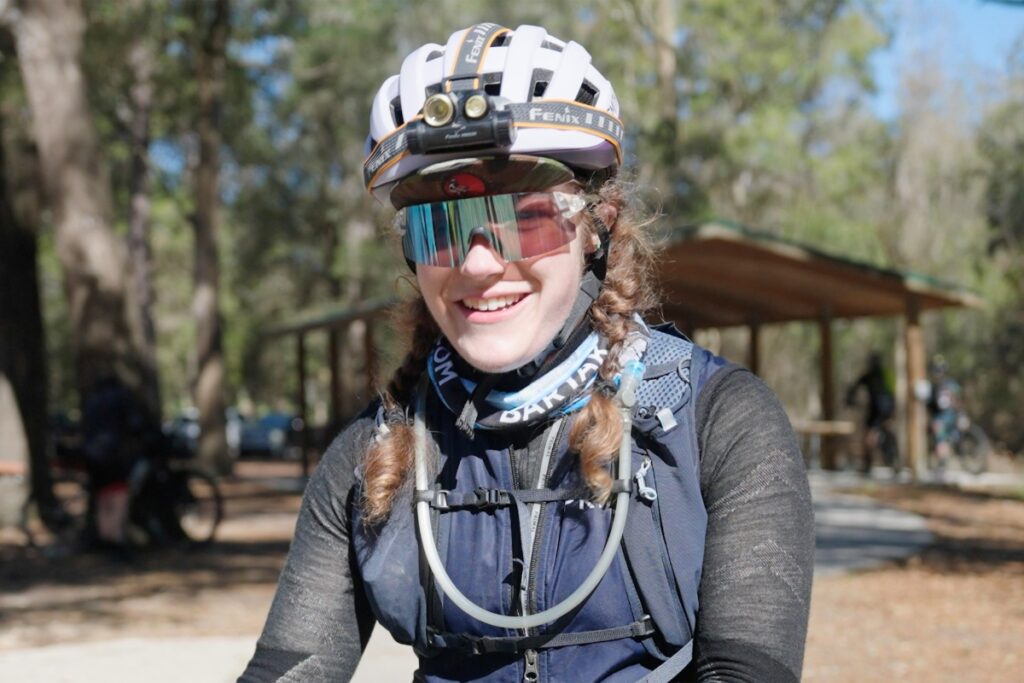
- Cate Hancock, a University of Florida student, was featured in a documentary about the Huracan 300 Bikepacking Challenge in Florida.
- The Huracan 300 is a self-supported, 350-mile mountain bike race with varied terrain including forests, singletrack, and climbs.
- Hancock completed the race in five days using a Priority 600HXT bike but faced challenges like cold nights and camping difficulties.
Cate Hancock loves to ride bikes.
She started riding in 2023 when she got her first gravel bike.
“It’s just been nonstop from then,” said Hancock, a fourth-year University of Florida forest resources and conservation major.
Hancock said she developed a passion for biking while working at REI, an outdoor retail company.
“They have a bike shop at that store, so I was kind of exposed to it there,” she said. “Me and my co-workers would ride bikes after work. It was just a really fun way to hang out with my friends. Since then, I’ve gotten more connected with the Gainesville bike community and a few group rides around here. It’s been an awesome way to explore new places and make new friends.”
Hancock was recently featured in a documentary about Florida’s Huracan 300 Bikepacking Challenge. Known as the “ultimate off-road endurance experience” in the state, the challenge is a self-supported bikepacking race through Florida.
According to BIKEPACKING.com, the original 300-plus mile course – there are four route options for participants – includes more than “100 miles of singletrack, many remote miles of double-track forest roads and abandoned paths, and a few miles of pavement here and there.”
While on the route, “riders cross numerous forests, the Cross Florida Greenway, two mountain bike parks, and miles of some of Florida’s longest and hardest climbs,” according to BIKEPACKING.com.
The race, which is organized by Singletrack Samurai (Karlos Bernart), is typically held annually in February. This year’s event took place on Feb. 7 at Shangri-La Trailhead and Campground in Ocala.
The nearly 40-minute documentary, “Huracan 300: The Hard Way Through Florida,” follows Hancock – and another Florida-based rider – as they go through the highs and lows of finishing the bikepacking challenge.
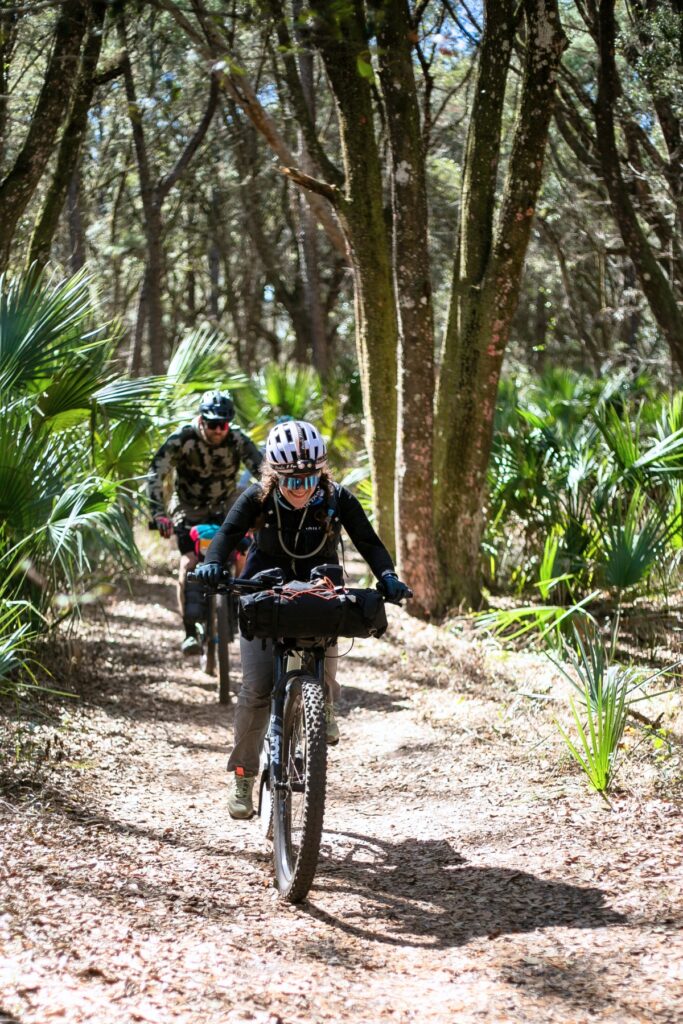
“[The] Huracan [300 Bikepacking Challenge] is more of a mountain bike route, at least the original version of the route is,” Hancock said. “And I was looking for something with even more varied terrain. I wanted to explore Florida and try out some new, fun trails. So, that was my main draw to the Huracan.”
Hancock said it took her five days to finish the race, adding she had planned for four days.
Those five days of riding – 350 miles total – were by no means easy for Hancock.
“There were so many unexpected challenges,” she said. “It [the race] was in February, so it got really cold during the nights, and the terrain was just constantly changing.”
Hancock said the biggest challenge for her was camping and sleeping at night, given that it was so cold and that she didn’t have the best camping setup.
“I packed a bivouac,” Hancock said. “It’s a tent, but it’s shaped a little bit more like a sleeping bag. [It] had a sleeping bag liner and a down quilt. I think I would have benefited from some warmer camping setup.”
Hancock said there were a couple of designated areas along the route for riders to group camp. She added that they could also stay at a campground for the night.
“It’s really wherever you can safely sleep along the route,” Hancock said.
In addition to the bivouac, Hancock said riders also packed food and snacks for the journey.
Hancock had her tent and snacks stored on her Priority 600HXT bike, which she used for the race.
“It’s their [Priority Bicycles, a bicycle brand based in New York City] mountain bike,” Hancock said. “And it had a lot of really awesome features. It worked out really well for this route.”
Connor Swegle, co-founder of Priority Bicycles, who produced the documentary, provided Hancock with the bike.
“Right when we met Cate, it was just really inspiring – her approach to riding bikes,” he said. “And I think for us here at Priority, a lot of what we want to do is make bicycles that make riding easier and simpler for people. If you get somebody like Cate with a great disposition, and then we’re able to give them one of our bicycles that they can really use, it’s just a really great partnership.”
Swegle said they met Hancock through a Trailblazer Grant program that Priority had in 2025. When discussing the documentary, he noted that the original idea was to show their bikes in motion and document the Huracan 300 ride.
“It then quickly became a lot less about the ride, and really more about this challenge and the people who go out there to accomplish it,” Swegle said. “And I think Cate, in terms of her ability not just to ride, but also document the ups and downs and all that, gave us a much bigger and more compelling story than [a] bike on [a] trail.”
Hancock admitted there were times in the race where she received help and didn’t think she would be able to finish, especially on the last day.
“On day five, being on the roads really got difficult,” Hancock said.
While there were some challenges, Hancock said she still managed to have a good time.
“The main reason that I was out there was to ride my bike,” she said. “I was able to still have that fun out there.”
In fact, as she neared the finish line, Hancock jokingly said that she wanted to keep riding. Nonetheless, she said it was “immensely satisfying” to reach the end.
“By the time I got back to the campground, I was ready to go lay down,” Hancock said.
Swegle said what he hopes viewers take away from the documentary is that there is “value in facing challenges head on and trying to do something different.”
“I think it’s really amazing to see somebody be vulnerable and forward with facing challenges,” he said. “That hopefully just makes it easier for everyone to face a challenge in their life.”
Editor’s note: This story has been updated to reflect the correct spelling of Karlos Bernart.
Nick Anschultz is a Report for America corps member and writes about education for Mainstreet Daily News. This position is supported by local donations through the Community Catalyst for Local Journalism Fund at the Community Foundation of North Central Florida.
Suggested Articles
No related articles found.