



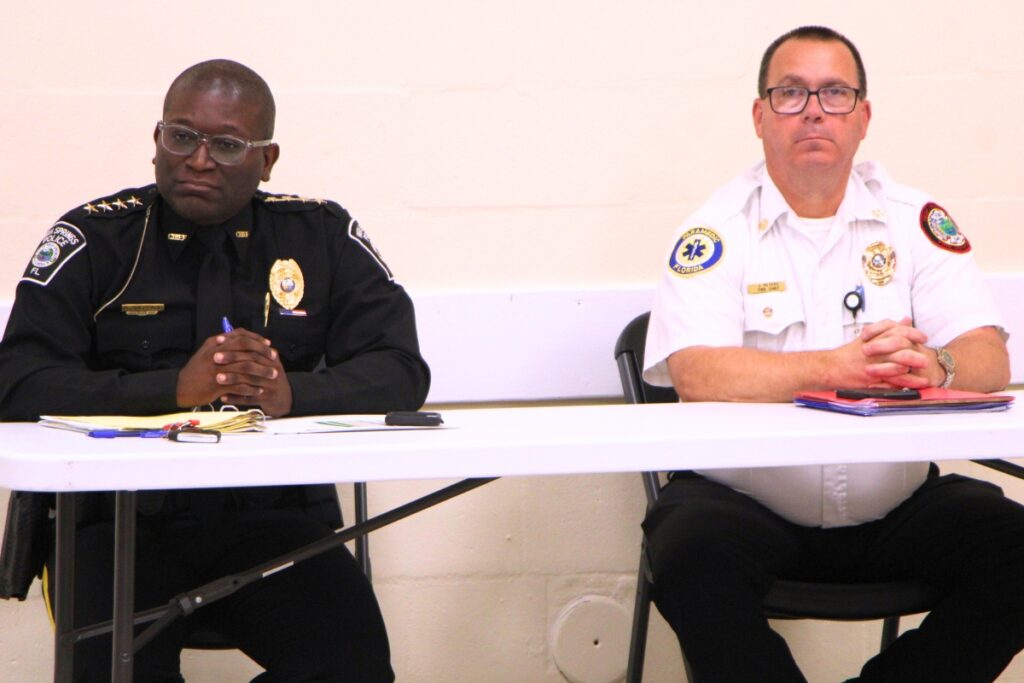
- High Springs City Commission held a workshop on April 27, 2023, to discuss public safety cuts and alternative revenues for the 2026-27 budget.
- Public safety consumes 64% of the city's budget, with 42% for police and 21.5% for fire, exceeding recommended limits.
- The fire department has reduced staff to four per shift, risking safety and increasing insurance costs if cuts continue.
- Police department is fully staffed with 14 officers, but proposed cuts could raise response times and affect recruitment negatively.
During an emotionally charged budget workshop on Thursday, the High Springs City Commission weighed the ins and outs of public safety personnel cuts, department eliminations and alternative revenue routes in hopes of addressing ongoing financial deficits.
Commissioner Chad Howell called for the workshop during a regular City Commission meeting in March to prepare for the upcoming 2026-27 fiscal year budget season.
Around 60 people attended the Civic Center, some wearing “Support High Springs Firefighters” shirts as police and fire staff dipped in and out of the building when called on duty.
The commission said it needed to figure out how to run the city without relying on utility revenue to sustain its general fund. They said solving this is especially critical ahead of the state’s consideration of eliminating property taxes.
City Manager Jeremy Marshall said the city needed to look at public safety cuts after he’d already downsized City Hall staff and is considering privatizing public works. The workshop continued conversations from last year when the City Commission talked about cutting fire and police personnel or shutting the departments down altogether.
Marshall said public safety accounts for around 64% of High Springs’ budget, with 42% going towards police and 21.5% fire. Municipalities are encouraged to keep public safety below 30% of their budgets, Howell said.
Marshall said the city’s infrastructure is suffering and can’t handle growth already approved, like Bridlewood, or others wanting to come. He said he’s having to turn away applicants because the sewer is at capacity and operating at a negative rate.
“We’ve cut a lot of staff to make this year go through. There’s no more we can cut in operations,” Marshall said. “We are on a shoestring staffing level.”
High Springs Fire Chief Joseph Peters and Police Chief Antoine Sheppard both presented the costs of running their departments and how cuts could impact them.
Peters said the fire department, which has been around since 1913, is severely understaffed with four personnel per shift, a drop from five in February to save $468,880 annually in operation costs.
The department has a crew of eight full-time, eight part-time and three volunteer staff, down from 15 full-time employees seven months ago. Only two personnel operate an engine at one time, which is below the recommended four.
Dropping to three staff per shift as the commission proposed would be dangerous, Peters said, as burnout is already showing and four employees recently resigned over the uncertainty of their jobs. He said he hasn’t advertised the open positions, not knowing whether the department will live or die.
Peters said the proposed personnel cut would also raise the city’s Insurance Services Office (ISO) rating, which measures a department’s ability to protect a community, from four to 10, likely increasing insurance rates for homeowners.
Alternatively, if the city raised its $250 fire assessment to $335, Peters said the fire department’s $1,121,711 draw from the general fund would drop to around $788,000.
He also said the department anticipated a larger revenue collection this year from Alachua County because the number of calls shared between the agencies varied from the original estimate.
Even though the city just raised its fire assessment, the City Commission said there will be another hike this year. Howell said past commissions have not done so more proportionately and consistently over time, as the budget called for, which is why this commission is having to consider cuts now.
Staff also discussed moving from a flat fire assessment rate to a sliding scale based on house value, like how Alachua County collects its assessment. Marshall said that whatever methodology High Springs wanted to use, a $15,000 study needed to be done so it could raise its assessment.
The commission also considered dividing Public Information Officer Kevin Mangan’s salary among various city budget lines and selling fire vehicles to lower operating costs. High Springs will talk about fire services again during its joint meeting with Alachua County on May 14.
“We’ve got to get out of the fairytale, man. It’s a pay-to-play city now. That’s where we’re at financially,” Commissioner Tristan Grunder said. “If everybody’s okay with just paying more, then we absolutely can keep both departments. And I think that’s what the vast majority of us want.”
Sheppard said even though the High Springs Police Department is the lowest paying law enforcement agency in the region, they are fully staffed with 14 officers (two less than the recommended 16 calculated from the Florida Department of Law Enforcement’s suggested 2.3 officers per 1,000 residents).
One sergeant, two officers and one swing officer to help with peak demand periods cover each shift. The department responds to around 3,500 calls over six months and has secured over $200,000 of non-matching grant funding so far this year.
The commission proposed cutting two officers, which Sheppard said would save around $166,000 annually from the salaries. But it would increase response times, overtime pay, staff fatigue and lower operational stability that will likely impact recruitment in the long-term, he said.
Sheppard suggested two options for expanding services from the Alachua County Sheriff’s Office (ACSO), one costing $2.2 million and the other $4.4 million, both dependent on the School Board of Alachua County covering half of the School Resource Officer’s (SRO) salary. The school district currently pays 80% of the SRO’s salary while the city pays 20%.
Grunder, a sergeant for the Gainesville Police Department, said getting rid of High Springs police would turn the city into the wild west. He said response times would spike, as ACSO deputies would often be commuting from Gainesville.
The audience booed when Vice Mayor Wayne Bloodsworth Jr. said getting rid of property taxes was a great idea he’d be voting for, before applauding Sheppard’s response that safety shouldn’t be compromised now for a bill that may not happen.
“I have to stand on public safety and officer safety. My 25 years of service, I won’t jeopardize that,” Sheppard said. “I won’t come here and tell you, put one officer on here, and then it’s on me. I think if property taxes are passed and it devastates our city, we have to make those decisions at that time. I don’t think we compromise on public safety. If we can’t afford it, we can’t afford it.”
During public comment, attendees shared testimonials of how they’d benefitted from High Springs fire and police departments, urging the commission with tears to think in terms of minutes that could save lives instead of dollars.
One resident said she’d rather not go out to eat for an entire year to save enough money for the fire assessment than lose the services. Others suggested levying new taxes, increasing speeding ticket fines and raising impact fees as revenue streams; all options staff said it couldn’t do without policing for profit or paying for more studies.
High Springs Police Sgt. Vernon Higginbotham approached the commission in uniform. He said the first thing everybody needed to do in this situation was praise God, because he remembered 30 years ago when the commission voted on whether to keep the police department.
“They survived it then, and you can survive it now. This city is stronger than what we’re scared of,” Higginbotham said.
But he said the town would never be able to recover from the repercussions of cutting police, and that if the commission wanted to make cuts, it could start with themselves.
“I have never read anything except the charter, which can be changed, that says we have to have five on the commission. We can do it with three,” he said.
Even though some people might be willing and able to pay more, Bloodsworth said others are on fixed incomes that can’t afford the services. Marshall said he didn’t want to make any definitive decisions about public safety cuts until the new finance director is fully onboarded.
Howell said he’ll be tabling at the High Springs Farmer’s Market from 3 to 7 p.m. on May 8 and 22 to answer any questions residents have.
“Nobody up here wants to get rid of the fire department or the police department,” he said. “But the reality is, we’re an $8 million budget for the city of High Springs, and we’ve got to cut 12.5% of that.”
Suggested Articles
No related articles found.