



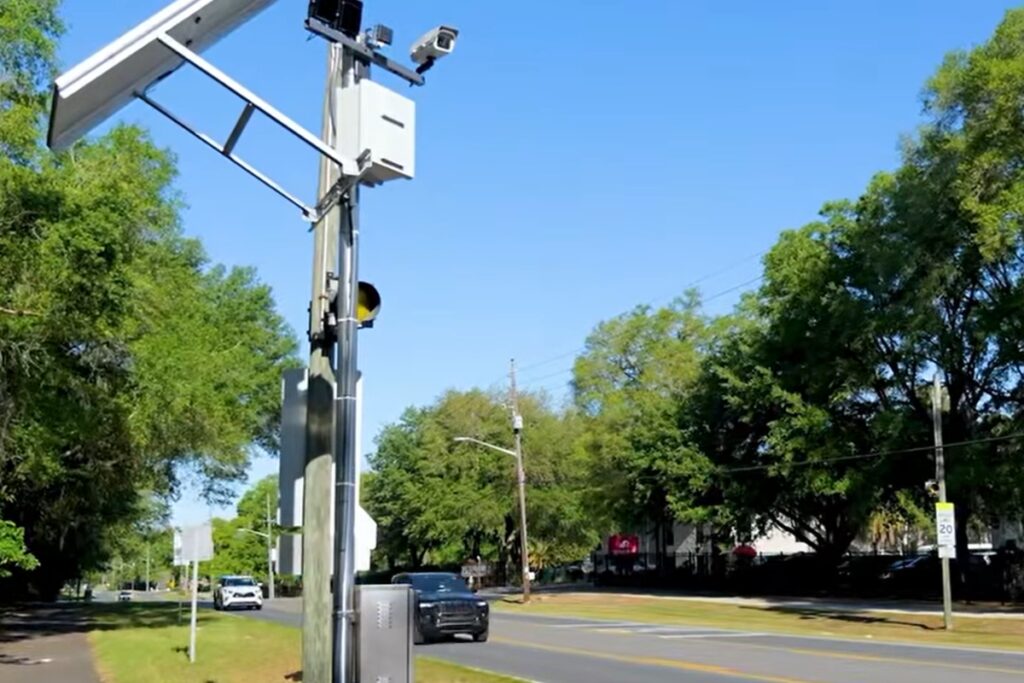
As students return to Alachua County Public Schools on Monday, Aug. 10, the Alachua County Sheriff’s Office (ACSO) is reminding motorists about school zone speed limits and the county’s school zone speed camera enforcement program.
According to an ACSO release, beginning Monday, drivers traveling 11 mph or more over the posted school zone speed limit while the zone is active will receive a $100 administrative fine by mail. Drivers traveling 15 mph or more over the posted speed limit in a designated school zone when the zone is not active, but school is in session, also will receive a $100 administrative fine by mail.
The administrative fine is not a Uniform Traffic Citation. It does not affect a driver’s driving record, result in points on a driver’s license or get reported to an insurance company.
ACSO said the program is intended as a deterrent and reminder that school zone speed limits are in place to protect children.
The agency also is addressing several common questions and misconceptions about the program. The following are myths/facts about the program released by ACSO.
Myth: The cameras were purchased with taxpayer dollars as a money-making program for the county.
Fact: The cameras and related program costs are funded entirely through fines collected from school zone speed violations.
Under Florida Statute 316.1896, the $100 civil penalty is distributed as follows:
- $20 is remitted to the Florida Department of Revenue for deposit into the General Revenue Fund.
- $60 is retained by the county or municipality to administer speed detection systems and support other public safety initiatives.
- $3 is remitted to the Department of Revenue for deposit into the Department of Law Enforcement Criminal Justice Standards and Training Trust Fund.
- $12 is remitted to the local school district for school security initiatives, student transportation or improvements to student walking safety conditions.
- $5 is retained by the county or municipality for the School Crossing Guard Recruitment and Retention Program.
Myth: The cameras continuously record vehicles or operate like automated license plate readers.
Fact: The camera systems do not continuously record every vehicle traveling through a school zone and do not operate as automated license plate readers for all passing vehicles.
The system first detects a speeding violation. When a violation is detected, the camera activates and captures a three-second video and four photographs. Tag information is collected for the purpose of issuing the citation.
ACSO said it cannot remotely access the cameras for live roadway viewing. Data is retained only until the citation process is resolved and then is purged. No information is sold or transferred to third-party entities.
Myth: If I don’t pay the fine, nothing will happen.
Fact: Recipients have 30 days from the issuance date to pay the civil penalty. If the penalty remains unpaid, the Sheriff’s Office provides an additional 15-day grace period before converting the violation into a Florida Uniform Traffic Citation.
Once converted, additional penalties may apply, including points against a driver’s license, potential reporting to an insurance company and increased fines.
Myth: If I wasn’t driving, I can’t be cited.
Fact: Similar to toll violations, school zone speed citations are issued to the registered owner of the vehicle, as provided by Florida law.
If the registered owner was not operating the vehicle when the violation occurred, the owner may complete a Civil Violation Non-Operation Affidavit identifying the driver responsible for the violation. The citation can then be transferred appropriately.
Myth: Why not assign a deputy sheriff instead of using cameras?
Fact: Deputies are unable to be physically present in every school zone every day. School zone speed enforcement cameras provide consistent enforcement intended to encourage safer driving behavior in areas where children are present.
ACSO also noted that a deputy sheriff’s salary is funded by taxpayers. A citation issued directly by a deputy for a comparable speeding violation could be significantly more expensive and may affect a driver’s record, result in points and potentially affect insurance rates.
The agency said the camera program provides an alternative that emphasizes administrative enforcement and encourages motorists to slow down in school zones.
Drivers with additional questions are encouraged to review the ACSO school zone speed camera enforcement program FAQ.
Alachua County Sheriff’s Office School Zone Speed Camera Enforcement Program FAQ
ACSO’s message to motorists is simple: Slow down, protect children and follow the rules.
“The goal isn’t writing citations. The goal is changing driving behavior before a child pays the price,” the release stated.
Suggested Articles
No related articles found.
If you REALLY want to be serious about theses cameras why not lower the tolerance to zero or 5mph over at best? 15 mph over in a school zone is okay?
its only 11 when the school zone is in effect, the 15 mph is for other times of the day. so if someone is going 60 in the 45 MPH zone for example. I’m guessing a few of those will be going out on 43rd. It seems like the fee should be higher for when the zone is in effect.
Good report. Thank you.