



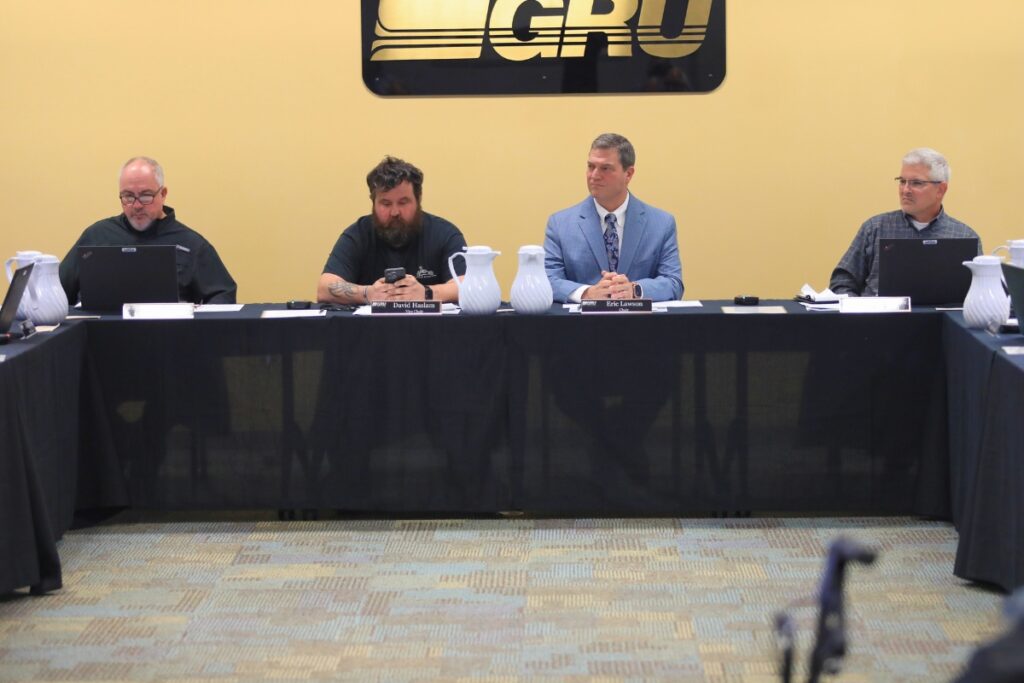
- The GRU Authority failed to vote on a new contract to continue collecting Gainesville's garbage and stormwater fees, ending decades of billing these through GRU.
- Gainesville will now collect these fees through the county tax collector despite wanting to stay with GRU and offering a high cost for the service.
Gainesville Regional Utilities (GRU) customers will see garbage and stormwater costs removed from their monthly bills after decades of paying for the city of Gainesville services through the utility.
On Wednesday, GRU staff presented a new contract that would allow the utility to earn more money by continuing the garbage and stormwater billing, but a gridlocked GRU Authority failed to make a vote on the item, effectively killing the contract.
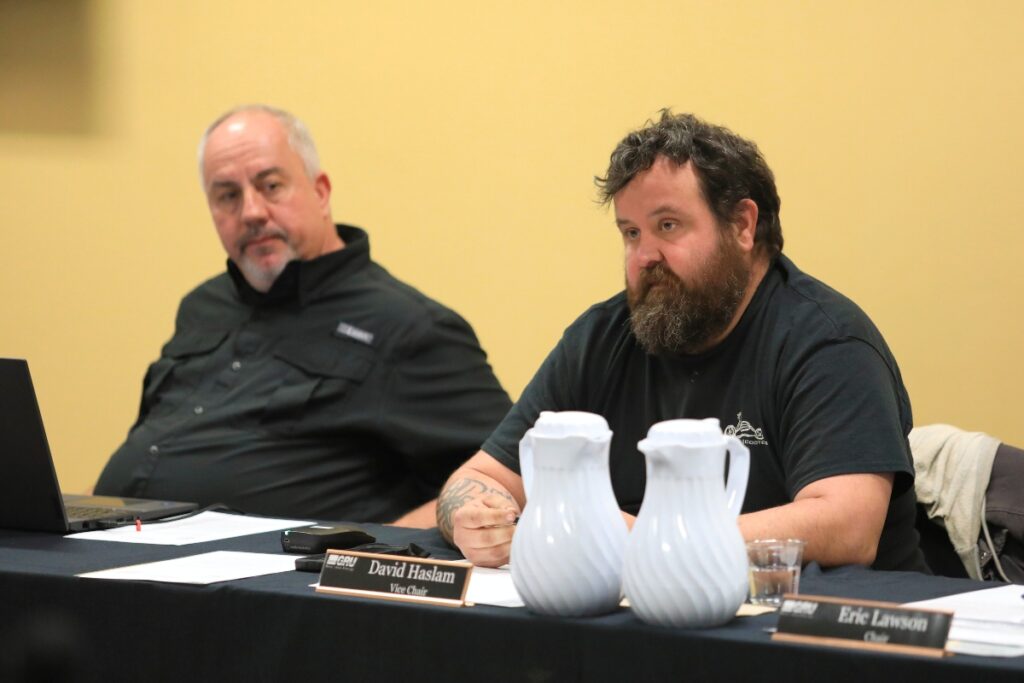
GRU directors Jack Jacobs and David Haslam opposed the new contract and advocated removing the city’s charges from utility bills. Directors Eric Lawson and Robert Skinner supported the contract and the additional revenue it would earn the utility.
Without a crucial fifth director appointed by Gov. Ron DeSantis, the two sides were left in a stalemate on the dais. The GRU Authority has operated with only four directors since former Director Craig Carter left in June 2025.
The GRU Authority started down this path over a year ago, voting in March 2025 to stop collecting garbage and stormwater fees for the city. That vote came after the Gainesville City Commission voted to raise its fees and a few months after a software error caused GRU to incorrectly bill more than 75,000 accounts.
However, the city returned and offered GRU more money to keep collecting the service fees.
Ed Bielarski, CEO of GRU, said it was too good of an offer not to bring back for the directors to consider. He said the utility has always had a public relations issue with the garbage and stormwater fees. The utility only collects them for the Gainesville City Commission, but he said it makes the overall utility bill higher, causing sticker shock and blame from customers.
GRU customers who currently pay the city’s garbage and stormwater fees would see at least $25 monthly bill reductions that could stretch to $60 depending on the level of garbage service used. Those bill reductions would likely come in late 2026.
In October, the authority voted to allow negotiations and a two-year contract to come forward for review. That vote resulted in the contract presented at Wednesday’s meeting. The contract would earn GRU an estimated $979,000 annually to collect the city’s fees, up from $821,000.
GRU staff originally presented the contract in March, but directors hit an impasse with Skinner absent from the meeting. Bielarski presented again with Skinner present, but the utility landed in the same place.
Bielarski said the Gainesville City Commission, which ratified the new contract in March, was scheduled to bring the item back at its next meeting because of the delays.
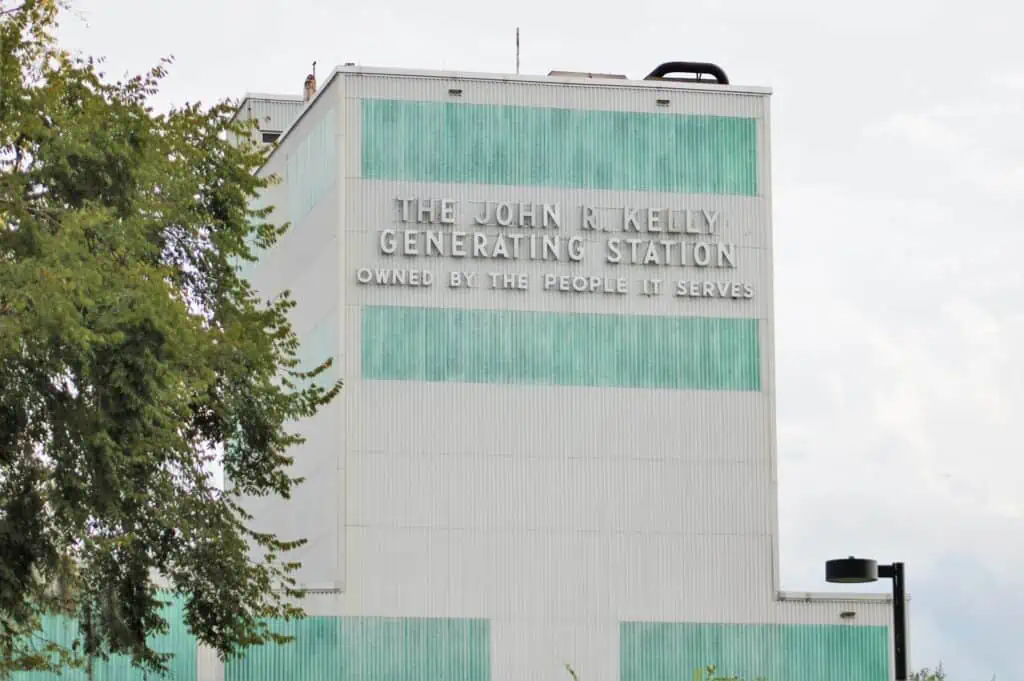
With the GRU Authority refusing the contract, the City Commission will collect payments through the tax collector, just like property taxes are assessed annually.
Alachua County Tax Collector Jon Power joined the Wednesday meeting and said his office would easily be able to handle the additional assessment. He noted that the office had collected the Board of County Commissioner’s stormwater and garbage fees for decades.
“We can collect it for half of what you guys are charging [the city of Gainesville]. Plus, they would have the money a lot sooner,” Power said.
Through the tax collector, the bulk of the revenue would be collected within two or three months at the start of the fiscal year. Power said the city could then shift that money around as needed or invest it and collect interest. He also emphasized the tax collector’s office has a 100% collection rate because of the tools given to it by the state of Florida.
Power would charge Gainesville a 2% fee—a percentage set by statute— for collecting the funds. The new contract Gainesville negotiated with GRU would give the utility a 4% fee.
Gainesville’s interim Chief Operating Officer Brian Singleton told the GRU Authority that the city estimated that it would still save by offering the utility the higher fee compared to the tax collector option.
He said the state of Florida gives a 4% discount to citizens who pay their property tax bill early, and Power confirmed that around 65% of accounts pay early to get the discount. Power also said the money is often invested to recoup that discount.
Singleton said the city also worried about recent lawsuits concerning these assessments and nonprofits, saying the potential losses could add up to $2.5 million. He said the city would rather keep the ongoing system with GRU and pay an extra $150,000.
But, the city of Gainesville has made the changes necessary to switch to the tax collector if needed.
Lawson supported the new contract. His main concerns were how GRU would recoup $1 million by ending the service to the city of Gainesville.
Bielarski confirmed that the savings would be minimal by not billing the stormwater and garbage fees. Lawson said the utility would then need to make up that loss of revenue.
“It is my position that GRU is benefiting from this shared relationship,” Lawson said.
But Jacobs said GRU knows exactly where to recoup that lost revenue, referring to the transfer of money the utility sends to the city of Gainesville each year. He added that the change could benefit customers who pay early with the tax collector.
“To me, it’s totally ridiculous to even consider this, considering the waste and the money,” Jacobs said.
The bigger issue, Jacobs said, was letting the city keep its fingers in utility bills. He said GRU could lower rates and be fiscally prudent, but if the city approves more fee increases on its side, GRU customers won’t see lower bills and will continue to fix blame on the utility.
Haslam said he saw Lawson’s perspective that the authority should only consider financial matters and the lost revenue. But he sided with Jacobs.
“My read on the comments is that there’s some political influence on making this decision because of the acrimony with the city,” Lawson said.
The Gainesville City Commission and GRU Authority have been locked in disagreement since the authority was founded—and even before, when the City Commission sued to prevent the authority from forming.
The two entities remain in legal battles following two city-initiated referendums to eliminate the GRU Authority. The referendums passed overwhelmingly but remain tied up in the courts.
Both sides claim misinformation and incorrect posturing from the other on numerous topics. Most recently, the issue rested on GRU’s fuel adjustment. A Florida bill could permanently enshrine the GRU Authority if signed by DeSantis.
Gainesville Commissioner Bryan Eastman released comments Wednesday night as soon as the GRU Authority made its decision. He called the decision a lose-lose for taxpayers and ratepayers. According to GRU’s backup, the utility staff viewed the new contract as a potential win-win.
“This decision will increase taxpayer costs as the City restructures stormwater billing, while also putting more pressure on GRU rates at a time when the utility is already facing major financial challenges,” Eastman said.
The agenda item prior to the stormwater and garbage billing on Wednesday was GRU’s financial position and estimated budget for the next fiscal year.
Bielarski said the utility is headed in the right direction and recommended no base rate increase for the electric or gas systems. He recommended a 2% increase for water and 1.75% increase for wastewater.
The GRU Authority will take a vote on the recommendations in June.
Update (5 p.m. Thursday): Interim City Manager Andrew Persons provided the following statement of response to Mainstreet:
For some time, the city has been working with Gainesville Regional Utilities CEO Ed Bielarski to draft a new agreement for stormwater and solid waste billing that would continue the practice of placing those charges on customers’ utility bills.
That system is outlined in a 2023 Memorandum of Understanding (MOU) between GRU and the City of Gainesville.
Although the MOU was intended to remain in place until a new agreement was signed or either side opted to end the arrangement with 24 months’ notice, yesterday’s GRU Authority Board discussion appeared to indicate there is not support for continuation. Because of this uncertainty, the city is taking necessary steps to shift the solid waste and stormwater charges to an assessment that would appear on the tax bills of property owners.
Suggested Articles
No related articles found.
These fees that the City levies shouldn’t be included on a monthly utility bill that can result in your electric being turned off because you don’t have enough money to pay your bill that month.
The GRU “Authority” messes up again. This DeSantis-appointed “Authority” has been a disaster from the beginning: dysfunctional, inept, a perfect example of bureaucratic Inertia. Supposedly created to lower utility rates, we now pay more than ever. Yes, if they no longer collect garbage and stormwater fees, our GRU bills will appear to go down, but we’ll still be paying the even higher cost for electricity that the “Authority” has saddled us with.
(Thank you, Former Florida State Representative Chuck Clemons for sponsoring creation of this monstrosity!)
Amen!
As an aside I was recently in Miami and saw an absolutely enormous beautiful yacht in Biscayne bay- largest one we saw there. It’s owned by the Canadian founder of GFL, the company that the city has contracted with for trash at a higher rate than competitors. The increase in trash bills was largely hidden from tax payers since it was buried inside the gru bills. https://www.superyachtfan.com/yacht/lady-jorgia/owner/
I think the people paying for garbage pickup are winning here. The job of collecting is gonna be done for half as much, saving about 400,000 per year. And, it is simpler. I like simpler.
Are you assuming that savings will be passed on to the citizen consumer? In the meanwhile, the tax collector is going to collect the full year’s worth of fees at the beginning of the year, and “invest it and collect interest”. Wouldn’t it be more beneficial for the citizens if we could invest and collect interest on our money until such time as the bill is due each month? What about Landlords who rent out a house, guess they have to pay for the garbage and wastewater now, rather than the tenant who made use of those services.
If the Governor insists on meddling in our local affairs, shouldn’t he have filled the vacant seat on the GRU Authority sometime last year?