



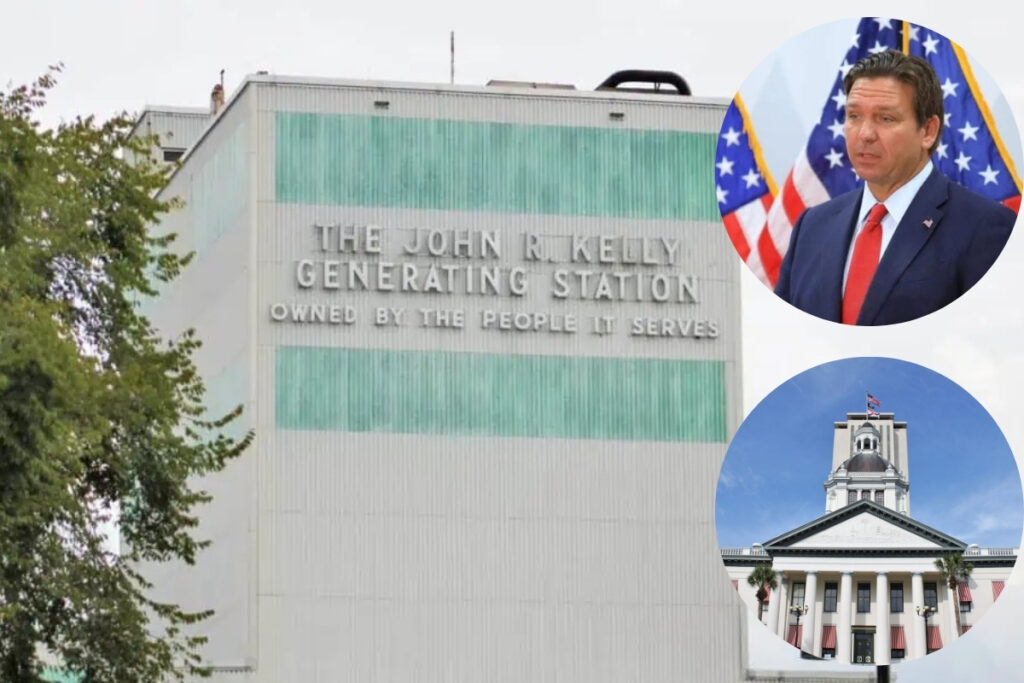
- Gov. Ron DeSantis signed House Bill 1451 on Friday, creating new parameters for municipal utilities operating outside city limits and seeming to cement the Gainesville Regional Utilities Authority.
- Established in 2023, the GRU Authority has been a dividing point and Gainesville residents voted twice to dissolve it and the DeSantis-picked members.
- Local officials seem divided on whether the bill will actually change the situation and end ongoing litigation or if the status quo will continue.
Gov. Ron DeSantis signed House Bill 1451 on Friday, creating new parameters for municipal utilities operating outside city limits and seeming to cement the Gainesville Regional Utilities Authority despite referendums and ongoing litigation to dissolve it.
The bill seems to prevent any entity besides the Florida Legislature from interfering with the structure of a regional utility authority created after 2023 by the legislature and appointed by the governor. The Gainesville Regional Utilities (GRU) Authority is the only authority impacted by that clause of the bill.
The Florida House and Senate passed the bill 85-26 and 30-6, respectively.
State Rep. Yvonne Hayes Hinson, D-Gainesville, strongly opposed the amendment. In a press release from the Alachua County Labor Coalition, Hinson said residents have lost their voice as the governor puts special interests ahead of the voters.
“Now the responsibility for higher bills and the mismanagement of GRU rests with the legislators who supported this,” Hinson said.
Fellow democrats joined in questioning the inclusion of the amendment and how it impacts home rule, with Gainesville residents having voted twice to eliminate the GRU Authority and return management to the City Commission.
In Gainesville, community groups mobilized to oppose the amendment that state Rep. Demi Busatta, R-Coral Gables, added at the final of three House committees.
The overall bill deals with how city-owned utilities relate with customers living outside the municipal limits, setting rate requirements, public meeting standards and new agreement contracts. But the amendment that would preempt and further codify the GRU Authority seems targeted to Gainesville.
The exact language is as follows: “the subject of a regional utilities authority created by the legislature through charter amendment after January 1, 2023, is expressly preempted to the state.”
A preemption typically means local governments or anyone besides the Florida Legislature are prevented from altering policy or rules on a certain topic—in this case, municipal utilities that meet the above parameters.
State Rep. Chad Johnson, R-Chiefland, told Mainstreet when the amendment was first proposed that it makes clear what the Florida Legislature always intended. He said Tallahassee has no desire to get involved in municipal utilities, but he said when those utilities become insolvent, then the state must step in.
“I don’t think that there’s any question what the intent of the legislation was in 2023,” Johnson said. “This amendment will just codify what the intent was.”
State Sen. Jennifer Bradley, R-Green Cove Springs, also supported the bill from the Senate floor. She represents northern Alachua County and said the residents deserve long-term stability.
Gainesville Mayor Harvey Ward said Friday that he doesn’t think the amendment language actually changes anything about the situation.
He said there’s also dozens of paths forward and added that he’s not sure how the bill would impact ongoing litigation.
“I don’t think the language in this bill changes a single thing about the way everybody currently operates,” Ward said. “I don’t think it changes anything. I mean, what it changed was that it made some lobbyists richer.”
Ward said it’s clear that the situation will look different in two years and added that any changes would take a couple years to shake through. Like in 2023, he called it a marathon and not a sprint.
But, GRU General Manager and CEO Ed Bielarski said the bill’s passage ensures the utility can continue its customer-first approach, pointing to its recent budget with no electric base rate increases.
“With the stroke of the governor’s pen, the seemingly never-ending attacks upon the governance of GRU have been put to rest,” Bielarski said in the release.
GRU Authority’s history and initial hurdles
The GRU Authority was established in 2023 after calls of financial instability caused by City Commission control. Proponents said the city had favored residents by forcing higher utility rates that also impact thousands of customers in the unincorporated area. Those higher rates then paid for a money transfer to city government that hit a $38 million annually.
Opponents touted the importance of home rule and pointed to past attempts to remove the utility from the commission’s oversight—attempts rebuffed by Gainesville voters in 2018. The City Commission also formulated a $315 million debt reduction plan to address concerns from the Joint Legislative Auditing Committee formed by state senators and representatives.
The GRU Authority’s tenure has proved bumpy in part due to two referendums issued by city commissioners to dissolve the authority and lawsuits in response to the referendums, which both passed overwhelmingly.
The authority hit a major snag after DeSantis appointed a director ratio that failed to follow the state law creating the GRU Authority. As a result, each of the directors voluntarily resigned before new appointments were made.
In the transition, the authority’s directors also wavered on whether to keep the top leadership who had started under the City Commission, namely former General Manager Tony Cunningham. After back-and-forth votes, Cunningham was fired and Bielarski, then a member of the GRU Authority, took his place and resigned his directorship.
Since June 2025, the authority has only had four members and found itself gridlocked in 2-2 votes, resulting in the end of a contract for GRU to provide stormwater and garbage billing for the city.
HB 1451 and ongoing litigation
The Florida First District Court of Appeal has three separate cases involving the GRU Authority and management issues stemming from the recent referendums. One of those already underwent oral arguments in February.
The GRU Authority’s case argues that the ballot language used in the 2024 referendum was out of line with state guidelines and that the city of Gainesville, even through its voters, cannot alter a part of its charter specifically placed by the Florida Legislature.
A Gainesville judge ruled that the ballot language was vague, though not for reasons cited by utility attorneys, but said the city could amend its charter through referendum—even eliminating the section on the GRU Authority.
There’s no timeline for when the appeal court rules, and now the language of House Bill 1451 must also be fit into the legal equation.
Gainesville Commissioner Bryan Eastman, who will head into a second term after no one ran against him, said the bill and amendment impact the whole state.
“This bill should be a wake-up call for cities across Florida,” Eastman told Mainstreet. “When the Legislature is willing to override 75% of voters to maintain control of a local utility, every community should take notice.”
Suggested Articles
No related articles found.
Thank you again governor! “…Hinson said residents have lost their voice as the governor puts special interests ahead of the voters…” – Sorry sweetheart but I am a voter and this actually solidifiedthe fact that the majority of people in the GRU service area are now, since last year or so, having a voice. We no longer bow to Harvey and his minions.
Hmm. It’s absolutely shocking that the local government mayor and commissioners are having trouble with the fact that they can’t keep siphoning money off of the utility with money paid by residents that have no stake in its use. And to actually speak of mismanagement as though the City didn’t mismanage this and put GRU into an inexcusable amount of debt is beyond me. How they think they can justify that is bewildering. But hey, that’s government isn’t it. Doesn’t matter the party or affiliation, it’s all about what government can do for the individuals in the elected seats and no longer what’s good for the people.
and surprise surprise! rates are going up! bamboozled again!
Water and waste water rates if you hadn’t noticed. Electric stays the same.
The purpose of a municipal utility is to provide services and to use money beyond what is needed for operations for the city to pay for emergency services, roads, parks and the many services the city provides. A private utility would give that money to shareholders.
Ironically, GRU does not pay property taxes because it is a city entity. Along with UF and non-profit organizations, some 60% of Gainesville land is exempt from paying taxes. Now, GRU is not paying taxes and they are not respecting a formula for transferring money to the city. They are freeloading at the expense of other property tax payers.
The appointees by the governor do not meet the statutory qualifications that the legislature and governor approved. Not a single Authority member has experience in utilities. In the several years the two Authority boards have sat at the dais and made decisions, they have never been a full, qualified board. The State is picking which laws it wants to comply with. That doesn’t serve anybody well.
If you a GRU customer outside city limits, you depend on emergency services and roads that are maintained well when you are in city limits. The GRU Authority is making it harder to provide those services.
Hello to say the GRU authority is making harder to provide well maintained roads and emergency services is both ridiculous and offensive. You are very nice and I do typically appreciate your questions at the meeting but please stop be so partisan.
If the legislation giving control of Gainesville’s electric company to the so-called “Authority” applies specifically to city-owned utilities that serve customers living outside the municipal limits, why not just sell that part of the system? Let folks living beyond the city’s corporate borders deal with whomever buys their custom–Clay Electric or Duke Energy or Florida Power or whatever firm serves as “Big Energy” these days. Wouldn’t that allow Gainesville to take back control of the utility it built and paid for?