



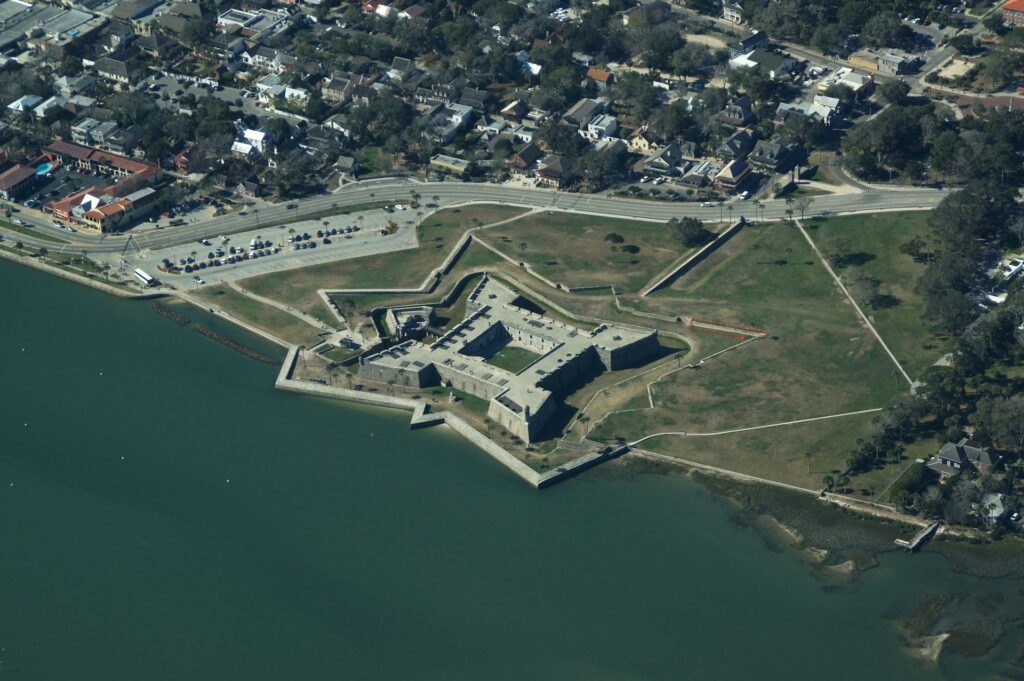
The Free State of Florida earned statehood in 1845 after 23 years as a territory. Even earlier, Florida played an important, if overlooked, role in the American Revolution, embodied by the Declaration of Independence established 250 years ago this week.
But as loyal citizens, Florida fought for Great Britain and against the Founding Fathers remembered across the nation, using St. Augustine as a launching pad for incursions into Georgia and South Carolina.
The skirmishes and battles that resulted were largely forgotten in the last century, according to UF adjunct professor Roger Smith in his 2011 dissertation, “The Fourteenth Colony: Florida and the American Revolution in the South.”
“Neglect of the early Southern campaigns does not stem from a lack of documentation,” Smith said. “Rather, because East and West Florida both remained loyal to Great Britain and reverted to Spanish control after the war, this story does not fit neatly into the standard narrative of the 13 heroic colonies.”
Reverting to Spanish control meant St. Augustine and Pensacola—capitals of the East and West Florida colonies with the dividing line at the Apalachicola River—emptied of over 10,000 loyalists and refugees who had fled the 13 colonies.
At Mainstreet’s Forgotten Front event in April, UF Chair of Southern History, Dr. David Silkenat, said leading Floridians relocated after the war, leaving no one to erect monuments or remember their contributions for the crown.
Silkenat said Florida served as a buffer between the 13 colonies in rebellion and the colonies that Great Britain cared about, its lucrative Caribbean holdings.
“[The British] saw East and West Florida as barriers to sedition from rolling out into the Caribbean, and then launching pads for regaining the American south,” Smith writes in his dissertation.
A key player in regaining the American South was Thomas Brown. Born in England, Brown bought the rights to thousands of acres and established Brownsborough, Georgia, in his mid 20s. He worked as a planter and magistrate but refused to join with neighboring revolutionaries after Georgia joined the Continental Association in 1775.
Brown’s loyalty to the British crown spurred fervent revolutionaries to beat, tar and feather him. He suffered a fractured skull and lost three toes because of the encounter.
He moved to St. Augustine for safety, becoming a forced Floridian. He formed the East Florida Rangers, launching raids and skirmishes into Georgia and helping defend British interests.
George Washington frequently mentioned Florida in letters and authorized five campaigns to seize St. Augustine—a strong seaport and base of operations for Britain. Only three of those campaigns resulted in using modern military parlance and kinetic action. But all three were rebuffed in 1776, 1777 and 1778.
From St. Augustine, the British retook Georgia and established a landing point for Gen. Lord Charles Cornwallis to arrive from New York to launch his 1780 southern campaign.
Brown fought across Georgia and was captured in Augusta in 1781, where a historic plaque remembers the building of The Mayham Tower to defeat the British Loyalists led by Brown. On the opposing side in that battle were Gen. Andrew Pickens and Lt. Col. “Light Horse Harry” Lee, the father of Civil War Confederate Gen. Robert E. Lee.
With Cornwallis’s surrender at Yorktown, Virginia, more loyalists from the 13 colonies arrived in St. Augustine. East Florida had remained faithful to Britain, and Smith said the residents expected the colony to remain a part of the empire.
Smith said St. Augustine was the only British stronghold in North America outside of the Canadian provinces.
“By December 1782, St. Augustine had become the third most populous city in British North America, with reason to exult in the victory they achieved even when the rest of the empire could not,” Smith writes. “Loyalists in East Florida were of the firm belief that they had earned the right to remain in a haven of British sovereignty that survived the test of revolution.”
But Britain would give East Florida to Spain, which had ruled it before, in exchange for Gibraltar in 1783.
Smith traces Florida’s role in the war through succeeding historians and notes that East Florida figured prominently in the later works of Dr. David Ramsay and the memoirs of Henry Lee.
“For the next one hundred years after the war, accounts of the conflict allow for entire chapters on the exploits of St. Augustine in the various southern campaigns and as the linchpin of the southern British land-based activities, with Pensacola as the anchor for the western theaters,” Smith said.
He pinpoints Florida’s erasure from the American Revolution narrative on the professionalization of history in the 1880s. By the 1910s, Florida was only a paragraph in the histories before being relegated to “regional” or “peripheral” studies.
Outside of St. Augustine and Pensacola, not a lot of Florida landmarks remain from the Revolution. But Florida is still remembering its contributions to the union since becoming a state by drawing attention to the Space Coast, the Everglades and the home of the Blue Angels.
Alachua County also has contributions to the America250 Road Trip, including Gatorade, Tom Petty and Marjorie Kinnan Rawlings.
You can find the full road trip list here.
Suggested Articles
No related articles found.
Very interesting! Thank you.