



- Newberry plans to draft a resolution for an annual road maintenance fee to offset a $2.3 million property tax loss if Amendment 3 passes in November.
- The proposed fee could generate up to $1.2 million annually and shift gas tax funds to future capital projects.
- The City Commission voted 3-2 to draft the fee resolution, with notices potentially appearing on 2027 tax rolls if approved.
The city of Newberry will draft a resolution to create an annual road maintenance fee, which would charge residents if approved, to help supplement the city’s general fund if Amendment 3 eliminates property taxes in November.
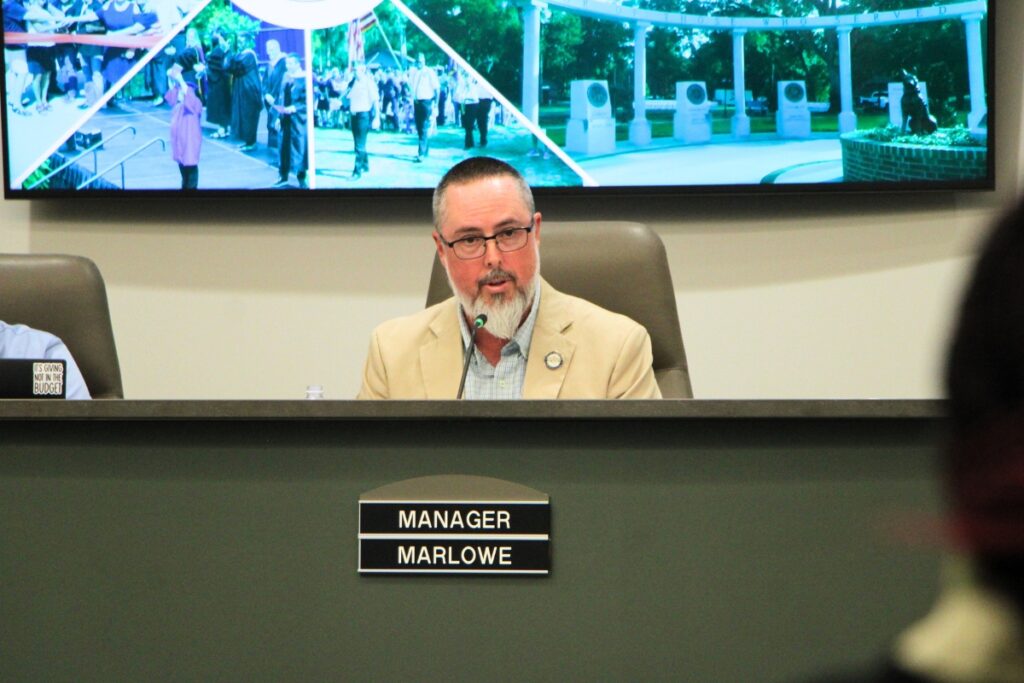
According to City Manager Jordan Marlowe at Monday’s regular City Commission meeting, Newberry is projected to lose $2.3 million in the first year of the homestead exemption, and $2.7 million in the second year.
Marlowe said the city currently allocates about $1.36 million from its general fund to the road maintenance department. The proposed fee could return as much as $1.2 million to the city’s budget, while gas tax revenue that traditionally funds road maintenance could instead go toward future capital projects.
Marlowe said Newberry’s preparations for the potential property tax elimination started two years ago and included a road maintenance study launched by Stantec MTC Financial Management last summer.
Stantec Senior Manager Peter Napoli presented the findings on Monday. He equated a road maintenance fee to a fire assessment, since both are non-ad valorem revenues charged at flat rates based on property type instead of scaling according to property value.
Napoli said such revenue diversifications with assessments are common in Florida and would likely increase as cities adapt to functioning without property taxes.
Stantec’s study used the Institute of Transportation Engineers standards to calculate a $27.71 rate per trip for the nearly 5,000 assessable properties in Newberry (minus the 658 of those that are vacant or belong to the government, so the city couldn’t charge fees to them).
The standards define that a building’s level of benefit from road maintenance is derived from its size; the larger the building, the more trips it adds to the roads, and the higher its fee would be.
Stantec calculated the following maximum annual road assessment fees Newberry could charge, with the estimates viable for three to five years:
- Single-family home
Trip rate: 9.09 per dwelling
Annual bill: $252
- 15,000 square feet industrial
Trip rate: 1.7 per 1,000 square feet
Annual: $711
- 3,500 square feet office
Trip rate: 11.6 per 1,000 square feet
Annual: $1,120
- 5,000 square feet commercial
Trip rate: 27.6 per 1,000 square feet
Annual: $3,829
Staff said the city could start the fee anywhere between $0 and $252. Should it charge 75% of the max at $189 per home, it would generate $880,000. Half of the maximum would bring in $585,000 at $126 per home, and $292,000 at $63 per home for 25% of the maximum rate.
The City Commission voted 3-2 to allow staff to draft a resolution of intent for the fee. Staff said the resolution would notify the Alachua County Tax Collector and Property Appraiser that the city is considering the fee, but it would not require the city to adopt or implement it.
Commissioners Mark Clark and Monty Farnsworth were opposed to the resolution. Farnsworth said he felt current citizens would bear burdens future residents should and that residents taking fewer trips shouldn’t have to pay as much as those taking more.
Marlowe said the fee shouldn’t be based on usage because it could change depending on who’s in the house. He also said assessments needed to be distinguished from impact fees geared towards future residents. Because the assessment would apply to existing roads, he said it’s fair for existing residents to pay for maintaining them.
If the resolution is adopted by the City Commission, Stantec would update the study with Newberry’s 2026-27 budget ahead of the Jan. 1 deadline for adopting new assessment programs.
Notices of the commission’s hearing to implement the fee would be mailed to property owners—similar to fire assessments—and if approved, tax rolls could reflect the fee as early as November 2027.
“My favorite quote is, ‘You fail to plan, you plan to fail,’” Commissioner Donald Long said. “So, all we can do is be prepared, whether we use it or not. That is all it’s about, is getting information and putting it out there so people understand where we can go. Not where we’re going to go, but where we can.”