



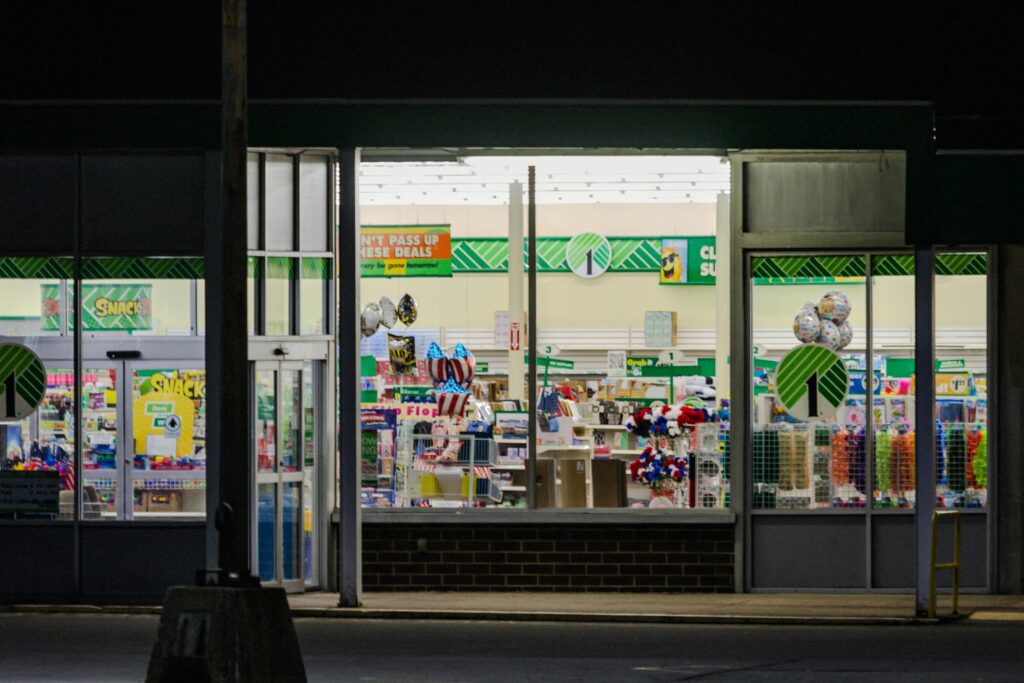
A new study from University of Florida food economists has found that building dollar stores may create food deserts in specific city environments, while having no impact on grocery access when they enter other areas.
The study, authored by UF Institute of Food and Agricultural Sciences (UF/IFAS) Food and Resource Economics Department experts and published in the American Journal of Agricultural Economics, focused on one central question: When a dollar store opens in an area, does it ultimately decrease food access?
The answer is that in some, limited cases, it does.
The opening of a dollar store is more likely to reduce food access in urban neighborhoods that initially only have a single grocery store. Urban areas with larger Black populations, limited vehicle access, high reliance on public transportation, high dependence on public assistance or high poverty rates are more likely to have less food access after a dollar store opens, said Conner Mullally, a study author and UF/IFAS associate professor in the food and resource economics department.
Dollar stores grew in number throughout the 2000s, prompting numerous municipalities to restrict their growth through policies – many of which cited concerns for reduced food access as an impetus. Federal programs followed the USDA’s creation of the “food desert” definition, with economists left wondering whether policy concerns around dollar stores were based in science, which prompted this study, Mullally said.
Using machine learning and neighborhood-level data from 2006 to 2020, the research team included data on variables such as demographics, location and retail availability.
They found that in the 14% of urban census block groups with only one grocery store already, opening a dollar store led to a measurable decline in food access, said Chuck Grigsby-Calage, a study author who was a Ph.D. student at UF while working on this research. He is now an assistant professor of agricultural economics at the University of Tennessee at Martin.
Rural areas also see impacts, Mullally said, but fewer than in urban areas. But unlike urban areas, there wasn’t a trend across demographics.
“On average, the effects are small overall in most urban and rural areas, but in urban communities with just one grocery store in the first year of our data set, the impacts are quite large,” he said. “In fact, the impact grows with every dollar store that opens in a given neighborhood.”
“The concerns motivating the limit of dollar stores are real in certain circumstances, but there is more work to be done to understand this effect, as well as other aspects of dollar stores, such as whether they can improve food access in certain circumstances, or whether they improve overall consumer well-being despite having some negative impacts on grocery stores,” he said.
He said the results are complex and differ neighborhood to neighborhood, so any policy response would need to be similarly nuanced. The goal of this study is to provide policymakers with more complete insights into the consequences of dollar store expansion and the impact of restrictive policies.

Suggested Articles
No related articles found.
Food deserts are caused by shoplifting in certain communities more than others. Only reason dollar stores and gas station/liquor shops survive is they are very low staffed and high profit (the opposite of grocery stores).
Political, church and school leaders must first address stealing in general, and shoplifting so prevalent in the same communities as “food deserts.”
Got facts? If so, then provide references please.
Since dollar stores have grocery sections and a lot of them have freezer/cold food options I am a little confused as to the accuracy of this study … or maybe its because this study is OLD DATA and does not reflect anything after 2020. If governing/zoning bodies use inaccurate studies to base their decisions this can be an issue
Now that I see the Publix ad following the article it makes me even more suspicious …. 🙁
Ridiculous so called study
UFBS
Dude got a PhD by taking a walking trip to East Gainesville and writing about what he saw?
Man. I am in the wrong line of business,
Read the article carefully and talked with a few other readers. Sorry, we can’t understand why the Dollar stores would increase food deserts. They do sell food.
I agree with your take. The article doesn’t address why a dollar store would cause less food access in the areas described, despite the facts that they sell food. It’s just word salad.
“dollar stores” offer little to nothing in the way of healthy foods, especially fresh fruits and vegetables.
“dollar stores” offer mostly ultra-processed “garbage”, along with snacks, candies and unhealthy high-sugar beverages, all which contribute to diabetes, obesity, etc.
The real question is, “why no Aldi, Publix, Trader Joe’s, Whole Foods etc. found in east Gainesville?
Who funded the study?