



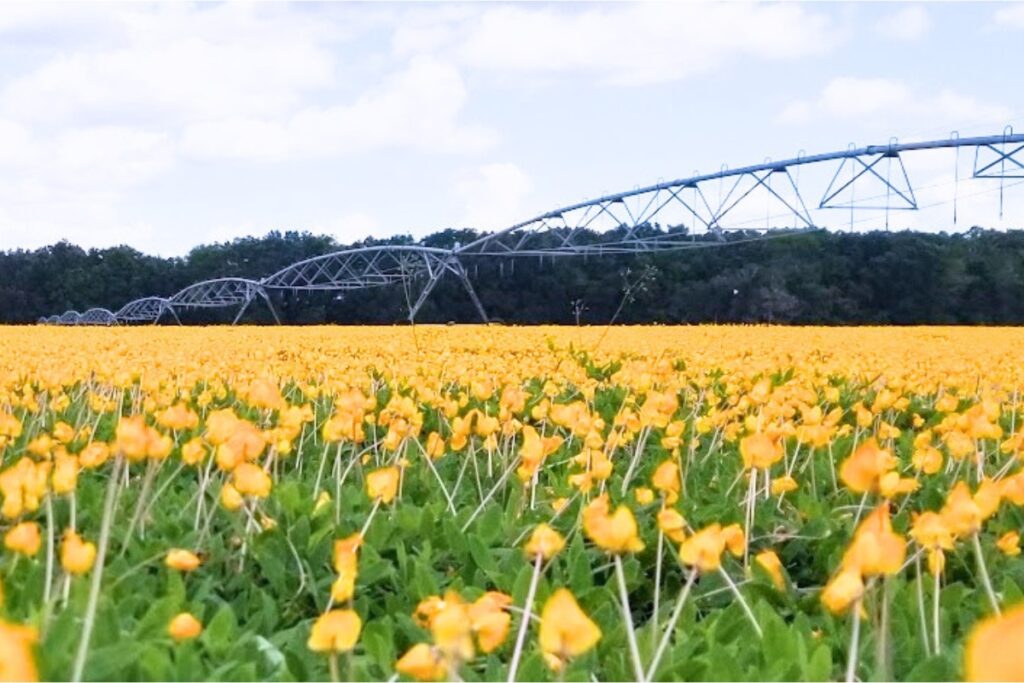
- UF/IFAS researchers develop fertilizer and irrigation management practices that reduce input use while maintaining crop productivity across various Florida crops.
- UF/IFAS Extension provides on-farm trials and education to help growers adopt precision techniques that conserve water and minimize nutrient runoff.
As Florida’s population continues to grow and demand for food increases, farmers face the challenge of producing high-quality crops while protecting the state’s valuable natural resources.
Water conservation and responsible fertilizer use have become essential components of modern agriculture. Researchers and Extension specialists with the University of Florida Institute of Food and Agricultural Sciences (UF/IFAS) are working alongside growers to develop practical, science-based solutions that help farmers produce more while using fewer inputs.
A Science-Based Approach to Sustainable Agriculture
UF/IFAS has spent decades researching ways to optimize fertilizer and irrigation management across a wide range of Florida crops, including citrus, vegetables, peanuts, blueberries, ornamentals, and field crops. Rather than applying more water or fertilizer as insurance against poor yields, researchers focus on determining exactly how much is needed, when it should be applied, and where it will have the greatest benefit.
This approach helps growers reduce production costs while minimizing nutrient losses and conserving Florida’s water resources.
Improving Fertilizer Efficiency
Fertilizer provides essential nutrients that support healthy plant growth, but excessive applications can increase costs and contribute to nutrient movement beyond the root zone. UF/IFAS researchers study plant nutrient requirements under varying environmental conditions to develop recommendations that maximize nutrient uptake while reducing unnecessary applications.
Research has led to several management strategies, including:
- Split fertilizer applications that provide nutrients throughout the growing season rather than all at once.
- Precision placement techniques that deliver fertilizer closer to plant root systems.
- Soil and tissue testing to determine actual nutrient needs before fertilizer is applied.
- Enhanced nutrient management practices that improve fertilizer efficiency and reduce losses.
These Best Management Practices (BMPs) allow growers to maintain productivity while reducing fertilizer use whenever possible. The 4 Rs of nutrient stewardship focus on the right source, right rate, right time and right placement of fertilizer to ensure maximum uptake and reduce off-site movement.
Click here for more information on the 4 Rs of nutrient stewardship
Advancing Smart Irrigation
Water is one of agriculture’s most valuable resources, and UF/IFAS researchers are continually developing irrigation strategies that improve water-use efficiency without sacrificing crop performance.
Much of this work centers on precision irrigation, where water is applied only when crops need it. Researchers evaluate technologies such as:
- Soil moisture sensors that monitor water availability within the root zone. Click here for more information on Florida Ag Soil Moisture Sensor Network
- Weather-based irrigation scheduling tools.
- Automated irrigation systems that respond to real-time field conditions.
- Remote sensing technologies that identify areas of fields requiring additional attention.
These technologies help growers avoid both overwatering and underwatering, improving crop health while reducing water withdrawals and energy costs associated with pumping.
Turning Research into Practice
Research alone does not change agricultural practices. UF/IFAS Extension faculty work directly with producers throughout Florida to demonstrate new technologies, conduct on-farm trials, and provide educational programs that help growers implement research findings.
Extension agents offer workshops, field days, demonstration projects, and one-on-one consultations that translate university research into practical management decisions. This close partnership allows researchers to better understand the challenges producers face while ensuring that new recommendations are realistic and economically viable.
Supporting Florida’s Water Resources
Reducing unnecessary irrigation and fertilizer use benefits more than individual farms. Improved nutrient and water management helps protect groundwater, springs, rivers, lakes, and estuaries by reducing the movement of excess nutrients into surrounding ecosystems.
Many UF/IFAS research projects also evaluate how conservation practices influence water quality, soil health, and long-term agricultural resilience. These findings help inform statewide BMP programs and support producers in meeting environmental stewardship goals.
Innovation for the Future
Emerging technologies continue to expand opportunities for more efficient farming. UF/IFAS researchers are investigating artificial intelligence, drone imagery, satellite data, machine learning, and advanced sensor networks to provide growers with increasingly precise recommendations for irrigation and nutrient management.
Scientists are also developing crop varieties with improved water- and nutrient-use efficiency, allowing plants to maintain productivity under more variable environmental conditions.
A Partnership for Sustainable Agriculture
The success of Florida agriculture depends on balancing productivity with responsible resource management. Through research, Extension, and collaboration with producers, UF/IFAS is helping farmers make informed decisions that reduce fertilizer and irrigation inputs while maintaining profitable operations.
By combining scientific innovation with practical field experience, UF/IFAS continues to support an agricultural industry that is both economically competitive and environmentally responsible. These efforts demonstrate that conservation and productivity are not competing goals—they can work together to benefit growers, consumers, and Florida’s natural resources for generations to come.

Suggested Articles
No related articles found.