


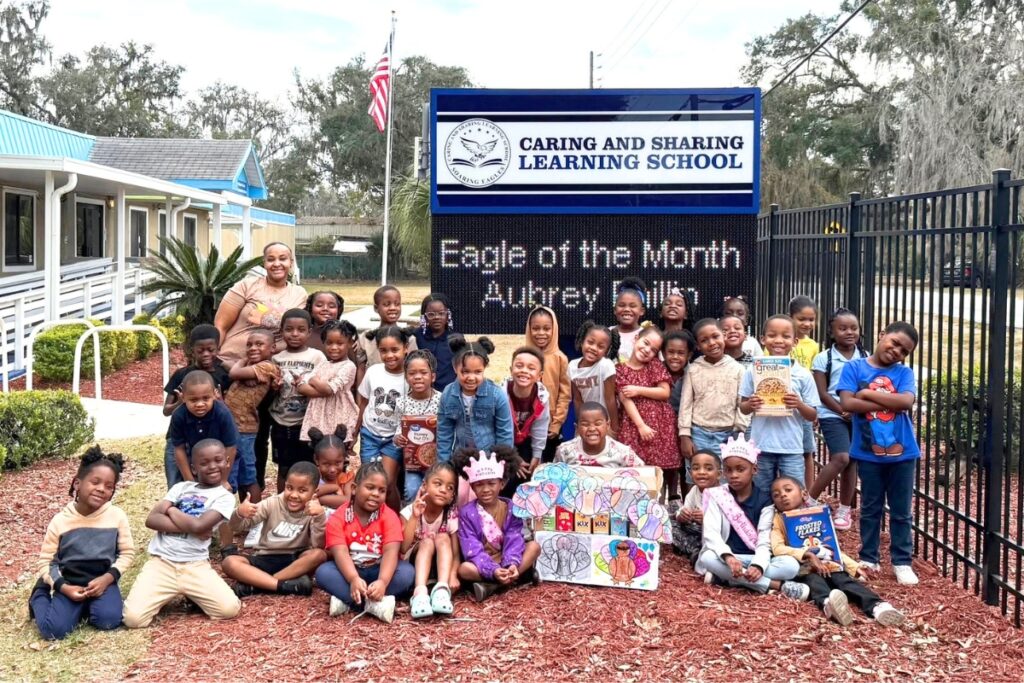
- The Caring and Sharing Learning School expects 400 students this year, a large increase from the 31 pupils in 1998 when it was founded.
- Principal Curtis Peterson plans to expand the school to include middle school grades within a few years and seeks sponsors or donors for a new building.
- The school emphasizes data-driven learning groups, frequent testing, and strong community involvement to drive student success and growth.
The Caring and Sharing Learning School has limited days to reorient from summer camp into school mode before pre-kindergarteners through fifth graders flood through the front doors.
The staff must wait to see if the actual headcount matches the estimate, and this year, Principal Curtis Peterson said the school expects 400 pupils. It’s a big jump from the 31 students who started when his parents founded the charter school in 1998.
Peterson and Tova Peterson, his wife and the school’s family liaison, now manage the school under the Board of Directors. The couple took over in 2008 and oversaw a period of “tremendous growth.”
Since then, Caring and Sharing Learning School has established itself and, Peterson said, defied the detractors who thought it would flounder. The school keeps a waitlist filled from word-of-mouth marketing and plans future growth after clearing three acres adjacent to the school’s current campus south of Williston Road near Evergreen Cemetery.
“The next move now is to see if we can get some sponsors or if we can get some donors, or we can maneuver how to get a building,” Peterson said. “Because it’s like Field of Dreams. I really do believe if we build it, they’ll come because they’re already here.”
The school has two sections for each class level, and an expansion would push into middle school territory—the ages Peterson taught as an educator in Atlanta. He said the sixth through eighth grades will likely come in the next few years.
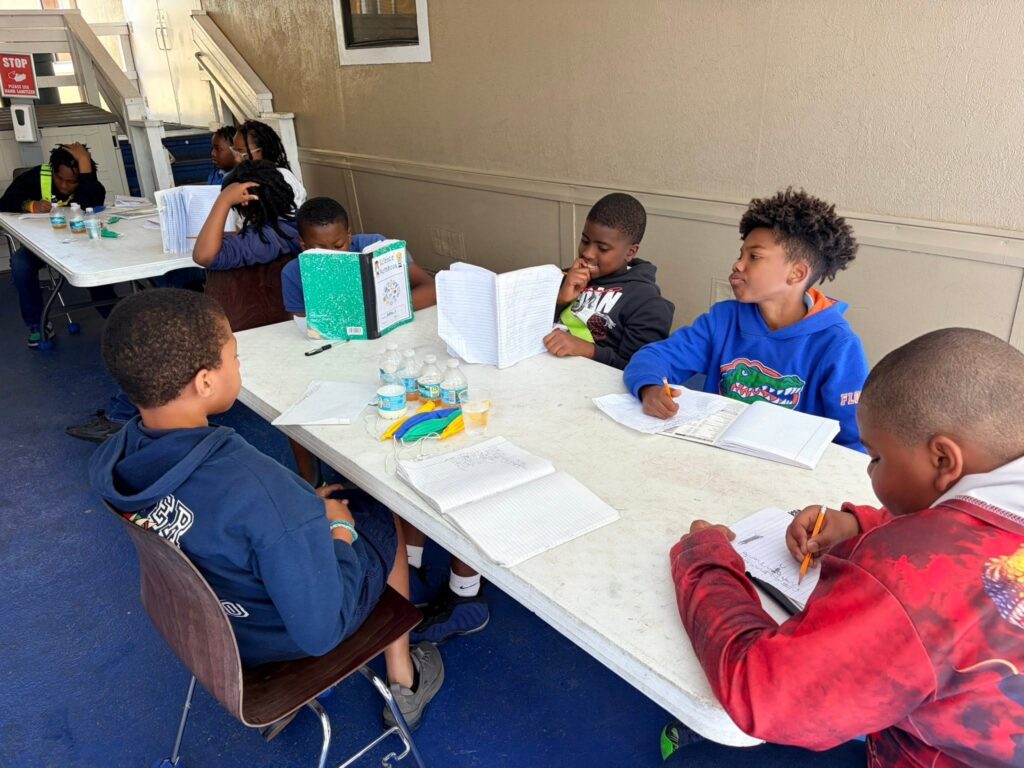
He said he hears frequent feedback about expanding all the way through the 12th grade, but that’ll have to wait for now.
When the school opened, charter schools were still a new concept, and Peterson said community support helped overcome initial and subsequent hurdles. Even now, he said the charter school structure is misunderstood, with people associating the structure with private schools.
But Peterson is adamant. Charter schools are a part of the public school system.
The teachers must pass the same training; the state evaluates it with the same criteria; and the students often use the same curriculum. Peterson tries to mirror the public school closely in order to keep an equal comparison between students at the Caring and Sharing Learning School and its open public-school peers.
Where the public school system is larger and balances needs across dozens of schools and decisionmakers, a charter school is like an entire school district unto itself.
“They’re dealing with the same thing the charter school will deal with. It’s just at a bigger level,” Peterson said.
Peterson said flexibility is the difference. He can change class structure quickly if students are struggling and implement teacher recommendations without any bureaucracy.
That flexibility, though, can be a double-edged sword.
That’s why Peterson said he’ll bend on certain points but refuse to budge on proven parts of the Caring and Sharing Learning School model.
“With a charter school, you get one year to slip up. If you get a D or an F [school grade], just like the traditional schools, they’re coming to shut you down,” Peterson said. “There is no Superman coming to save you.”
Public schools might try to rezone students or transfer a batch of different teachers to a failing school as part of a turnaround plan, but that’s not on the table for charter schools.
Constellation Charter School in Waldo was shut down by the School Board of Alachua County during an emergency meeting in 2025.
Academically, though, the school’s students have led the way for years, earning two A and three B grades in the last five years. Plus, the school earned a 2017 National Blue Ribbon School of Excellence and a 2010 National Title 1 Distinguished School award.
He was a little mad this summer when school grades came out and the school barely dropped down to a B grade. It was especially bittersweet, he said, because the graduating fifth-grade class had led the entire school district in academic performance moving from class to class.
“We just knew that we wanted to send that group out with an A because they’ve been the highest, pretty much in the county, when they were third and fourth and then fifth,” Peterson said.
Still, Peterson said the mindset is always improvement for each individual student, the staff and the school overall. He said a student who grew from scoring a 1 on tests to a 2 at the end of the year will get just as much positive reinforcement as a student who earned a 5 and maintained that level.
He condenses success to high parent involvement, a strong community and dynamic learning groups.
Since parents choose to send their kids to a charter school, higher parent involvement comes easier, but Peterson said the school also stays in frequent contact and will regularly call parents.
Peterson said if a child keeps showing up late, the parent might get a call to remind them of the importance of arriving on time. If a parent comes into the school upset, he brings them back to talk.
That frequent interaction plays into the strong community built over 28 years. Peterson said nearly every child at the school has connections to different staff.
“We’re gonna know your parents, we’re gonna know your grandparents, we’re gonna know someone who can tie back to that specific child,” Peterson said. “So when you get that connection, it actually lends itself to more of a trusting environment.”
That connection also means Peterson and his staff go the full distance for each child.
“I take that burden on because I can’t do anything for my personal children that I wouldn’t do for a child who goes to school here,” he said. “I can’t go to church or go to a grocery store or ride down the street and see you and know who you are and know that I’m not doing the best for your child.”
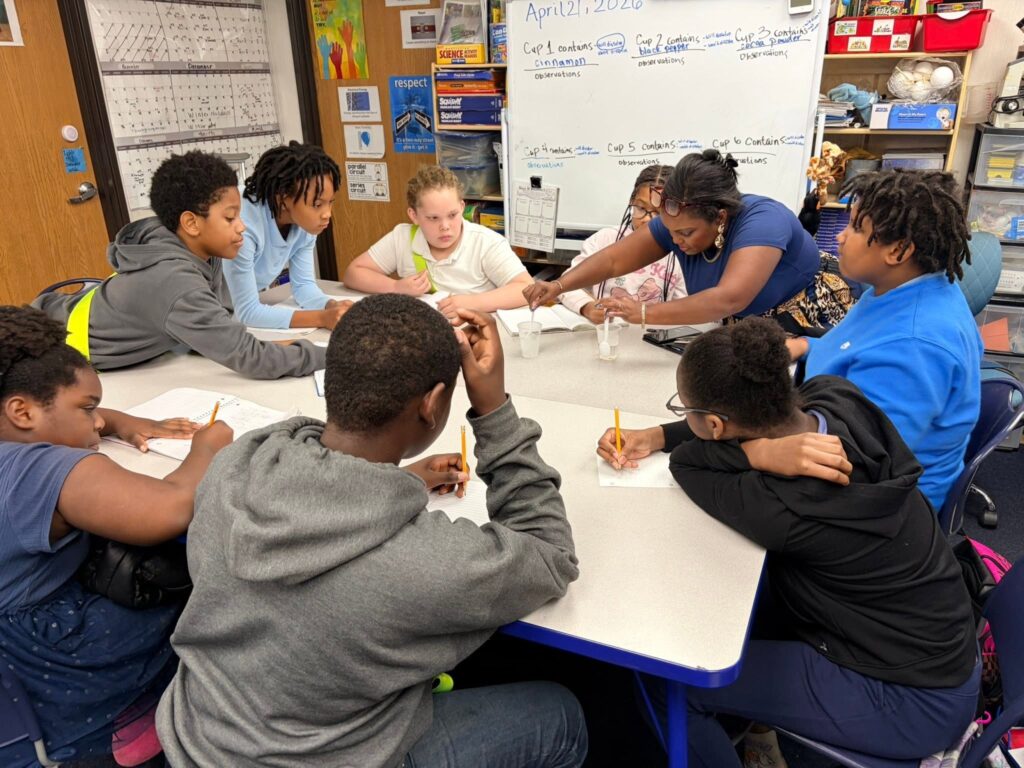
Within the classroom, Peterson places a premium on data-driven learning groups and frequent testing.
Children are tested at the start of each learning unit and divided into three groups based on their scores. The teacher can then teach the skills that each group still lacks, whether that’s half the material or just the finer points of that unit, while a classroom assistant helps another group and the third works on digital problems.
Peterson said he should nearly always see three distinct groups when he glances into a classroom.
“If I step into a class and they’re lecturing past 15, 20 minutes, all I got to do is look, and they know we don’t do this,” Peterson said.
It’s a pretty big adjustment, especially for teachers comfortable with the lecture style. But Peterson said it works, so that’s the style teachers are expected to use.
Peterson added that unlike merit-based groups that stay unchanged from the start of the year to the end, the Caring and Sharing groups always change from unit to unit with new testing on the new concept.
Teachers also have the flexibility to see if a student suddenly has a lightbulb moment and can be moved to a different group. Or if a student bluffed their way through the initial assessment but really failed to grasp the lesson, they can be regrouped for additional instruction.
But the Caring and Sharing Learning School model isn’t just a blueprint for principals to follow. While a flattering thought, Peterson said it also upsets him because it seems to negate the hard work of the teachers, staff and parents who make the model work.
A builder can use the same blueprints and get a very different result. By focusing on teacher growth, the right personnel and flexibility, he said the school has found success not just for itself but for the community it was founded to serve and plans to continue serving.
Suggested Articles
No related articles found.
I love Caring & Sharing so much. There is such an atmosphere of excellence there. The expectation is high-achieving. The parents who have their children here also are involved and support the teachers. If you come in an F student, you’re leaving at least a B+ one.