



- The Florida Board of Governors proposed a new campus safety regulation to comply with HB 757, expanding K-12 safety programs to public universities.
- The regulation requires universities to conduct annual risk assessments and implement threat management teams under the ARMOR Act by January 2027.
- The Board amended admissions rules to bar undocumented students from initial enrollment starting in the 2027-28 academic year, despite public opposition.
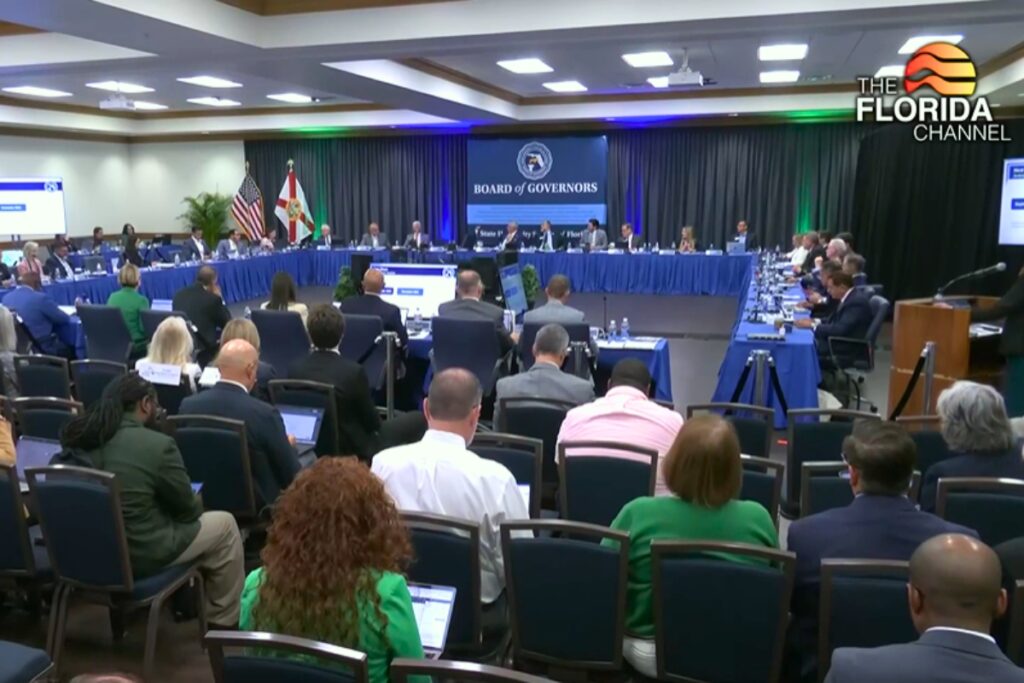
The Florida Board of Governors (BOG) held a two-day meeting on Wednesday and Thursday at Florida Gulf Coast University, where members discussed a proposed regulation to comply with the state’s new school safety law. The board also approved an amendment to an existing regulation that prohibits students who are in the U.S. illegally from initially enrolling in state public universities.
Proposed regulation – Campus Safety and Security
During the Campus Safety and Student Success Committee meeting on Wednesday, Emily Sikes, the State University System of Florida’s vice chancellor for academic and student affairs, provided an overview of the proposed BOG regulation – Regulation 3.0015 (Campus Safety and Security), which aims to comply with House Bill (HB) 757, also referred to as School Safety.
Sikes noted that part of HB 757, which was signed into law by Gov. Ron DeSantis in May and expands school safety measures and the Chris Hixon, Coach Aaron Feis and Coach Scott Beigel Guardian Program to include Florida’s public higher education institutions, requires the BOG to adopt a regulation.
“This is a very comprehensive piece of legislation,” Sikes told the committee about the new law. “We talked about this overview in June and since that time, staff has been working with Florida Department of Education staff, with staff in our universities, to kind of lay out some options, collect information, get feedback on existing processes across the system, so that we can come forward with a comprehensive regulation that covers all aspects of the provisions in the law.”
The Guardian Program was established in 2018 through the Marjory Stoneman Douglas High School Public Safety Act following the mass shooting at Parkland’s Marjory Stoneman Douglas High School.
Before the signing of HB 757, the program allowed trained individuals to serve as armed guardians on public K-12 campuses across Florida to deter and stop active assailant incidents. This has since expanded to include public college and university campuses throughout the state.
Participation in the program is optional for schools.
The proposed regulation presented by Sikes includes an option for universities and colleges to opt into the Guardian Program if they choose to participate.
“The language currently directs them [universities and colleges] to follow appropriate procedures for this program and work with their local sheriffs for training,” Sikes told the committee, adding that the program can be initiated now and does not need BOG regulation.
Committee Chair Ashley Bell Barnett asked Sikes how many universities were currently utilizing the Guardian Program.
“To my knowledge, I don’t know that anyone has done the training process yet,” Sikes responded. “I know some are in initial conversations on how to do that, but to my knowledge, I don’t know that anybody has done the training piece yet.”
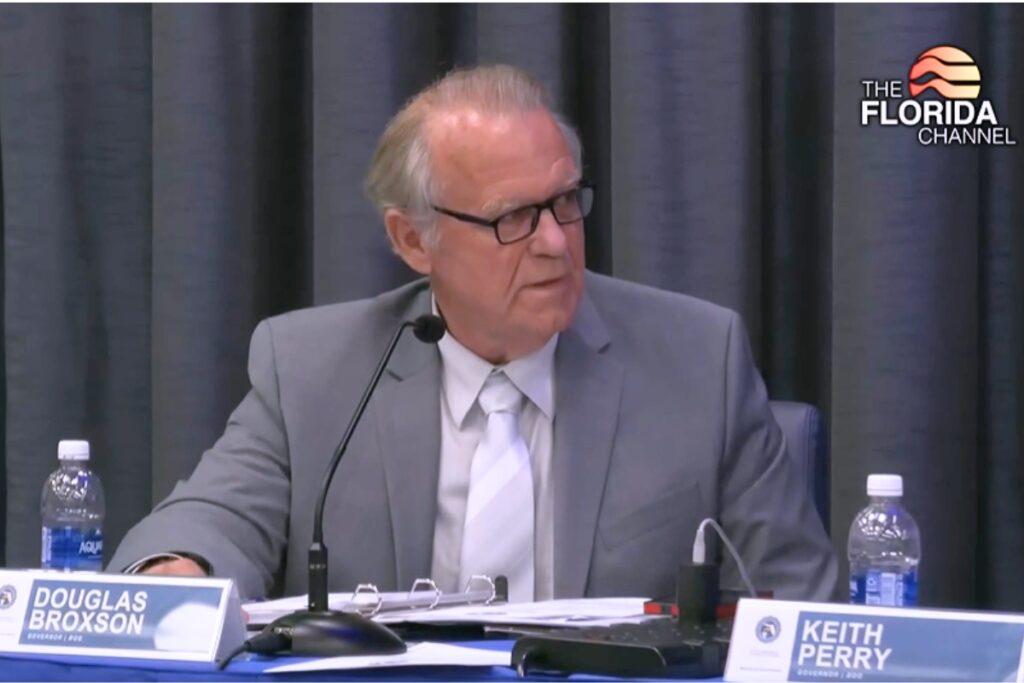
Board member Douglas Broxson said there is a “significant difference between K-12 and the university system.”
“One, you have a closed environment, and the other, you have an open campus,” he said. “I believe that the legislature will look very carefully at what we do and allow each university to probably create their own program,” he said.
The proposed regulation also includes other provisions, such as requiring universities to implement a public safety reporting application or a mobile suspicious activity tool, providing annual mental health training for staff and making resources available to students.
While not outlined in the law, Sikes said they are recommending that universities “get prepared and look at a communication plan.”
“Having a plan in place for communications so that if some incident does occur on campus, the university knows how to respond, knows how to communicate things to its students, parents, community, and other entities nearby, like other K-12 schools, other universities nearby, other colleges nearby, and to coordinate with local law enforcement,” she said.
During her presentation, Sikes also took time to walk through what she felt were the more “robust” sections of HB 757, which centered around campus safety, risk assessment and behavioral threat management.
Under HB 757, Sikes said every university is required to conduct a university-wide risk assessment of campus safety and security each year using a BOG-approved tool.
She said staff plans to bring a potential tool to use for the risk assessment for consideration at the BOG’s November meeting.
Sikes said HB 757 also added a new section to Florida statutes called the Active Response and Mitigation of On-Campus Risks (ARMOR) Act. She said the statute requires every university to create “threat assessment and management teams to review potential threats posed by students and to develop, implement and monitor behavioral threat mitigation plans.”
The teams will consist of members from a variety of divisions within universities and use a threat assessment framework and levels that are expected to be approved at the November meeting.
Sikes also briefly touched on the transfer of threat assessment records from K-12 institutions to the Florida College System – another requirement under HB 757.
“We have been working with the Florida Department of Education on this,” she said. “We have laid out a roadmap to collect this information on how they will provide it and document it to us for students that are moving from our public K-12 institutions into our universities.”
A timeline provided in Sikes’ presentation showed that final approval of the campus safety regulation is anticipated for January 2027.
Amended regulation – General Admissions
During its regular meeting on Thursday, the BOG voted to amend Regulation 6.001 (General Admissions) that prevents undocumented students from initial enrollment in state public universities.
In a press release on Thursday, the United Faculty of Florida (UFF) and Florida Education Association (FEA) said the BOG approved the rule unanimously without discussion despite public outcry.
According to the amended regulation, the changes will take effect starting in the 2027-28 academic year.
“Beginning with the 2027-28 academic year, a person who is present in the United States unlawfully shall not be eligible for initial enrollment in any state university which, for the two most recent academic years, did not admit all academically qualified applicants, except for cases in which applicants were rejected for non-academic reasons,” the amended regulation said.
Presidents of both the UFF and FEA weighed on the BOG’s decision.
“The Board of Governors has lost sight of its responsibility to safeguard higher education for the common good,” Robert Cassanello, president of the UFF, said in the release.
Andrew Spar, president of the FEA, was also critical of the BOG’s decision.
“Florida has already invested in the future of these students, many of whom were brought here as children through no fault of their own. Forfeiting that investment is not only wasteful, but it also harms our communities and Florida’s economic future,” he said in the release. “Every student deserves the opportunity to attend Florida’s top-ranked universities and colleges, and our state is better off when every child can learn and achieve their full potential.”
Nick Anschultz is a Report for America corps member and writes about education for Mainstreet Daily News. This position is supported by local donations through the Community Catalyst for Local Journalism Fund at the Community Foundation of North Central Florida.
Suggested Articles
No related articles found.