



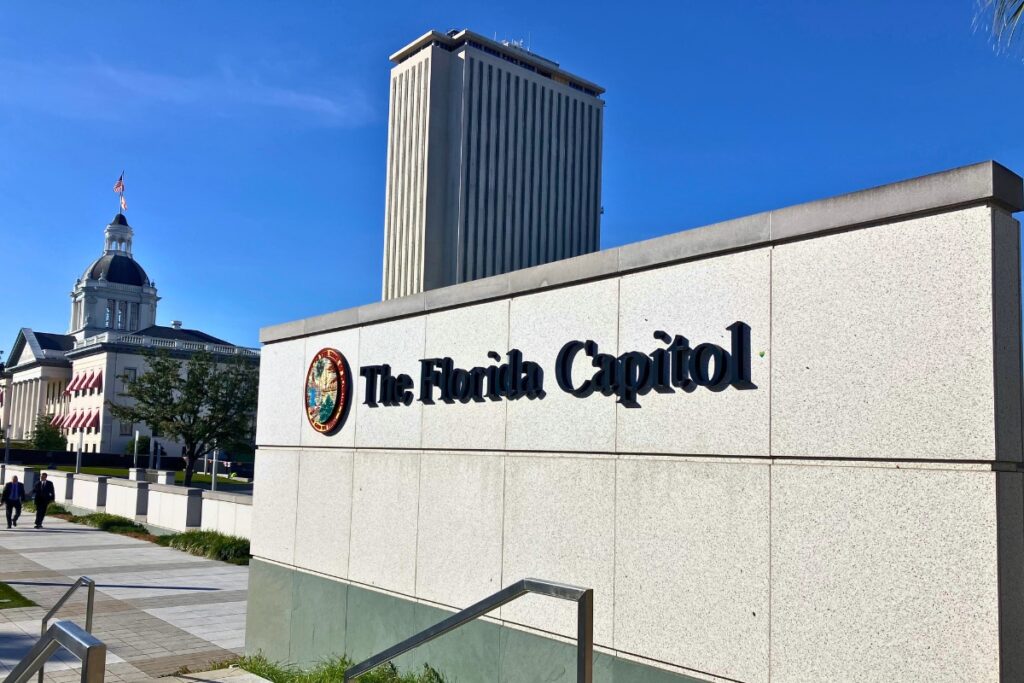
- The Florida Legislature passed 234 bills in the 2026 session, with several focusing on education, now awaiting Gov. Ron DeSantis's signature.
- SB 182 mandates public schools to display portraits of Washington and Lincoln and requires third to fifth graders to learn cursive writing.
- HB 757 allows trained guardians at Florida colleges to carry firearms under a school safety program and sets strict penalties for firing near schools.
- HB 1279 restricts preeminent universities to reserve 95% of freshman seats for Florida students and limits international enrollment to 5% per country.
The Florida Legislature concluded its 60-day regular session on March 13, with lawmakers passing 234 bills out of 1,896 filed, according to a report by Florida Phoenix.
Of the nearly 300 bills that were approved by the Senate and House of Representatives, several relate to education and now await the signature of Gov. Ron DeSantis.
Here are some of the education-related bills that made it through the 2026 Florida legislative session.
The bill requires school boards in Florida to adopt rules requiring portraits of former U.S. Presidents George Washington and Abraham Lincoln to be placed at every public school in the district. According to the bill, the Florida Department of Education (FDOE) would be responsible for selecting the portraits and making them available to every school district.
The bill also mandates cursive writing instruction for students in third through fifth grade. Students would be required to “demonstrate proficiency in cursive writing” by the end of fifth grade.
The term “demonstrate proficiency in cursive writing,” according to the bill, means students should have the capability to write both uppercase and lowercase letters of the alphabet in cursive, write words and sentences in cursive “legibly” while “maintaining proper spacing and alignment,” and have “the ability to read and apply cursive writing in a manner that supports literacy development, including writing essays and assignments in cursive writing,” compliant with state academic standards.
Another component of the bill has to do with private school zoning. Under the bill, private schools with 150 students or less would be allowed to operate in commercial or mixed-use zoning districts without rezoning or having to get a special exception or land-use change.
According to the bill, these private schools would be allowed to “operate in a facility that is an existing assembly, day care, mercantile, or business occupancy, as defined in the Florida Fire Prevention Code.”
If signed by DeSantis, this bill would take effect on July 1.
The bill authorizes Florida’s public colleges and universities to take part in the state’s school guardian program, which was created for K-12 public schools after the 2018 shooting at Marjory Stoneman Douglas High School in Parkland.
The measure allows trained school guardians at Florida’s universities and colleges to carry firearms on campus for school defense. It also requires local sheriffs to help with the training and implementation of the school guardian program.
Florida’s colleges and universities would not be required to take part in the school guardian program, according to a report by the Miami Herald.
The bill also requires “institutions to adopt an active assailant response plan, annually conduct a security risk assessment, train faculty and staff to detect and respond to mental health issues, connect students with mental health services, and establish threat management teams,” according to the bill analysis.
Additionally, the bill establishes a criminal offense for firing a weapon or firearm “within 1,000 feet a school, during school hours or during the time of sanctioned school activity,” according to the bill analysis. That offense is classified as a second-degree felony, which could result in up to 15 years of prison and a fine of up to $10,000.
If signed by DeSantis, this bill would take effect immediately.
One of the provisions of this bill would require Florida’s preeminent universities (University of Florida, Florida State University, University of South Florida and Florida International University) to reserve 95% of first-time undergraduate seats for Florida students based on a three-year average. The bill analysis states that “a state university that meets 12 of the 13 academic and research excellence standards specified in law is designated as a ‘preeminent state research university.’”
The bill also “limits international student enrollment” at Florida’s universities at 5% per country (starting July 1, 2030) and calls for students to be a U.S. citizen or lawfully present to receive financial aid, according to the bill analysis.
If signed by DeSantis, this bill would take effect on July 1.
SB 178: Athletics in Public K-12 Schools
The bill requires the Florida High School Athletic Association (FHSAA) to adopt bylaws that allow public K-12 coaches to use personal funds to support the welfare of their student-athletes. These personal funds can be used in “good faith” to provide food, transportation and recovery services to student-athletes, according to the bill.
Coaches would be allowed to spend up to $15,000 in personal funds, per athletic team, per year, according to the bill, with all expenditures reported to the FHSAA.
The bill states that the FHSAA’s rules must require that a coach get written parental consent before providing financial help to the student.
If signed by DeSantis, this bill would take effect on July 1.
SB 538: Extracurricular Activities
The bill includes several changes as it relates to extracurricular activities, including pay for coaches and activity sponsors, as well as student transfers.
The measure “authorizes school districts, in their sole discretion, to determine and approve compensation for athletic coaches, assistant coaches, athletic program supervisors, and activity sponsors of extracurricular activities,” regardless of whether these individuals are classified as instructional personnel, according to the bill analysis.
Compensation may be more than “any salary schedule, supplement, or stipend otherwise prescribed and may be paid in any form or amount deemed appropriate by the district school board,” according to the bill analysis. This includes salaries, stipends, performance-based incentives, bonuses and hourly or per-assignment pay.
The bill would also allow the school district to adopt a policy that permits “payments by booster clubs or associations to be included in the compensation for an athletic coach and activity sponsor of extracurricular activities,” according to the bill analysis.
The measure states that these booster club funds may not be used for severance pay.
Another provision of the bill relates to student transfers. The bill states that “a student may not participate in sports at two different schools during the same school year,” unless he or she meets specific exceptions. These include relocation due to military orders, foster care placement, “court-ordered change in custody due to separation or divorce, or the serious illness or death of a custodial parent, or has been granted approval by the applicable governing organization’s executive director.”
If signed by DeSantis, this bill would take effect on July 1.
Nick Anschultz is a Report for America corps member and writes about education for Mainstreet Daily News. This position is supported by local donations through the Community Catalyst for Local Journalism Fund at the Community Foundation of North Central Florida.
Suggested Articles
No related articles found.
This bill has nothing to with education, and everything to do with a cash grab for gun dealers.