


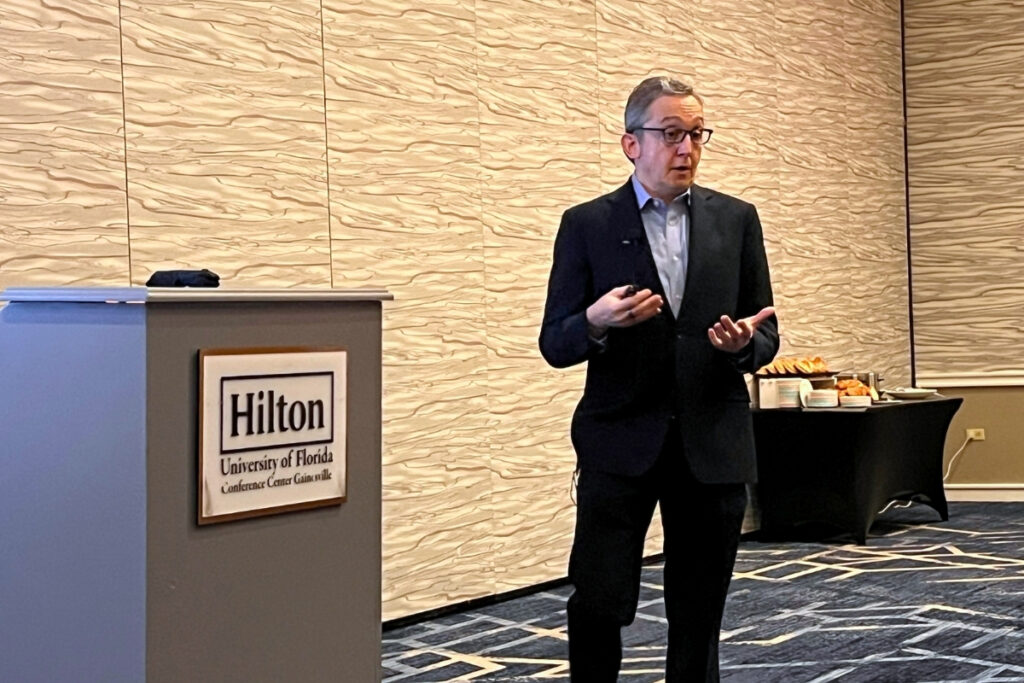
- Dr. Michael Okun presented at UF’s 2026 Eye Opener Discovery Breakfast about the Norman Fixel Institute’s mission and his book on Parkinson’s disease.
- The Normal Fixel Institute, opened in 2019, focuses on care, research, and education for complex neurological disorders like Parkinson’s and Alzheimer’s.
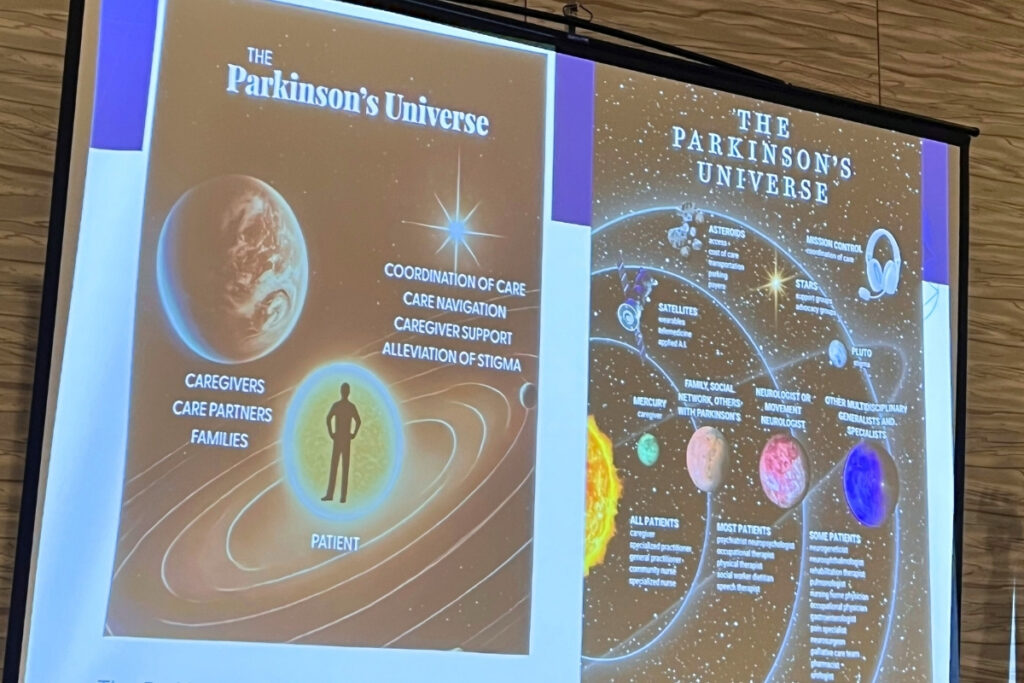
- Okun introduced a new Parkinson’s care model called ‘The Parkinson’s Universe’ that centers patients surrounded by caregivers and healthcare partners.
- Okun emphasized environmental risks like pesticides for Parkinson’s and promoted ‘Parkinson’s 25,’ a checklist to reduce risk through lifestyle changes.
The University of Florida’s Office of Community Relations held its first Eye Opener Discovery Breakfast of 2026 on Wednesday, where a well-known neurologist, neuroscientist and New York Times bestselling author spoke to the attendees.
Dr. Michael Okun, chair of neurology, professor and executive director of the Norman Fixel Institute for Neurological Diseases at UF Health, gave a presentation at the Hilton University of Florida Conference Center in Gainesville.
He focused on two main topics: the Fixel Institute and its mission to become a destination for care for several neurological diseases, like Alzheimer’s and Parkinson’s, and the book, “The Parkinson’s Plan: A New Path to Prevention and Treatment.”
Okun said the growth of diseases like Alzheimer’s and Parkinson’s has been “explosive,” adding that 12 million people are currently living with Parkinson’s alone.
“The question is simple. If you have one of these diseases…where are you going to go?” he said. “The answer needs to be here, at the University of Florida.”
Okun said they are trying to become the “epicenter” for neurological research, noting that there are already epicenters for cancer diseases but not for ones like Alzheimer’s or Parkinson’s.
“We don’t have epicenters for these diseases [Alzheimer’s or Parkinson’s] yet; they are growing at an astronomical rate,” he said. “And so, we dream, and we plan, and we aspire, and we’re determined to make this [UF] one of those destinations.”
UF is already making headway in neurological research and disorders through the Fixel Institute. Opened in July 2019 and located at 3009 Williston Rd. in Gainesville, the Fixel Institute, “is a leading center for care, research, and education in complex neurological disorders like Parkinson’s, ALS, and Alzheimer’s,” according to the UF Health website.
A June 18, 2019, UF Health article said the Fixel Institute would “expand upon the interdisciplinary service and science hub specialty care model started in 2011 as the UF Health Center for Movement Disorders and Neurorestoration” by Okun and UF neurosurgeon Dr. Kelly Foote, who is now the institute’s co-director.
“The question we always get is, ‘What does the Fixel Institute do?’” Okun said. “I love to use the word create. If you look up the word create in the dictionary, it means to make something new that didn’t exist before, to bring an idea to life, to manage or build something from scratch, or to turn imaginative plans or efforts into a real thing. And that’s the imagination that the Fixel [Institute] does. We’re here to create the best care models for how we deal with these diseases.”
Okun said the Fixel Institute has used a “patient-is-the-sun” model since he and Foote arrived at UF in 2002. He said they’ve since expanded that framework “to think of it as a universe model.”
According to a December 2025 Norman Fixel Facebook post, the new model – “The Parkinson’s Universe” – “reimagines person-centered care by placing people with Parkinson’s at the center of their own ‘solar system.’”
In an Instagram post, Dr. Bastiaan (Bas) Bloom, a neurologist and founder and director of the Center of Expertise for Parkinson & Movement Disorders at the Radboud University Medical Centre, Nijmegen, said the in the universal model, “the person with Parkinson’s is the sun or center of the universe, and is surrounded by essential partners” like “caregivers (Mercury), the support network and healthcare professionals (the planets), and care coordinators (mission control).”
“Barriers to care are represented by asteroids, stigma by Pluto, and technology by satellites,” he said in the post. “The satellites are for remote monitoring or for extending support into the home. Stars symbolize support and advocacy networks that shine both light and guidance for families.”
This new model is featured in “The Parkinson’s Plan” book, which was written by Okun and Dr. Ray Dorsey, a neurologist, researcher and public health advocate.
Okun referred to the book as “a new path to prevention and treatment.”
While giving his presentation, Okun said, “The environment can cause Parkinson’s.” He cited examples of different pesticides and chemicals that could lead to a greater risk of getting Parkinson’s, including paraquat, a toxic chemical often used for grass and weed control.
In “The Parkinson’s Plan,” it mentions the “Parkinson’s 25”, a checklist of 25 actions people can take to help reduce their risk of Parkinson’s. Okun said some of the things people can do are get a carbon water filter, wash their produce, get a proper amount of sleep and exercise.
“We have an opportunity to change this and other diseases for this generation and for the next,” he said.
Nick Anschultz is a Report for America corps member and writes about education for Mainstreet Daily News. This position is supported by local donations through the Community Catalyst for Local Journalism Fund at the Community Foundation of North Central Florida.
Suggested Articles
No related articles found.