



- The University of Florida purchased 2,660 acres called Hickory Sink Forest to create a new teaching forest for its School of Forest, Fisheries, and Geomatics Sciences in 2025.
- Land manager Cully Lord began infrastructure work in June 2026 including fire breaks and fencing removal to transform the habitat with prescribed burns and invasive species control.
- Hickory Sink Forest offers diverse sandhill and karst terrain for research, with plans to open for special events and an open house in October 2026.
When the University of Florida spent $39 million in Florida Legislature funding to buy 550 acres for a 36-hole championship golf course, the Gators also acquired another 2,660 acres as part of the deal.
Those extra acres, called the Hickory Sink Forest, now provide UF’s School of Forest, Fisheries, and Geomatics Sciences (SFFGS) with a generational opportunity to create a new teaching forest for students, researchers and the public while doubling the acreage managed by the school.
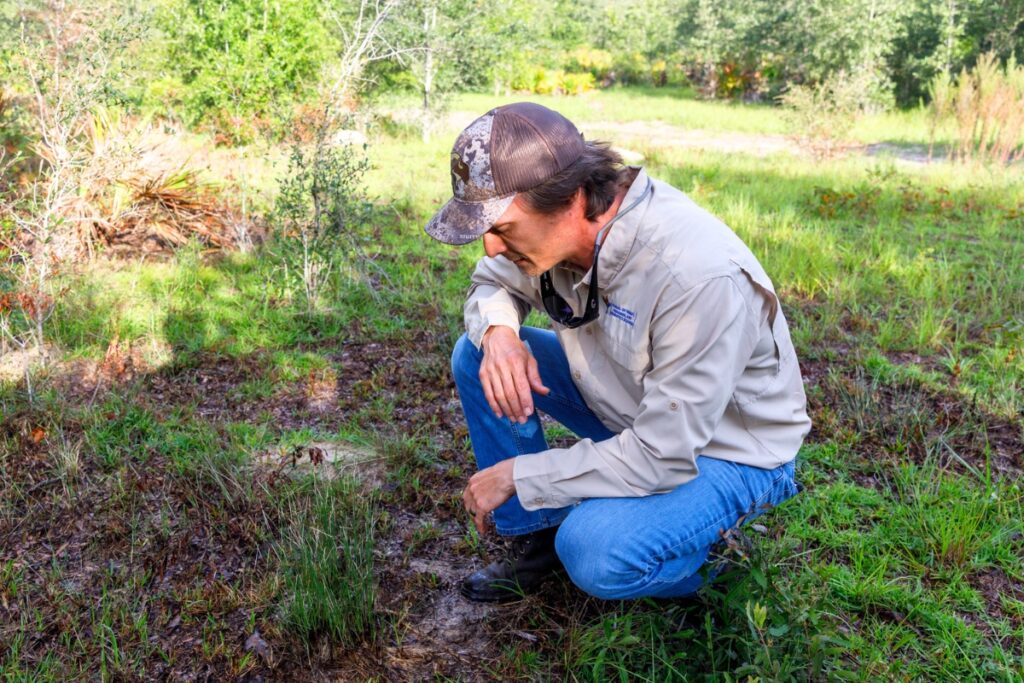
It’s an opportunity to draft and build a conservation plan and test the results. That’s what drew land manager Cully Lord to the job from the city of Gainesville’s natural resources division.
“To me, this was like a higher calling. If your higher calling that you felt in life was in your backyard almost, why wouldn’t you go for that opportunity?” Lord said.
Lord was hired by SFFGS as the first land manager for the Hickory Sink Forest. His boots hit the ground in June, and he told Mainstreet that the property has a lot of infrastructure to get in place before being fully equipped as a living laboratory.
But the act of installing that infrastructure—fire breaks, a small field office, land equipment and roads— will also provide SFFGS students in the coming years with the opportunity to see how a tract of nearly virgin scrubland turns into a wildlife conservation area.
The property is nearly the same size as the UF/IFAS Austin Cary Forest (2,040 acres) just northeast of Gainesville. Where the school has had decades to turn that property into a managed research and teaching forest, the process is just getting started at Hickory Sink with Lord running point.
The property
Hickory Sink primarily contains sandhill habitat, with well-draining soils, sparse tree cover and diverse plant life able to survive in the low-nutrient environment.
Currently, the land has an overgrown midstory of saplings and brush that closes tight on the few roadways across the property, allowing you to see less than 30 feet out the side windows of Lord’s truck.
“You see how dense and overgrown it is,” Lord said. “The area’s had a lot of fire suppression in the last eight to 10 years. So we’ll be dealing with that some, too.”
After returning fire to the ecosystem through prescribed burns, he said the view will expand to a quarter or half mile. So far, the school has burned 50 acres with help from Alachua Conservation Trust.
The fires will burn the midstory away while ground grasses quickly recover. Lord points to wire grass already popping green shoots through the black char.
The property was used for decades by the Lee family, who still retains sizeable acreage even after the 2025 sale of the forest and golf course properties. The family largely used it for cattle, timber and farming operations along with hunting and will keep some access to the property under the purchase agreement.
The property is located on one of Alachua County’s strategic ecosystems, sensitive environmental areas that need special development plans. The Lee family conducted a special area study to show what could be built on the property—700 acres of solar panels, dense town centers and thousands of homes.
According to Val Lee, the family looked at development but preferred placing it in conservation. He said the county and UF got behind the initiative and pushed for state funding to make it happen.
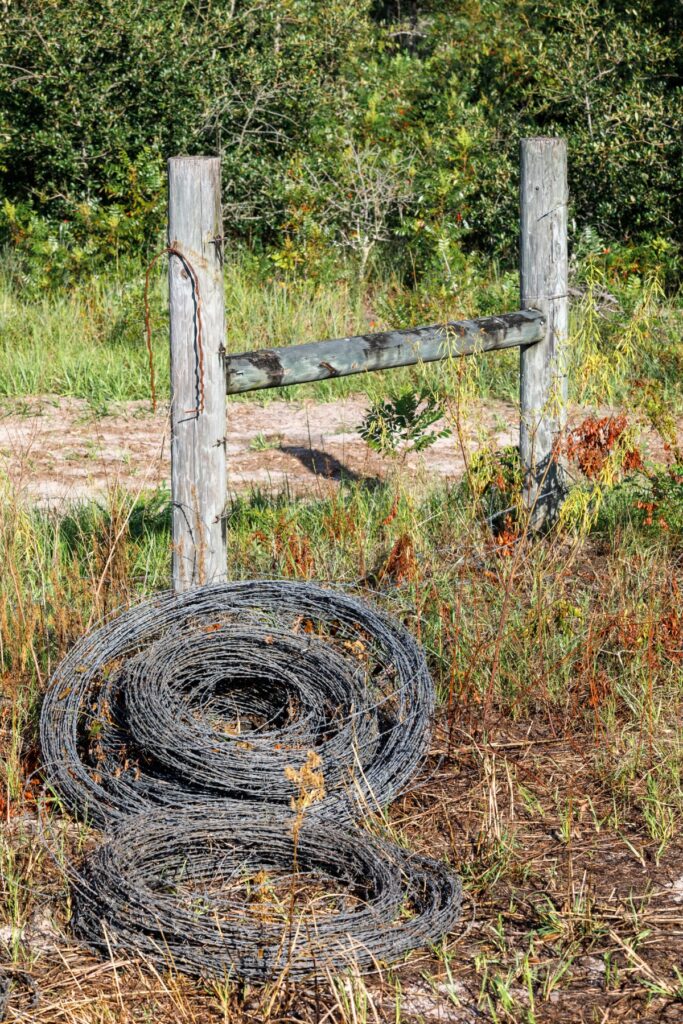
With the former cattle grazing operation, the property came with 20 miles of wire fencing, and Lord said removing all of it was a top priority for safety. The school hired a contractor for the work scheduled to finish in August.
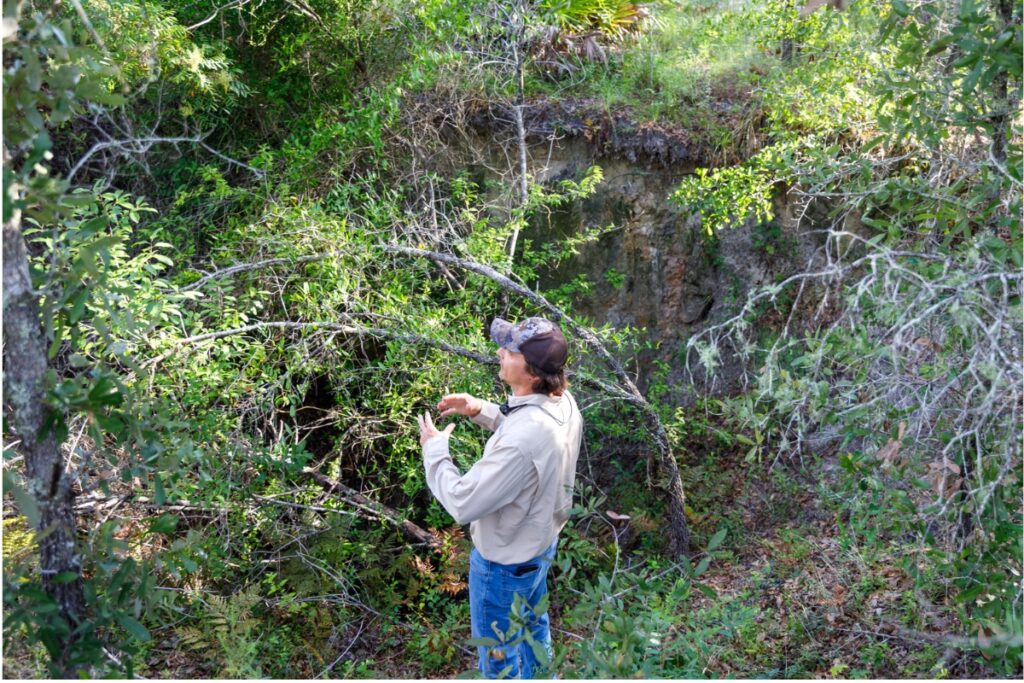
Another safety issue comes from the karst geography of the land and its landmine of sinkholes.
“You’ll be walking along like this, and there’ll be a hole that’s about three feet wide; you can’t see the bottom of it, just like holes. So it’s pretty wild,” Lord said. “I’ve never seen a property like this before. On paper, we’ve got about 10 or so acres of stuff, but I suspect it’s going to be more than that.”
A trail to the largest sink of the property winds down a dirt path as the limestone walls loom four- or five-times your size. It’s cooler at the bottom, where Lord spots Japanese Creeping Fern and marks it with an app on his phone.
Invasive species will be another part of management. Lord said the SFFGS will kill the plants with chemical treatments and potentially mechanical removal as well. He said it’s no different from nearly any federal, state or local conservation management plan.
The goal is to return the land to a natural Florida habitat where possible. Lord said the school is still discussing what that looks like in certain areas, like 500 acres of cow pasture on the eastern boundary.
“We’re still having conversations about how restoration of those kinds of systems looks a lot different than what it would look like to restore this area here,” Lord said. “So it’s going to be a little bit of give and take on that front, but restoration will look different based on where you’re standing on the property.”
The opportunity
UF created the Austin Cary Forest when its School of Forestry, now SFFGS, needed a space to put its management theories and teaching into practice. The property has two creek systems, a lake and wetlands, along with miles of pine trees used in silviculture research.
The Hickory Sink Forest’s scrub habitat and karst terrain are completely different habitats that allow teaching new subjects, Lord said.
“Another big thing I would love to see come to fruition sooner rather than later would be to have this be a teaching forest specifically focused on fire, because there’s a lot of great opportunity for that and there’s a big need for that, not only on the private landowner side but the nonprofit, public sector,” Lord said.
Scott Sager is an assistant director for SFFGS. He said the school learned in early 2026 that it would officially take over management of Hickory Sink. He said his reaction was 50% amazement at the opportunity and 50% realization of the amount of work ahead.
He said the school, with Lord in the forefront, is making as much progress as it can, but it’ll take time to plant trees where needed, remove brush, get invasive species under control and get fire established.
“I don’t mean one burn,” Sager said. “You’re going to need to burn blocks regularly for several cycles before you can really start to see the ecosystem change, the understory conditions change, those sorts of things.”
Sager said the school also isn’t trying to rush toward a perfectly managed property. He said they only have one opportunity to work from scratch on the land and test different management approaches as the school goes along.
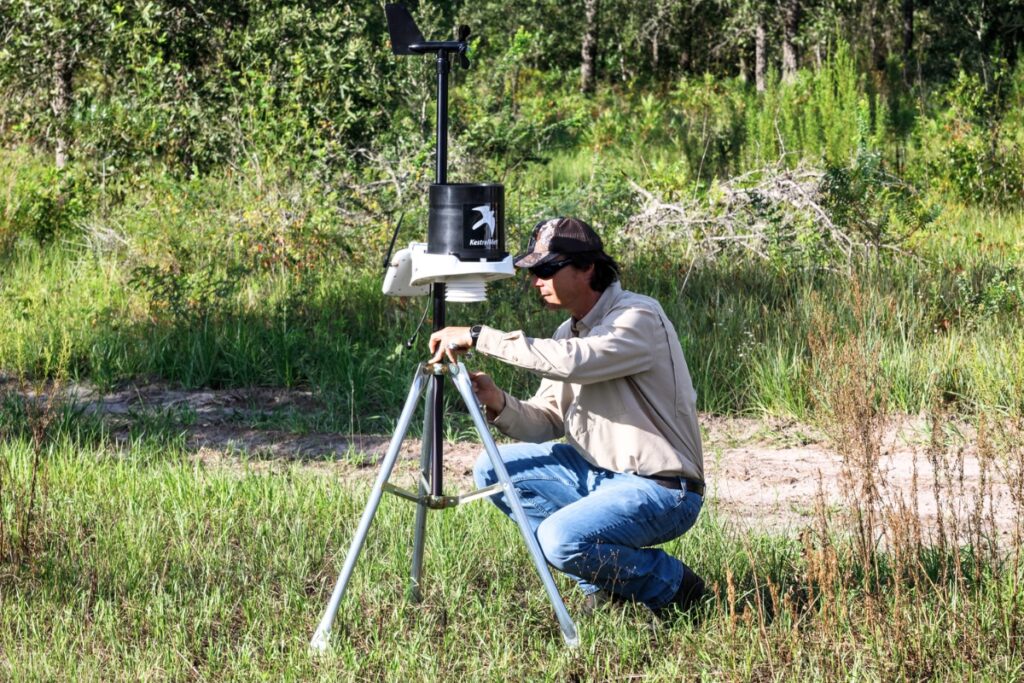
He said the school already conducted intensive overflights to collect aerial imagery and Lidar (Light Detection and Ranging) data. Sampling and data collection will happen now, Sager said, as baselines for future research as the land changes with management.
“We’re only going to do this once, and so we want to make sure we are providing opportunities for folks to set up experiments so that they can evaluate different approaches to different practices and have the students be able to see how you basically start from scratch in terms of sort of having a management operation on a piece of ground,” Sager said.
Lord said the property is a rare opportunity for a land manager to start from the ground up. There are few properties left where that kind of work can happen, he said.
But it’ll require a lot of effort as SFFGS tackles its first-year plan.
Like the Austin Cary Forest, the Hickory Sink Forest isn’t publicly open, but Lord and Sager said the plan is to open the site for special events. At Austin Cary, that happens through a Flatwoods 5K and the Flatwoods Fire and Nature Festival.
Lord said staff are planning to host an open house in October where community members can come check out the property and learn what UF is doing with the property and how UF’s conservation, forestry and geomatics education will expand with the new acres of scrub classroom.
Suggested Articles
No related articles found.
So, 2600 more acres off the tax rolls… Great. Just what we the taxpayers need so we can get our horribly neglected roads back in drivable condition… 🙄
This is fantastic news that that this property will be protected. It’s Also a great opportunity for the university to teach in a scrub community, in which there are very few left.
So 2600 acres that won’t need additional police and fire dept personnel hired, won’t generate thousands of police and fire calls a month. Won’t add more roads needing future repairs. Won’t need additional city and county services. Won’t add thousands of daily car trips etc etc etc. Growth does not pay for itself, it raises taxes for all.