




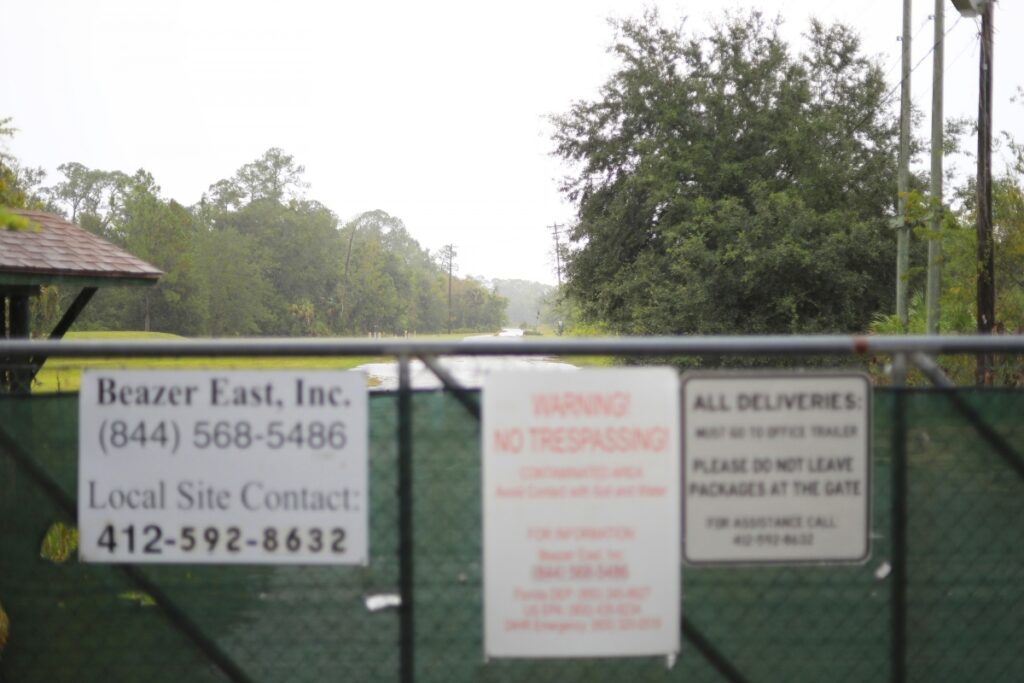
- The EPA plans to build a mile-long, 65-foot-deep underground wall at Gainesville's Koppers Superfund site to contain contaminated groundwater.
- Construction is expected to last until mid-2027, with the site being remediated to commercial/industrial standards, prohibiting future residential use.
The U.S. Environmental Protection Agency (EPA) plans to build a mile-long, 65-foot-deep, circular wall underneath four contaminated sites on the Koppers portion of Gainesville’s Cabot/Koppers Superfund site, with construction starting this fall.
EPA site manager Megan Arias presented the plan to the Gainesville City Commission on Thursday. She said the largest impact to nearby neighbors would likely be the removal of trees and heavy machinery from the 90-acre Koppers site.
The site (200 NW 23rd Ave, Gainesville, FL 32609) is located north of NW 23rd Avenue and just west of N. Main Street.
The wall will not be visible from the surface, Arias said. It’ll start underground and extend down through different aquifers and into a clay bottom. Eventually, she said, the wall will be capped to prevent rain infiltration or any overflow. The purpose will be to contain any contaminated groundwater within the wall and not let it flow outside the property boundaries.
Already, she said, the EPA is monitoring groundwater at the property borders to detect any runoff.
The wall would likely be there to stay, Arias said, but development could eventually occur on top of it and several feet of clean soil.
“The way I like to think about it is like a landfill where we cap it, and it’s there for what we know of it,” Arias said. “From my understanding of other wood treatment sites, this is how it’s handled, and it’s not thought that eventually we can get rid of the wall and everything’s fine.”
The EPA will hold a community informational session on Oct. 21 from 5 to 7 p.m. at the site.
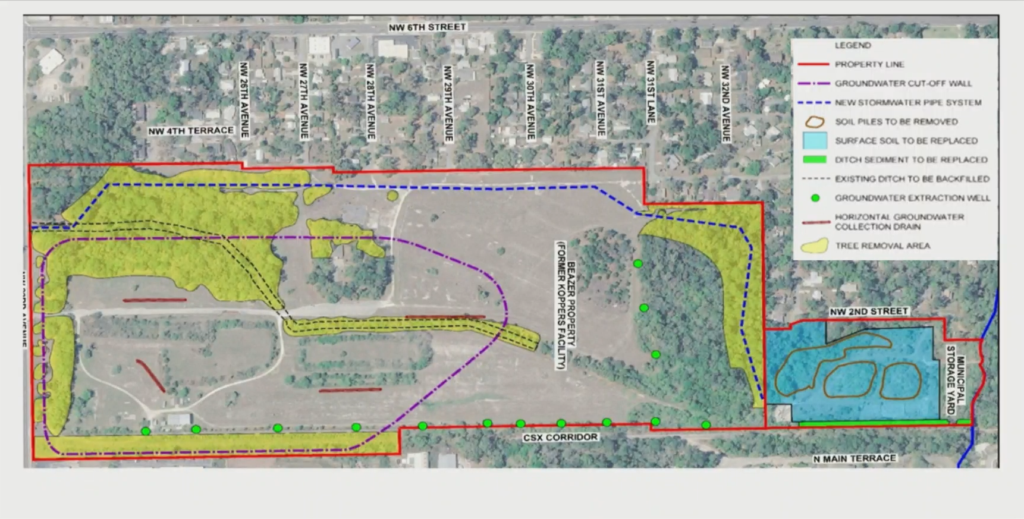
Cabot/Koppers Superfund site was identified decades ago, and Arias said a remediation plan was formulated in the 1990s and early 2000s with community input. The Superfund site is made of three main portions: the Cabot area, which is already being reused after cleanup; the Koppers site, which will contain the mile-long underground wall; and the municipal storage yard, which should be fully remediated after the current scheduled activity.
For the 37-acre municipal storage yard owned by Gainesville, Arias said EPA will remove soil piles and surface soil, placing it inside the soon-to-be-capped wall. She said the city’s property would then finish mitigation and be open to future uses.
The Koppers site is owned by Beazer East Inc. In 2013, a consent decree was signed between the EPA and Beazer to clean the site for $55 million.
Arias said construction could start later this year and last until June or July 2027. She said the Koppers site will have other steps to complete before being reused, and she noted that the property will only be remediated to commercial/industrial standards, preventing any future residences.
Suggested Articles
No related articles found.
This would be a good place for a solar farm. Too bad the City Commission blew so much money on a wood burner instead.
Annie, that is a fabulous idea, which is precisely why the commission will never embrace your plan.
Historically, Alachua County politicians, when given a choice of a good idea or a bad idea, will nearly always choose the bad idea. Your example is perfect, another would be the decision to purchase Citizens Field. This is what happens when you allow children to do things that should only be done by adults.
In Alachua County, the inept children running the playground have the support of a majority of other children.
There is no better place to build “affordable” housing than on this site.
Once again you are living up to your “handle”. A real class act.
Now, now LVMR. Sleazeweazel’s “handle” isn’t any more disturbing that your own. I think it’s very safe to assume that you embrace marxist concepts and that being the case, the word “realville” in your moniker kind of makes you an easy target for ridicule. At some point, you jumped off the train to reality and decided to associate yourself with deluded sociopaths known as Democrats.
Placing yourself in a position of authority in an imaginary municipality suggests that you have issues that are more important than trying to be clever while passing judgement on Sleazeweazel.
Have a wonderful day.
This saga has been going on for how many years? Decades?
Milk it. Consultation, Engineering, Legal Representation, Political Tom Foolery, the government teats are always glad to oblige!
Underneath and/or encircling?
So what happens when the water seeps below to 66 feet? Their answer to toxicity is simply…. Meh dig a hole smh.
halfway to the aquifer!
Why are they considering a “remediation plan was formulated in the 1990s and early 2000s with community input”. Hasn’t remediation technology advanced or changed at all in the last 30 years? It’s been sitting there, minding it’s own business for decades, and now, all of a sudden, they want to dig up toxic soil that’s been slowly degrading with help of trees, and natural processes? What happens when cutting down all the trees and disturbing the soil (down to 65 feet!!) causes the remaining toxins to suddenly leech out, and contaminates our air and drinking water? This sounds like a Flint Michigan style debacle waiting to happen.
B-b-b-b-bingo
gee whiz, how much money are they gonna throw at this thing? correct me if i am wrong, but this has to be the most embarrassing boondoggle this town has ever seen.