



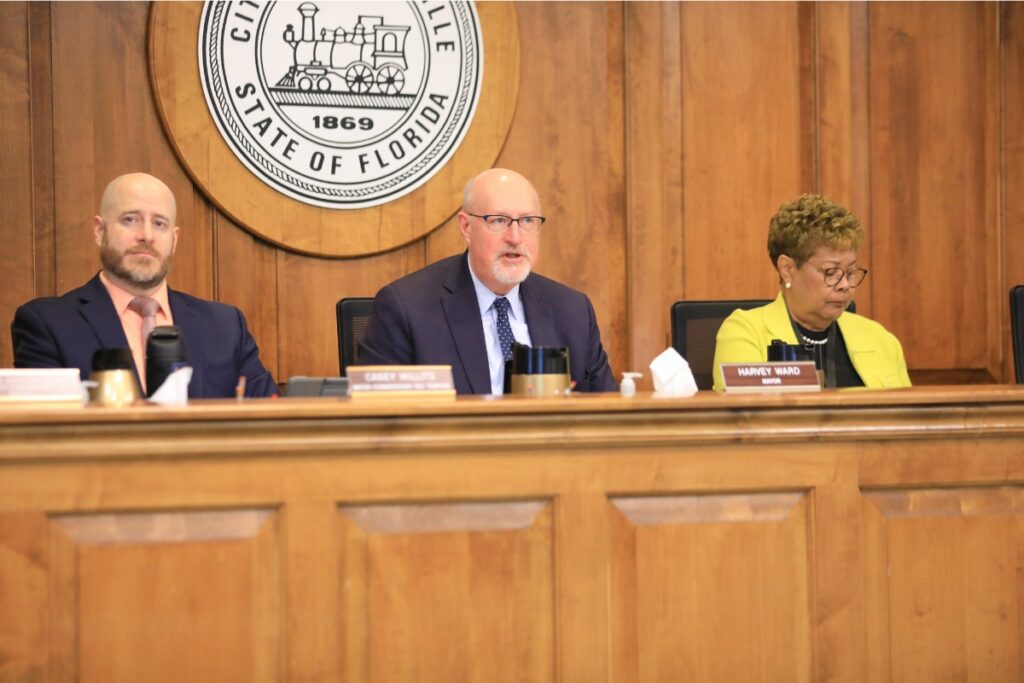
- Gainesville City Commission approved a charter amendment to allow appointments for vacant seats regardless of time left in term, avoiding costly special elections.
- The City Commission allocated $40,000 from a reinvestment program for HVAC repairs at the historic Cotton Club Museum and Cultural Center.
- The decision on vacating a 10-foot right-of-way for a 14-story apartment near UF was delayed to May 21 due to lack of second for the motion.
The Gainesville City Commission voted on a potential charter amendment for the November ballot, approved $40,000 for the Cotton Club Museum and Cultural Center and stalled a decision on a right-of-way easement for a 14-story development.
Charter amendment
The charter amendment concerns filling commission seat vacancies. Currently, the Gainesville charter allows the city to fill a vacancy via an appointment by the commissioners if less than six months remain in the term before a regular election.
If more than six months remain in the term before a regularly scheduled election, then the charter directs the city to hold a special election just for that seat.
The City Commission made a first vote on Thursday to proffer an amendment that would allow the commissioner to appoint someone to the seat regardless of how long until the next regular election—meaning an appointed commissioner could serve for two years and a few months in a maximum term.
If ratified on a second commission vote and then ratified by Gainesville’s voters, the amendment would do away with the need for special elections.
The last special election to fill a commission seat happened in 2021 when former Commissioner Gail Johnson resigned. The resignation resulted in a special election in November 2021, followed by a runoff in January 2022 that placed Commissioner Cynthia Chestnut back on the dais. Each of those special elections cost the city around $200,000.
City Attorney Dan Nee said the option to just appoint instead of a special election came up a few years ago, but never made it before voters. He said the cost and burden to quickly hold a special election make it less feasible than decades ago, and he said other cities also have the same appointment process.
Gainesville city commissioners serve four-year terms, with half the terms staggered, so not all seven seats are up at once. If a resignation happens in the first half of a term, an appointment could last until the city election at roughly the halfway point. Whoever wins the seat would earn the remainder of the resigned commissioner’s original term.
If the election happens in the second half of the term, then the appointment would last until the term would originally expire, with the newly elected commissioner earning a new, four-year term.
The amendment also has a caveat that if the resignation happens within six weeks of the start of the qualifying period for a regular election, then the City Commission would appoint someone and not use the upcoming election. The reason, Nee said, is that six weeks or less wouldn’t be enough time for citizens to decide to run and then launch a campaign for qualifying.
The City Commission voted unanimously on the amendment, with commissioners Bryan Eastman, Desmon Duncan Walker and James Ingle absent. For the final vote, the amendment will need six of the seven commissioners in favor.
Cotton Club Museum and Cultural Center
The city of Gainesville has had multiple private organizations reach out for aid during the current fiscal year, including Bread of the Mighty during an historic federal government shutdown impacting SNAP benefits, and Heartwood Soundstage, dealing with ongoing deficits.
Commissioner Casey Willits said there’s a limit to approving these requests.
“We can’t be the majority investor in everything,” Willits said.
Mayor Harvey Ward said he wouldn’t support any more one-off requests for funding that arrive outside of the city grant process or already established programs.
At the meeting, the City Commission voted to allocate $40,000 to the Cotton Club Museum and Cultural Center for HVAC repairs. The funds will come from the Gainesville Community Reinvestment Area (GCRA) program, primarily funded by the county, to boost activity within certain geographic boundaries.
Vivian Filer, chairman of the center, said the county had committed funding to the site and sent employees to walk through and inspect for any other needed repairs. Filer said the wooden building was built in the 1940s, with some damage to the structure since then.
She said she wasn’t sure if county funding would cover everything, but she said it’ll be a good start, just like the city’s help with the HVAC.
County spokesperson Mark Sexton said county staff made a list of recommended repairs and will estimate costs. That list will go before the Board of County Commissioners who will decide how much to allocate on the project.
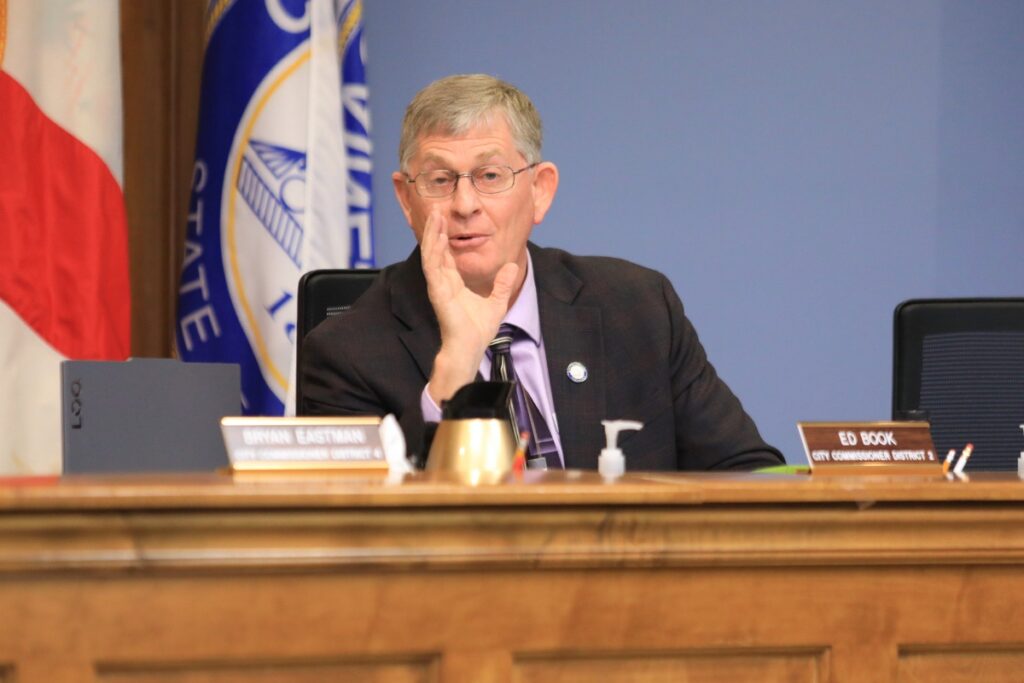
Commissioner Ed Book said he was glad city staff recommended the GCRA funding source because they won’t impact the city’s current budget or other programs in the works.
He added that with the recent spontaneous funding requests, the commission had considered a new program that could provide a framework for how the city responds. As part of that program, Book said he’d like the city to focus on long-term, operational aid (like an HVAC system) versus programmatic funds.
Willits agreed that the funding source matched the need, and he pointed out that historic buildings can be very expensive. The city will not be able to shoulder that cost for every historic church, nonprofit dwelling or private residence.
Looking at a list of future repairs for the Cotton Club Museum and Cultural Center, he said it’s going to take a much larger community using and supporting it to keep the center viable.
“Is this a sustainable project overall?” Willits asked. “Does the community want this building, because it can’t just be the city that wants this building?”
Commissioner Cynthia Chestnut said the Cotton Club Museum and Cultural Center started as a collaboration between the University of Florida, the Florida Secretary of State’s Office, the Florida Legislature and the community. She said it’s been a collaborative effort to get where it is.
The city of Gainesville also invested in the beginning through the same revenue source, but Ward said it’s been a while. He added that the city has formed a tradition of providing support on an ad hoc basis.
But he said those small investments can return big long-term dividends, referencing city support for Working Food. Still with the budget situation tight—including a current $7.6 million gap for the next fiscal year—Ward said he won’t support new requests that fail to go through a current city program.
He added that the city does need a policy to follow.
“So if somebody needs something, as they will, there’s a way for us to approach it that is not just how are we feeling.”
He also pushed back against the idea that the city fails to support historic restoration. He highlighted recent funding to the Seagle Building, Matheson House and Florida Theatre that came through the Business Improvement Grant, along with past work on the Hippodrome State Theatre, South Main Station, the Depot Building at Depot Park, Bethel Gas Station (building at Bo Diddley Plaza that now houses Kushi & Co.), the Sun Center and the Thomas Center.
“Anybody who intimates that the city of Gainesville does not do historic preservation in a robust manner is not paying attention,” Ward said, adding that it needs to be talked about more.
Right-of-way vacation
This right-of-way vacation came before the City Plan Board in March and earned quick approval from the members.
The issue is just north of UF’s Library West, where a 14-story apartment complex received approval in a split vote in 2025. The complex could have 240 units and multiple bedrooms per unit. The site plan includes only 13 parking spots, as critics pointed out during approval.
Gerry Diedenbach, agent for the developer, said that after the City Commission approval, the team found a 10-foot strip of land that was incorporated into the private property but was offered to the city as a right-of-way 120 years ago.
Diedenbach said the land was offered but never accepted or incorporated into the city’s right-of-way, according to any documents. He said the private owner of the parcel next door, which became a Burger King, eventually encroached on the 10-foot section. Now, staff said the best way to resolve the issue before building a multistory building was the right-of-way vacation—officially giving up any authorization for the city to use the strip.
Willits said it’s not a small strip. With the price per square foot in urban environments, he said 10-feet feet is a lot and can change a building design and the price of rents.
Book said the streetscape around the project had slowly been whittled down from impacts and vacations to become difficult for all modes of transportation. He asked the developer to use the 10-foot strip to ease the problem, especially to the south with University Avenue.
But when it came time to make a motion, everyone seemed reluctant. Only Book, Willits, Ward and Chestnut were present.
Chestnut finally put forward a motion to approve the staff’s recommendation to vacate the right-of-way and officially let it be a part of the private parcel where it’s been used for decades.
But neither Book nor Willits gave a second, preventing a vote. Ward asked three times if anyone would like to second the motion before announcing the motion failed.
Patrice Boyes, a land use attorney with Holtzman Vogel and agent for the developer, asked if the commission would delay the item until the full commission is present.
Willits agreed and made the motion.
Boyes then chimed back in. She noted that the item is quasi-judicial, meaning the commission can only vote upon the legal and competent substantial evidence of the issue.
“I’m concerned that other issues outside the record related to the issue have been introduced that may have influenced our situation here today, Boyes said. “I just want to say that for the record. I mean no disrespect.”
The commission settled on the May 21 meeting to hear the item again.
Suggested Articles
No related articles found.
Fact check: @mainstreet news, was this a City of Gainesville special election costing over $200,000 in 2025? https://enr.electionsfl.org/ALA/3887/Summary/
How was this election missed in your reporting? This also proves this current amendment futile…
As previously reported (https://www.mainstreetdailynews.com/govt-politics/gainesville-retry-utility-referendum), city leaders expected the cost for the special utility referendum in November 2025 to be around the same–over $200,000. It wasn’t mentioned in the story because it wasn’t a special election to fill a commission seat which is what this amendment deals with.
A 240 unit apartment complex, across from UF, with only 13 parking spaces, approved by GNV?
LMAO!
14 story apartments👀
Another Moms Kitchen?