



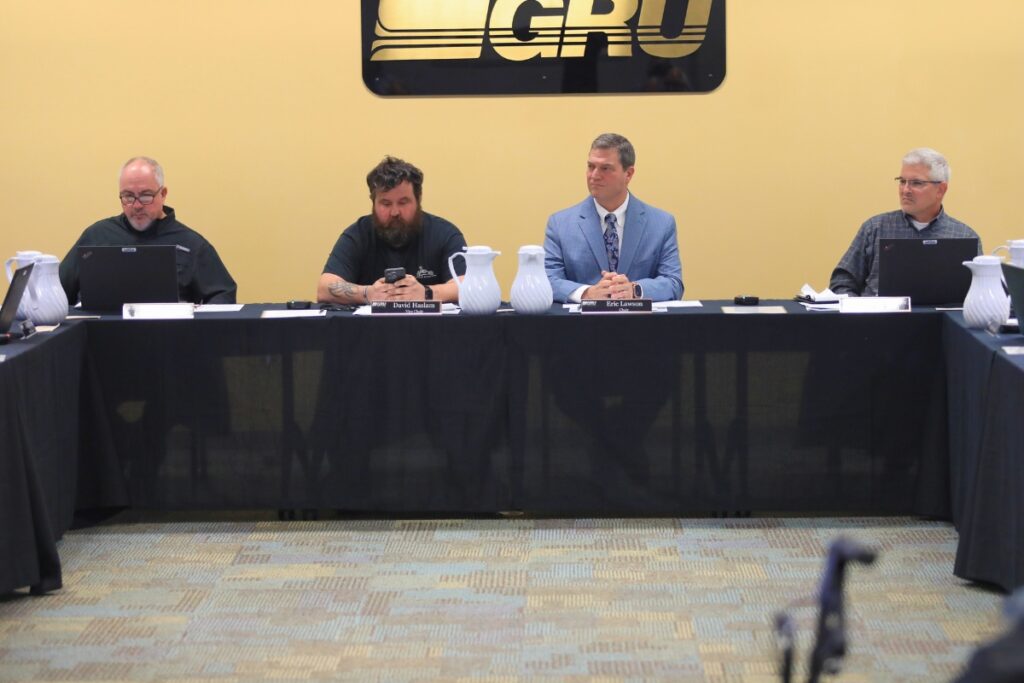
- The GRU Authority caused Gainesville to reduce its general services contribution, which once funded up to 25% of the city's budget, leading to staff cuts and tax hikes.
- In 2023, the Florida Legislature passed a bill creating the GRU Authority under a governor-appointed board, sparking lawsuits and charter amendment battles in Gainesville.
- The Florida First District Court of Appeal ruled Wednesday that the city of Gainesville cannot amend, or ask its voters to amend, Section 7 of its charter that created the Gainesville Regional Utiliti
The Florida First District Court of Appeal ruled Wednesday that the city of Gainesville cannot amend, or ask its voters to amend, Section 7 of its charter that created the Gainesville Regional Utilities (GRU) Authority.
The ruling said the Gainesville City Commission lacks the power to amend a part of its charter that was created by the Florida Legislature.
“The Legislature may create a city’s utility authority either directly by special law or indirectly by enacting a special law that amends the city’s charter,” the ruling said. “Either way, the utility’s authority stems from a special law enacted by the Legislature. Accordingly, even when the Legislature enacts a special law that amends a municipal charter, a municipality cannot subsequently adopt a charter amendment that conflicts with that legislative enactment.”
The ruling reverses a trial court decision that said the Gainesville City Commission had the power under Florida’s Home Rule Act to amend its charter. But the Alachua County judge said the ballot language used by the city was confusing and failed to meet state standards.
With the First District Court of Appeal (First DCA) decision, the governor-appointed GRU Authority is poised to remain in charge of utility management for around 100,000 customers.
But the ruling isn’t final yet, and the city of Gainesville has time to file additional motions or an appeal to the Florida Supreme Court. Any future motions and decisions would now need to overturn the First DCA order.
“We have always been confident that the GRU Authority was on the right side of the law,” said GRU CEO Ed Bielarski. “With this ruling from the First DCA, we hope the city realizes the battle is over, stops wasting taxpayer money on legal fees and accepts that the Authority is GRU’s governing body.”
In February, the attorneys for GRU said the city is actively revolting against the state of Florida. The comments earned critique from the panel of three judges who oversaw the case.
The Florida Legislature passed a bill in May, signed by Gov. Ron DeSantis in June, that many called a preemption targeting the GRU Authority and preventing the referendums from taking place. The First DCA asked for briefs on the bill, HB 1641 from 2026, and its impacts. But in the final order, the court declined to rule on the new law.
“However, the parties’ arguments reflect that the effect of the 2026 Act, including its constitutionality, is a matter that should be litigated before we consider it,” the court said. “We choose not to address these questions here because we reverse the judgment on Count I and dismiss the cross-appeal on Count II, regardless of the 2026 Act.
This iteration of the “battle” for GRU started in 2023 with a hearing of the Joint Legislative Audit Committee (JLAC). The committee reviewed an audit of Gainesville that had 16 findings, including four about GRU.
Both Republican and Democratic members of the committee had sharp warnings for city officials to get the utility’s finances in order, but the path to stability fractured partisan unity.
Within weeks, former state Rep. Chuck Clemons, R-Newberry, filed a bill that would create the GRU Authority and keep the utility as part of the city but under a governor-appointed board. The bill passed the Florida Legislature along party lines.
The city of Gainesville sued to prevent the bill from taking place, and after Clemons left the Legislature, the City Commission proposed a charter amendment. Clemon’s bill had added Section 7 to the city’s charter, and the Gainesville referendum would remove it.
The GRU Authority sued to prevent the referendum, calling it a violation of state law. While the 2024 referendum was being litigated, the City Commission changed language in the referendum and returned it to the voters. Both referendums passed with over 70% of the vote.
The referendums were critiqued for not including GRU customers who live outside city limits, but city leaders said the commission lacks the ability to issue a referendum outside its borders.
The move to the GRU Authority caused more litigation from residents, the resignation of each of the authority members and the firing of then GRU CEO Tony Cunningham.
The GRU Authority also caused big budgetary changes for the city. The authority members voted to reduce the money transfer (general services contribution) sent to the general government annually. The transfer once funded up to 25% of Gainesville’s general fund budget.
The transfer reduction caused the city to reduce staff and raise property taxes to recoup the revenue.
Earlier this month, customers saw another large change as city fees for stormwater and garbage collection moved from monthly utility bills to the annual property tax. The GRU Authority initially voted to remove the fees from the monthly bills, but the city returned with a counteroffer that would allow the utility to keep a larger percentage of revenues as payment for the service.
The GRU Authority, lacking its fifth member since Craig Carter left the board in 2025, was gridlocked in multiple 2-2 votes, allowing the original direction to stand.
The GRU Authority has highlighted a flat electric rate and minimal increases to water and wastewater as signs of success. The average GRU electric bill has fallen close to the state average as a result of the changes plus reductions in natural gas prices.
The GRU management issue remains the most consequential for the City Commission and residents.