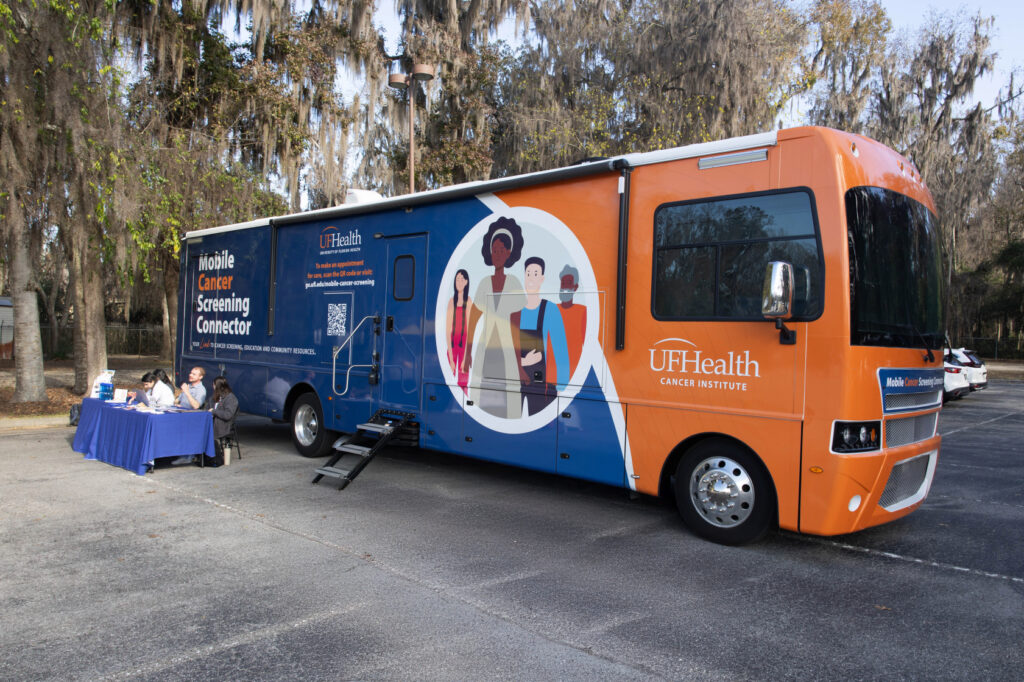


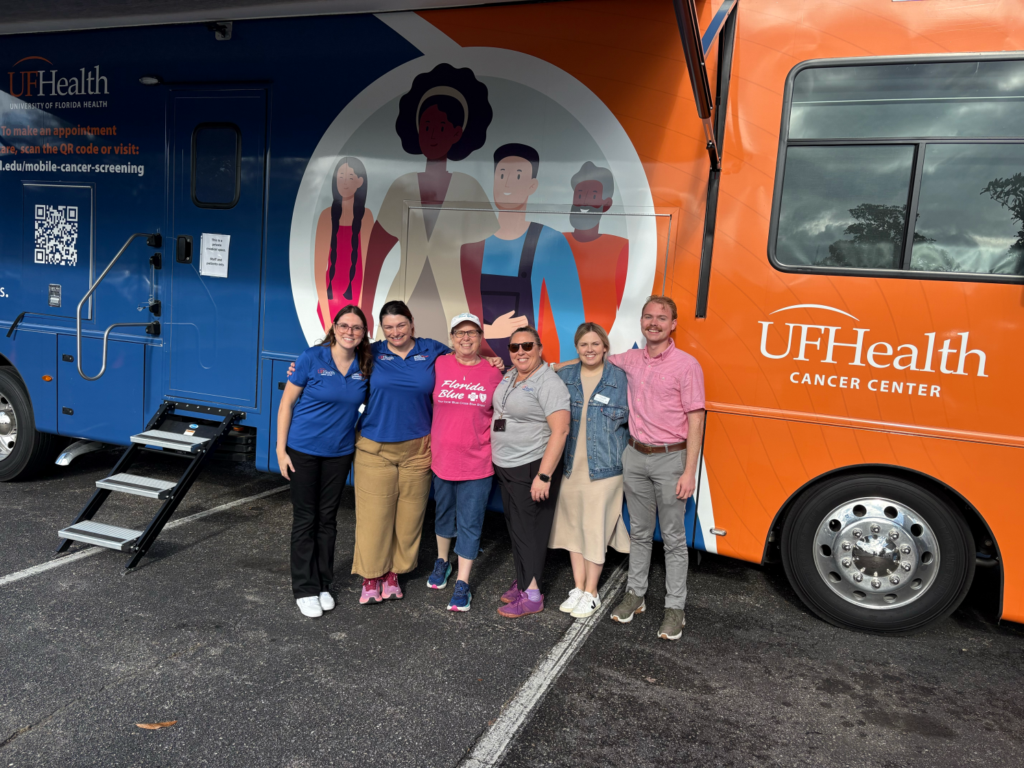
- UF Health's Mobile Cancer Screening Connector has provided over 300 mammograms in 26 counties, with 35% of patients new to UF Health.
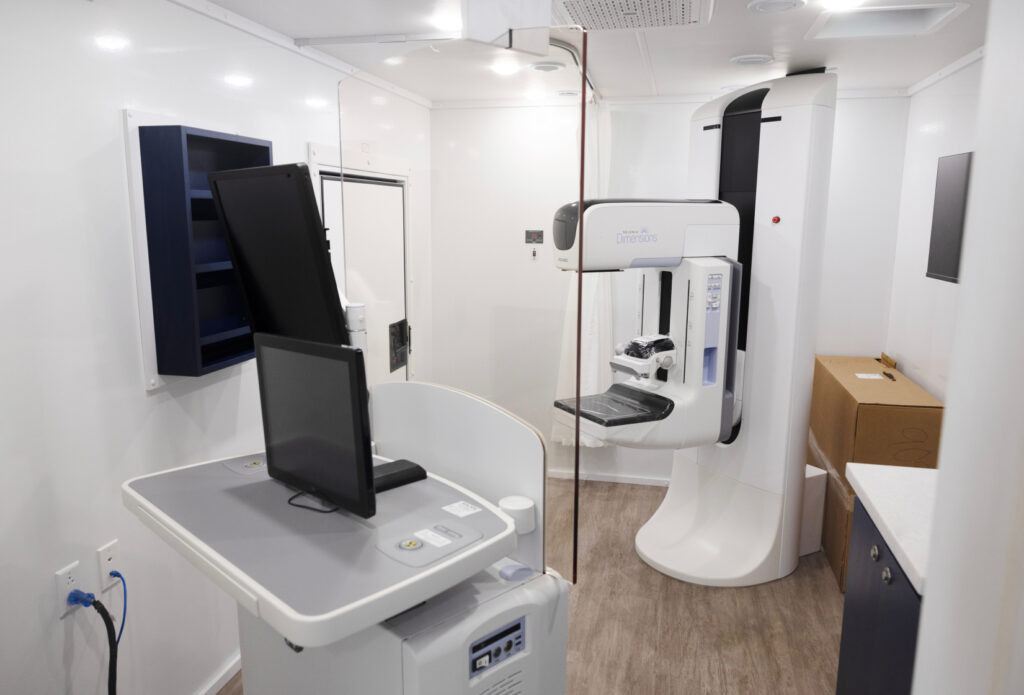
- The mobile unit offers bundled cancer screenings including breast, colorectal, prostate, and cervical cancers using clinic-quality equipment.
- UF Health partners with local groups and researchers to educate communities, support screening access, and involve patients in cancer research.
Editor’s note: This story is part one of two reports on UF Health’s mobile outreach programs. The next story will feature the Mobile Stroke Treatment Unit.
How can people in Alachua County and across North Central Florida get easier access to cancer screening? That’s the problem UF Health set out to solve when it launched the Mobile Cancer Screening Connector two years ago, and it’s proving successful.
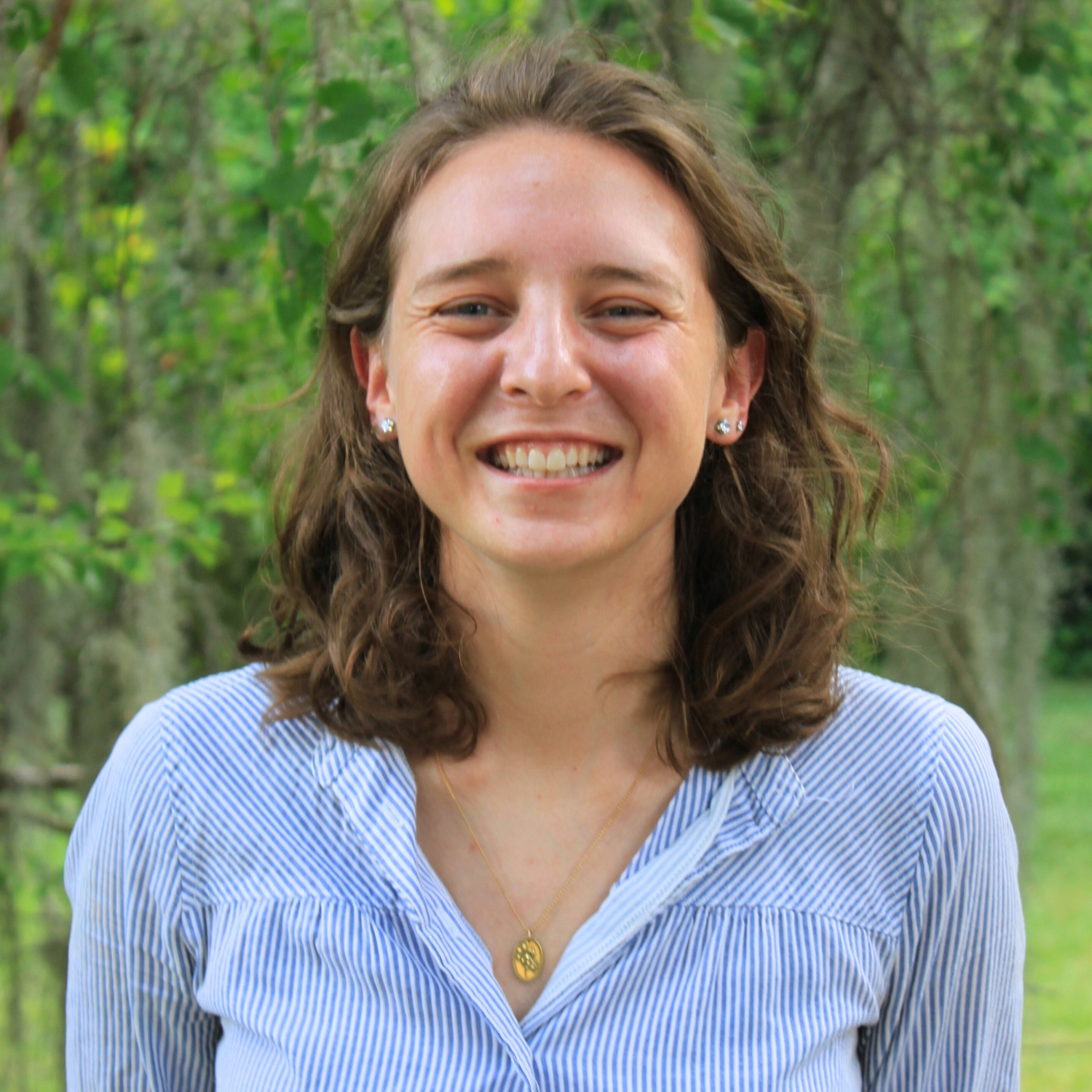
Assistant Director of Cancer Screening and Care Navigation Jamie Hensley oversees the mobile program.
Although it was a time-consuming effort to get something new up and running, Hensley said the hard work to mitigate barriers to screening, like transportation, time, finances and education, through the unit is unquestionably paying off.
UF Health reported that 55% of people in underserved communities within the connector’s catchment area received mammograms in the year prior to the unit.
But since hitting the road, the connector has provided over 300 mammograms, with 35% of those patients new to UF Health. Over 150 visitors have gotten more than one screening when they come.
Hensley said the organization is excited to reach even more communities in the future, as the catchment size grew this year from 23 counties to 26, about the size of Southern New England.
“A lot of people have to buy into what you’re doing,” Hensley said. “So it was truly a long process. But I’m so proud of where we are now.”
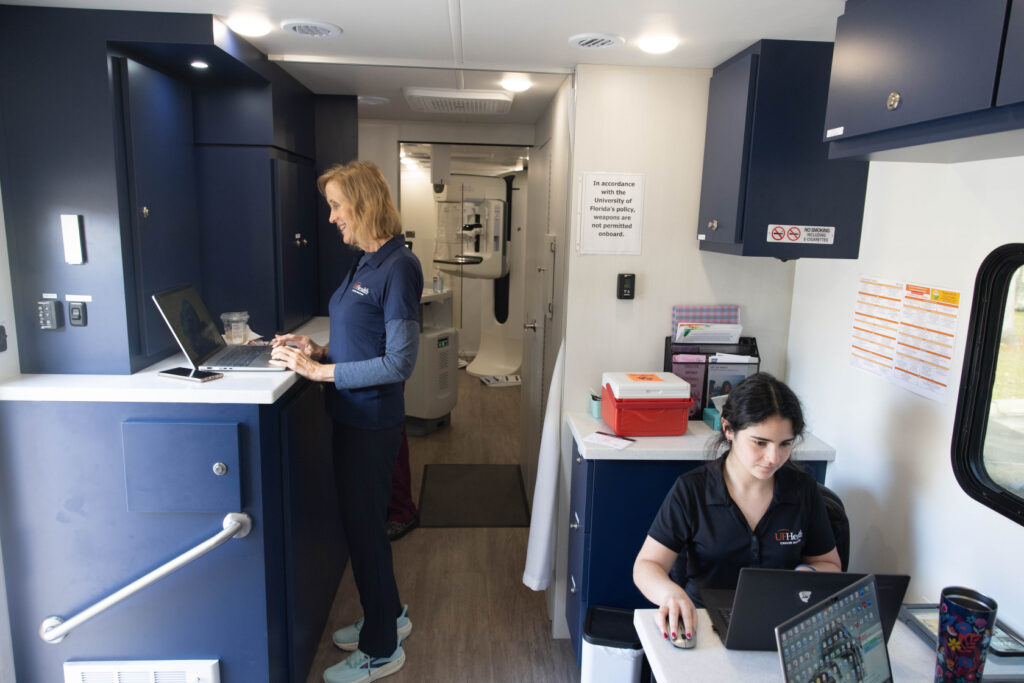
Unlike other mobile units that might only screen for one type of cancer, Hensley said UF’s is a bundled program where clients can get a variety of scans at once, including breast cancer, colorectal, prostate and cervical cancer, all with the same machinery and experts as a UF Health brick-and-mortar clinic room.
Hensley said the unit travels for up to a week at a time for general screenings, awareness campaigns like Breast Cancer Awareness Month in October, and research projects.
Its route targets rural areas in Alachua County and surrounding ones like Gadsden, Baker and Leon, extending down to Lake Sumter and over to St. Johns, serving clients from as far away as Georgia.
The educational component of the unit is key, relying on the Clinical Community Navigation Program (CCNP) led by Hensley. CCNP operated before the unit, just with less fancy pop-up tents and tables.
Hensley said the program connects with patients and clinical partners in an area that might be stretched thin medically to help people learn that they need to be screened for cancer, which types, how often and how to access help.
Should results show a need for further treatment, patients screened in the cancer unit are referred to local physicians or UF Health, Florida’s only National Cancer Institute-designated program at a public university.
The cancer unit will also educate people on preparing financially for a cancer diagnosis and help them apply for vouchers to make screenings low-cost or free.
Hensley said UF Health’s work is most sustainable when it adapts to each community’s needs rather than imposing its own systems and processes. Through the CCNP and cancer unit, UF Health builds on what communities are already doing well and helps strengthen those efforts.
He said the program partners with Department of Health offices in every county and the six statewide cancer control collaboratives to cultivate a continuum of care that lasts beyond the unit’s visit, helping build sustainable healthcare ecosystems and bear a community’s cancer burden.
“They know themselves best. They know their neighbors, their friends, their traditions, their values, their priorities,” Hensley said. “It’s about looking at what’s already happening and how UF Health can come alongside and help those rural communities expand and enhance what they’re already doing.”
Hensley said the cancer unit partners with other health groups for creative outreach.
Man Cave Health is a non-profit providing education about cancer risk factors in men. They partner with UF Health’s cancer connector to set up football tailgates, where men can learn about prostate cancer and check their levels.
The cancer unit’s outreach also aims to engage the community with active UF research and invite them to be part of it.
UF Research Assistant Scientist Lincoln Lu is looking at the mental health impacts of bicycling for cancer survivors. Hensley said Lu travels with the cancer unit and leads group bike rides where survivors can connect and exercise together.
Another study involves take-home cervical cancer screening tests. The kits are FDA-approved, but not yet standard care, meaning doctors typically aren’t using them, and insurance won’t cover the costs.
But Hensley said demonstrations through the cancer unit show they can lead to the early detection that helps lives, just one of many ways the unit is bridging the gap between science and the community.
“Researchers can come out with us and share their work and findings directly with the community,” Hensley said. “So, trying to dispel some of the mystery and some of the fear or trepidation around research, so that, God forbid, if someone does face a cancer diagnosis or a serious health crisis, and their physician says research may be an option for you, it’s not this foreign, new concept. They’ve heard about it before in their own communities and maybe have some comfort.”
Heading into year three, Hensley said UF Health is focused on maintaining the mobile unit’s services for new clients and the increasing pool of repeat ones, and on growing even more research opportunities.