



- Floridan aquifer levels in North Central Florida fell below the 20th percentile in March 2026, the lowest since 2011, due to ongoing drought conditions.
- Alachua County is split between two districts, both in Phase II Severe Water Shortage with mostly voluntary and some mandatory water use reductions.
- Agriculture accounted for 64% of water use in the Suwannee District in 2023, making it the primary water consumer in that area.
- The Suwannee District encourages water conservation for all users and runs programs to help farmers adopt efficient irrigation during droughts.
With no rain in the forecast, Alachua County and North Central Florida continue to draw more from the Floridan aquifer than it gets recharged, and the overall upper aquifer level dipped below the 20th percentile for the first time since 2011.
Alachua County is split between the Suwannee River Water Management District and the St. Johns Water Management District. Both districts are in Phase II Severe Water Shortage, which includes mostly voluntary measures with some mandatory reduction measures.
On Tuesday, the Southwest Florida Water Management District issued a modified Phase III Severe Water Shortage that includes more mandatory restrictions.
The Suwannee River Water Management District (Suwannee District) sat at a 15-inch rainfall deficit compared to the 12-month average at the end of February. At its March meeting, Hydrologic Program Manager Robbie McKinney said the rainfall deficit could have a decent increase because of the March 2025 data, leaving the 12-month average.
According to provisional data from its Live Oak station, March 2026 has only brought 1.13 inches of rain so far compared to 5 inches for the same month in 2025.
Troy Roberts, communications and outreach chief for the Suwannee District, said the district doesn’t have numerical thresholds to increase from one restriction level to another. Instead, staff continue to monitor drought conditions and water levels to see if additional restrictions are needed.
“We just ask people to voluntarily reduce their water use as much as possible,” Roberts said. “We understand that everybody needs access to water, and we also understand that drought conditions could worsen before they get better. We just want to make sure that we’re in a good spot for that.”
Roberts said the Suwannee District reaches out to large water users and permittees, asking them to conserve water where possible and to plan for a prolonged drought.
The primary water use in the Suwannee District, which ranges north and west from Alachua County, is agriculture at 64% of total water use in 2023. Each of the five water management districts in Florida produces annual water use reports, and the most recent reports are from 2023.
Roberts said the Suwannee District is the only one where agriculture is the primary water user. As spring and the growing season arrive, he said agricultural producers will need more water to support crops.
“Our farmers are going to need that water for crops, especially when we’re not seeing any rainfall,” Roberts said. “So that typically does have an impact on our groundwater levels, and again, we want to make sure that they have water, but we also want to make sure that people do as well.”
The district operates a series of Agricultural Cost-Share programs that help farmers pay for efficient equipment like field sprayers. But Phase III Severe Water Shortage restrictions could put some mandatory restrictions in place for agriculture operations, as well as other users.
While levels are low, Roberts said they’ve been low before as Florida cycles through high and low rainfall years. And with hurricanes a perennial possibility, the water situation could quickly change.
Florida experienced extremely low aquifer levels in May 2012 before Tropical Storm Debby arrived in late June and, along with other seasonal showers, helped quickly boost the levels to nearly 65% by the end of July.
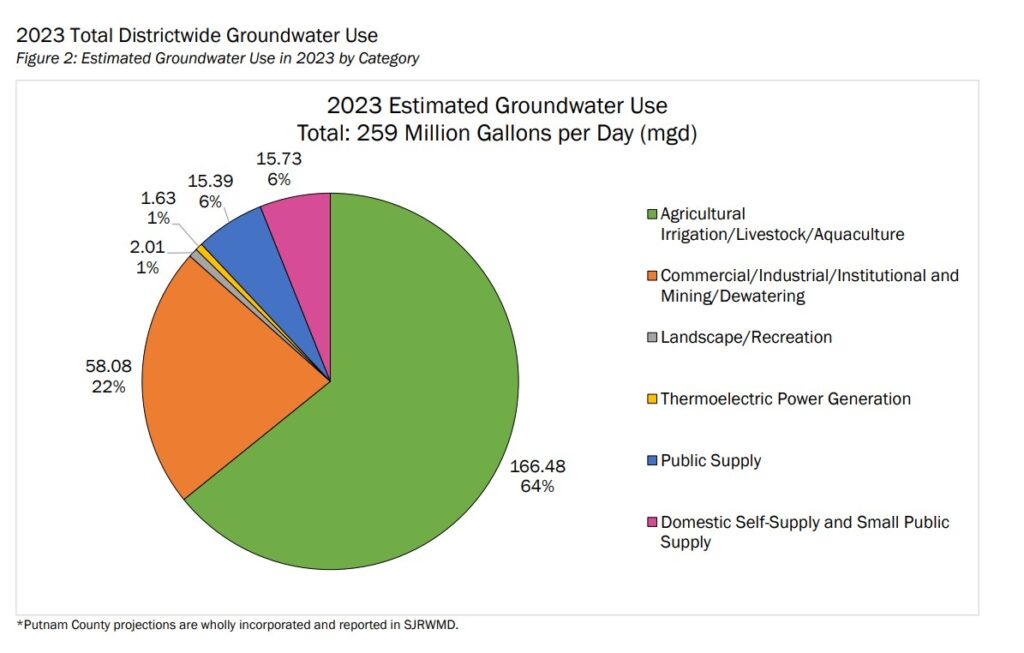
Overall, the Suwannee District averaged 260 million gallons of water used per day (MGD) in 2023—nearly the same as the 2016 average of 259 MGD.
In the St. Johns Water Management District (St. Johns District), the average daily water use hit 1.49 billion in 2023—a 25% reduction compared with 2004, despite an increased population.
Public supply, water taken out of a central supply system like a utility, is the largest water use for the St. Johns District at 609 MGD in 2023. Of that number, the portion of Alachua County within the district consumed 23.86 MGD. This district also includes Duval and Orange counties with their large population centers.
On the Suwanee District side of Alachua County, public supply water use in 2023 hit just over 3 MGD.
Between the two districts, Alachua County used 49.3 million gallons per day in 2023. Public supply is the largest category at 26.86 MGD (54.4%), with agriculture at 15.94 MGD (32.3%).
Roberts said the Suwannee District encourages small water-saving efforts people can implement at home. While only a few gallons per day, he said those savings compound when multiplied across all the residents in the district.
“I know a couple gallons in the grand scheme of things doesn’t seem significant, but if you have half of the population doing that, that’s a huge water savings every single day,” Roberts said. “We try to encourage people just to be mindful of that because when we are in drought conditions like this, every drop does count.”
Public feedback from water conservation messaging often touches bottling plants pulling water from springs. These comments on water districts’ Facebook posts and Mainstreet stories pop up frequently.
Roberts said the district reaches out to bottling companies just like agriculture producers and other large water users, asking them to conserve where possible. He noted that bottling spring water is a permitted use in Florida.
“We can’t really single out individual permittees, and so, any of those regulatory measures would have to affect all of our permittees,” Roberts said.
The industrial/commercial/institutional/mining category is responsible for around 22% of the daily water used in the Suwannee District, with 58 MGD. The bottling company pulling from Ginnie Springs, perhaps the most frequently cited example, is permitted to pull 1 MGD—less than 2% of that category’s water use and 0.38% of the total district.
Suggested Articles
No related articles found.
When will the many car wash companies and thos beloved golf courses be affected/ After all – we should all be part of the solution, right?
So are they telling Nestle to hold off on pumping millions of gallons a day out of Ginnie Springs? The orange spot on the map in Gilchrist County is right in the area where Ginnie Springs is.
No
Don’t forget about all the new developments being built!! How many huge wells do they pitch in place to support them?? All the while my small farm, that has been working since the mid 1800s, is dying.
This place makes zero freaking sense. Here we are almost 2yrs into a severe drought.
Poor resource mgmt. Can’t do anything about a drought right?
No serious water restrictions issued?
Pretty soon we will be squeezing toads…..
Maga said they have the tech to cloud seed so why isnt FL cloud seeding to solve the problem Ah?
Crickets chirping. Remember that logic, for them, only applies when it doesn’t unravel some conspiracy theory or culture war argument.
It’s no wonder it’s not just the drought we’re having here it’s the
legislators and the county commissioners that are allowing them to overdevelop the areas continuously building and building they think we have an unlimited supply of freshwater the Army Corp of Engineers never planned for this type of development so our aquifer system is suffering just what are they gonna do when we run out of freshwater? This is why we’re having all the sinkholes they’re destroying our ground water underneath. These people are corrupt and they need to be removed from their offices. It’s all for greed they need to come up with other ways of getting tax revenue.