



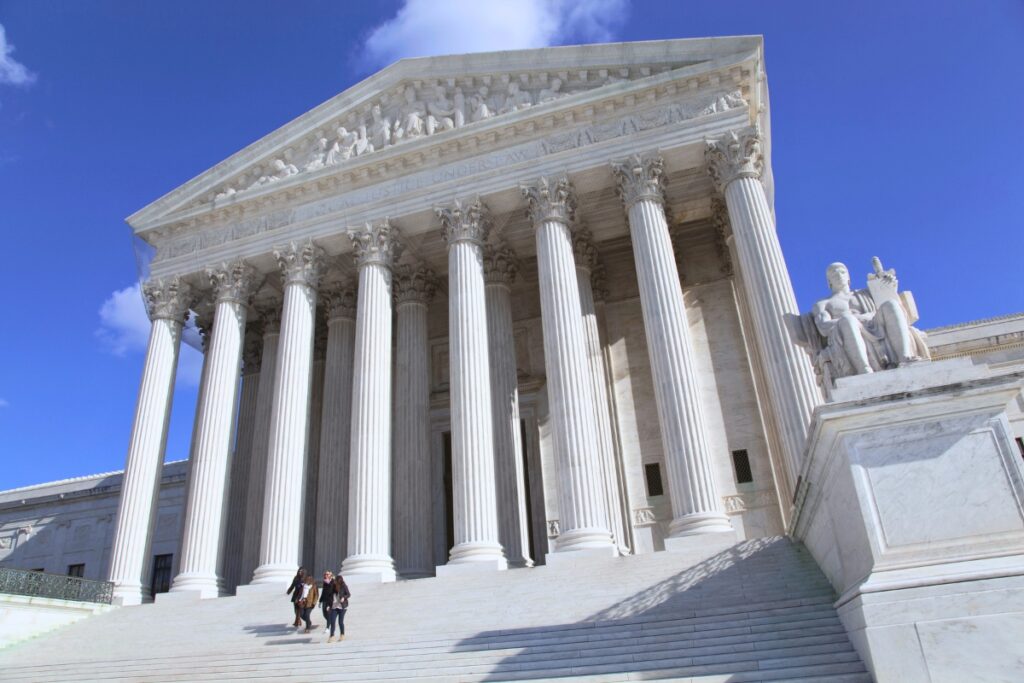
The nation’s highest court on Tuesday ruled that the children of people illegally or temporarily present in the United States are American citizens at birth. Justice John Roberts, writing for the majority, said that such children clearly fall under the Constitution’s 14th Amendment, which says anyone “born … in the United States, and subject to the jurisdiction thereof” is a citizen.
Previous court precedent included only very narrow exceptions to birthright citizenship, such as for the children of ambassadors, he wrote. The precedent also indicated that any private individual within the United States was subject to its jurisdiction, he wrote.
The case stemmed from President Donald Trump’s January 2025 executive order stating that automatic citizenship is not conferred to U.S.-born children whose parents are both illegal immigrants or temporary U.S. residents. Several federal judges blocked the order from taking effect as various challenges to it worked their way through the courts.
Which justices disagreed with the decision? Justices Clarence Thomas, Neil Gorsuch, and Samuel Alito filed dissenting opinions, while Justice Brett Kavanaugh wrote that he agreed with the end result but not the full majority opinion. Alito referred to the ruling as a serious mistake that grants citizenship to children born to parents who came to the United States solely for so-called “birth tourism.” He argued that, understood in proper context, the 14th Amendment’s citizenship statement referred only to people who did not have allegiance to a foreign power.
How did Trump react to the ruling? The president said the ruling was bad for America. However, the justices’ legal analysis showed that Congress could make a law to change birthright citizenship, without the need for a constitutional amendment, he said. He urged lawmakers to prioritize drafting such a law.
This story originally appeared in WORLD. © 2026, reprinted with permission. All rights reserved.

Suggested Articles
No related articles found.
This decision shows that even the most learned among us can make grievous errors. Based upon text and history which is the benchmark that was set in the Bruen decision, SCOTUS simply ignored their own ruling and then rewrote it in a way that guarantees massive problems for Americans in the not too distant future.
Make no mistake. Marxists want power over all of us, no more, no less. Power to take everything by force and give back nothing. The end goal then, is to gather voters who are lazy, frightened and who have been convinced by Marxist lies that there exists a social unicorn called “free stuff”. Alas, there is no such creature…never has been, never will be.
The Democratic Socialists of America are a vile virus who needs voters, plain and simple. Most of our young people have, by marxist design, never been taught the history of communism, so they are unaware that Marists have slaughtered more innocent people than Hitler could only dream of killing. They are only told about “free stuff”.
This SCOTUS decision guarantees that the Chinese, Iran or any other country will send pregnant women to the US, have a child, and then take the new US citizen back to the enemy nation to be forged into a weapon that can move freely and kill Americans with abandon.
Those who are cheering this decision don’t even realize that they too will be sacrificed on the alter on communism.
Make no mistake. FASCISTS want power over all of us, no more, no less. Power to take everything by force and give back nothing.
Fixed it for you.