



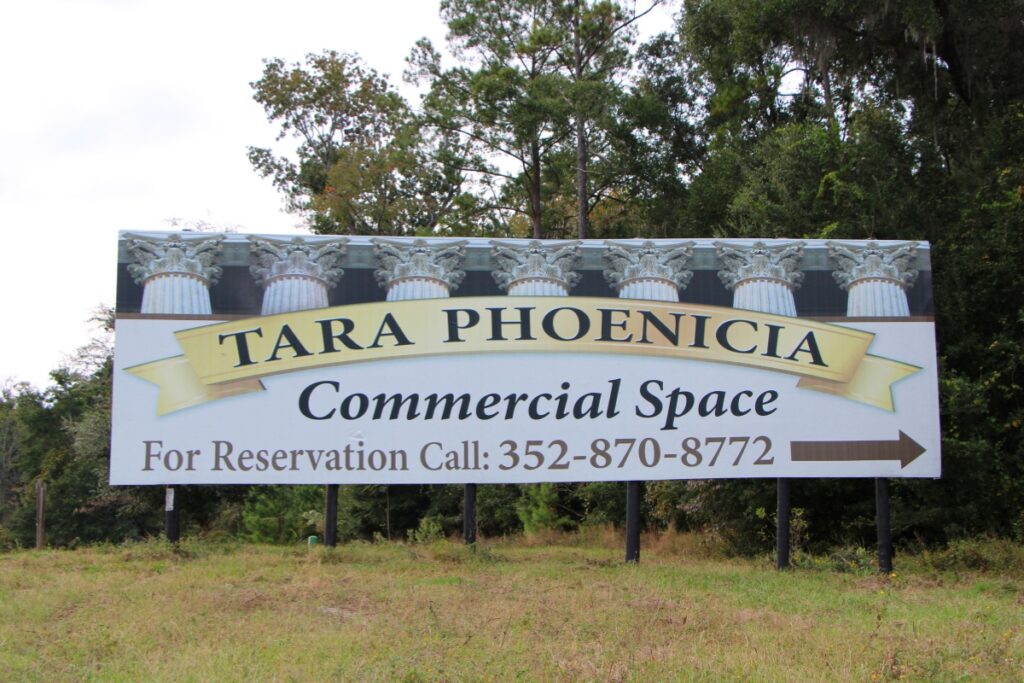
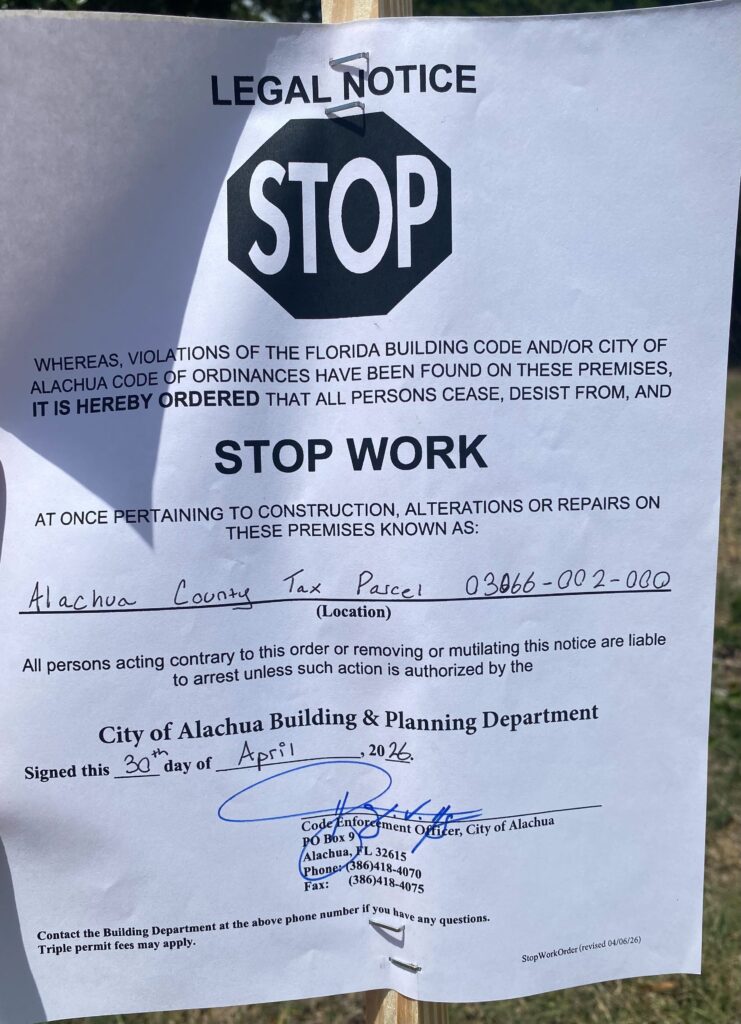
The city of Alachua’s Building and Planning Department placed a stop-work order on the Tara Phoenicia property near Mill Creek Sink on Thursday morning for unauthorized clearing of land.
According to the order, the complaint applies to Alachua County tax parcel 03066-002-000.
Principal Planner Carson Crockett said the city received the complaint Thursday morning and doesn’t know who was removing the regulated trees, although it typically falls on the owners of the land.
Developer Sayed Moukhtara owns Tara Phoenicia through Tara Forest LLC. The property is poised to serve as the commercial component of a five-development plan bringing more than 1,000 homes to the karst-sensitive land over the Floridan Aquifer.
Alachua’s Planning and Zoning Board issued a highly contested but unanimous rejection of a special exception permit for stormwater infrastructure on the Tara April property in January, seemingly halting development for the time being.
Crockett said no more trees are allowed to be removed until the complaint is sorted out. Although response varies for different properties, he said this can look like coming to the city with a restoration plan or getting proper approvals.
The landowners would have around 30 days to submit a restoration plan or else face fines.
Editor’s note: This story was underwritten by a grant from the Rural Reporting Initiative at the Community Foundation of North Central Florida.
Suggested Articles
No related articles found.
Kook-Tara did the same thing on the same property in 2018. Look it up!
Good!
Stop this Developer, as well as others, from acting outside the boundries of the norms of local requirements.
The situation facing the City of Alachua is concerning, but it’s also a reminder of how important it is to handle development disputes carefully and strategically. We’ve seen in other Florida communities, like Dunnellon near the Rainbow River, how prolonged legal battles with developers can strain a city’s finances and resources.
If mistakes have been made along the way, continuing down a costly legal path may only make things worse for taxpayers. Rather than escalating the conflict, the City of Alachua should focus on resolving this matter through mediation or a structured legal process that minimizes financial risk.
Protecting the community and environment is important, but so is protecting residents from unnecessary financial exposure. A balanced, practical approach one that seeks resolution instead of prolonged litigation will ultimately serve the city best.
Lawsuit? Escalation? Not mentioned in the article. If the developer has valid reasons for proceeding despite the ru I ing, let’s hear them. A letter to the editor, an opinion piece in the community paper would serve all of us. Otherwise let them just comply.
I can understand your worry about the city of Alachua’s fiscal issue of litigation however I would like to point out that is it rather short-sighted …. the development of this piece of property is not good for many reasons which could result much larger financial costs to the city of Alachua. The geological location is hazardous at best …. what will the rest of the city’s residents (you know the ones already living there …. property owners …. many for several generations ..) .. don’t they deserve their property rights protected by the city’s decisions ?? They could also file lawsuits for such failure ….. This landowner hiding under the LLC they perform as is a hit-and-run developer … and by their very actions are showing you their true colors …. I hope for your community’s sake that your city lawyers rise to this occasion …. ask your community for volunteer lawyer assistance …. there are many residents of your area with such expertise … think outside of the box if you want to continue to enjoy the life y’all have ….. don’t bend or yield just because your opponent has deep pockets …. ask yourself how their pockets got so deep … and whose pockets are they really ???
Didn’t the article mention a stop 🛑 order was placed on the property? That is a start of a legal process for the City of Alachua.
go find the tortoise holes and report them as needed–they can’t touch anything with the torts on them as well. These people are pure greed. This land is over a huge cavern which is not designed environmentally to support what they want to put on it–it will result in major sinkhole activity, flooding and damage to our aquifer system which we all depend upon.
He owns it. He can do whatever the heck he wants with his land. So what if he cut down some trees. Every single landowner cuts down trees whenever they want. If you don’t like growth then move. Because it’s coming whether you like it or not. Buckle up buttercups. Not a single one of you has done anything to help the economy but complain. At least this guy is providing jobs and growth.
Sounds like you should be the one to move. Maybe LA, New York, or Miami.
Hopefully he’ll provide you with water and sinkhole insurance …. bet not …. short sighted logic from you …. or do you even live in the community of Alachua ????
The stop work order is not valid. The stop work order must list what building code or city ordinance the stop work order is being issued for. Lack of experience on the City of Alachua yet again
Sorry, it’s valid.
Shut down the Tara-rists and stop them from destroying the public good