


Event to take place on Friday and Saturday, Dec. 19-20, at the Legacy Park Multipurpose Center (15400 Peggy Rd., Alachua)
This weekend, over 400 elementary and middle school students carrying Lego robots will gather in Alachua, Florida, to compete in the 2025-2026 Northeast Florida First Lego League Regional Championship. Among the crowd will be last year’s winners, the Turbo GatorBots, who recently outperformed more than 30 teams at a Clay County qualifying contest. For this team, the competition is tense. It’s nerve-wracking. It’s growth-provoking. But most importantly, it’s fun.
Each year, the championship’s sponsor, First — a global nonprofit that offers an array of robotics programs for students in grades K-12 — releases a new challenge based on a real-world, scientific topic. For this year’s Unearthed theme, teams are diving into the challenges of archaeology. In preparation for the competition, more than 15 teams connected with archaeologists at the Florida Museum of Natural History to learn more about the field.
“Meeting with these students has been fun. Sometimes you take your own discipline for granted because you breathe it every day. But then you see how excited other people get about it, and it makes you go back in time and realize why you developed a passion for it in the first place,” said Charles Cobb, the Lockwood chair in historical archaeology at the museum.
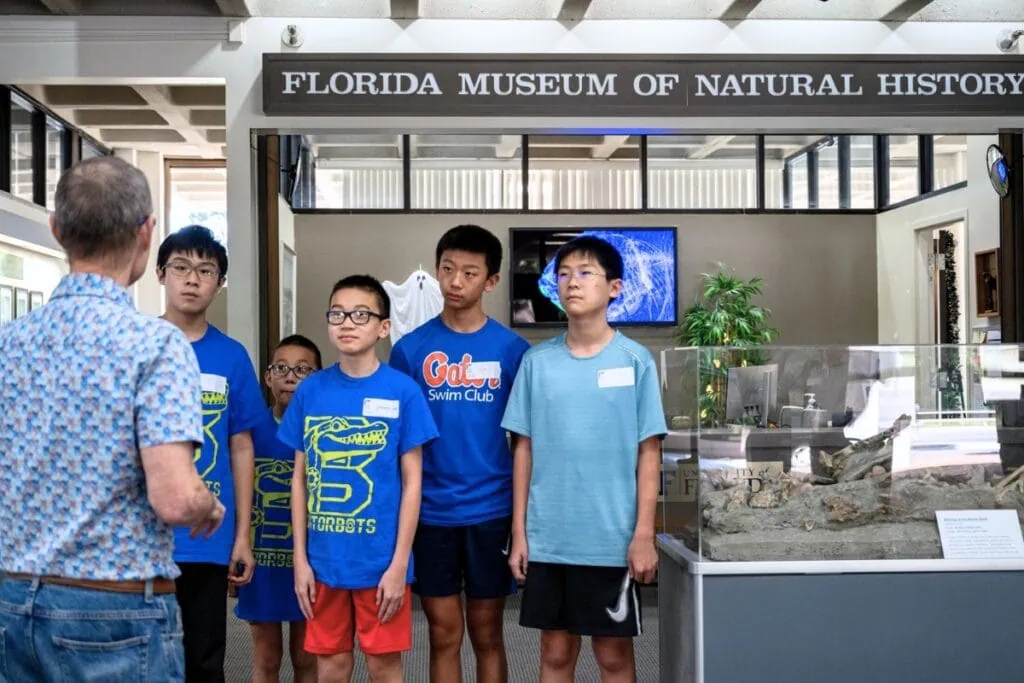
Such was the case one October afternoon when Cobb and five Turbo GatorBots team members stood between box-lined shelves of the museum’s collections, discussing archaeology, examining artifacts and passing around tools of the trade. This Gainesville-based team is comprised of returning members Dennis Chi, James Du, Jacob Li and Andrew Zhao, who are all in seventh grade at The Frazer School, as well as new member Daniel Chi, in fourth grade at the Frazer Institute for Greatness.

During the competition, judges score teams on four components: how the students design their robot, perform during timed missions, present their innovation project and display core values like sportsmanship and teamwork. In the months leading up to this event, the friends have met regularly after school, brainstorming ideas, building their robot, collecting data on trial runs and returning to the drawing board when obstacles emerge. Daniel, who watched his older brother compete last year before joining the team, acknowledged the hard work involved in being a team member.
“It’s much harder [to be on the team]. Observing is very simple. They build something, set up the robot and run the robot. But it’s more complex than you think,” he said.
For the performance test, teams use sensors and attachments on their robots to attempt 15 missions representing different aspects of an archaeologist’s fieldwork, including exploring a dig site, excavating artifacts hidden beneath rock and soil and uncovering clues to reveal stories of past civilizations.
Nerves can run high as the group gathers around the game table to navigate these missions under strict time limits and a judge’s scrutiny.
“It’s exciting. You have to make your robot really well. And it fails sometimes, so that part is intense,” Dennis said.
In addition to designing and building their robot, the team members undertake an innovation project, in which they identify and propose a solution to a real-world problem in archaeology. Their project culminates in a five-minute presentation in front of a panel of judges. The students also create a prototype of their solution and a poster to display at their booth, where they talk with fellow competitors and event visitors.
“At the start, we all feel nervous,” Andrew said. “But after 10 to 20 seconds of starting to present, I can feel excitement and joy from having conversations about this topic that we put so much time and effort into.”
The students are ready to step into their project roles as expert archaeologists and engineers by competition day, but it didn’t start that way. During hours of research and preparation, the teammates began to understand aspects of archaeology they never knew existed.
“Before this competition, I thought archaeology was just digging stuff up to put in museums,” James said. “I knew that it was useful for learning history, but I didn’t know you had to be so careful about considering the safety of artifacts, the safety of the workers, finding the balance between machines and the price. I had no idea archaeology had this much stuff included in it.”

One problem stood out to the Turbo GatorBots. Instead of jumping into digging, the students saw an opportunity to prevent unnecessary destruction caused by archaeology by focusing their solution on the steps that take place before excavation.
“When you dig in the spot, you can never recover it. If you dig without any information, it leads to destroying artifacts and nature,” Dennis said. “Before this, I thought you just dig in spots and hopefully you get something. But now I know there’s a lot more you can do to prevent damage.”
Their project utilizes different technologies to prevent such damage. Before picking up the shovel to dig, they collect information by using artificial intelligence to generate missing information on unknown artifacts and relying on radar and 3D modeling to get a look at archaeological sites underground. As they developed their solution, they continued to finetune it with feedback from Cobb and engineers at the University of Florida’s Malachowsky Hall for Data Science & Information Technology.
“There weren’t any shackles on their thinking. Talking with them was almost like having a brainstorming session,” Cobb said. “Their questions about remote sensing, AI and other things were really sophisticated.”
The students’ teamwork and division of tasks based on interests and strengths is something that Cobb sees as closely mimicking archaeology. According to the team members, it makes their final product stronger.
“If all of us have the same ideas and personality, then there’s no difference from one person being on a team or having seven people on the team,” Andrew said. “The competition is more about designing something together rather than the brute force of a bunch of people. You need people to constantly give their opinions to improve.”
And they don’t stop seeking new ideas when the competition arrives. Their fellow competitors are a great source for new ideas.
“During the competition, we can look at what other teams are doing, and if we think that will help us gain points and judges will like that, we might also do it next time,” Jacob said.
Displaying their core values is where these teammates thrive. In their last competition, the Turbo GatorBots didn’t get top marks in their robot design or performance, but they still received first place overall because the judges valued their communication and teamwork. Such life skills are ones that will last far beyond robotics competitions.
“You get to make new friends, go outside and cooperate with other people. You get over your fear of public speaking. You get core values by being nice to people. I could go on for hours — there are so many good things about this competition,” James said. “And it’s a lot more fun than sitting in the classroom.”
Top-performing teams at this weekend’s competition will advance to the Florida state championship in March.