



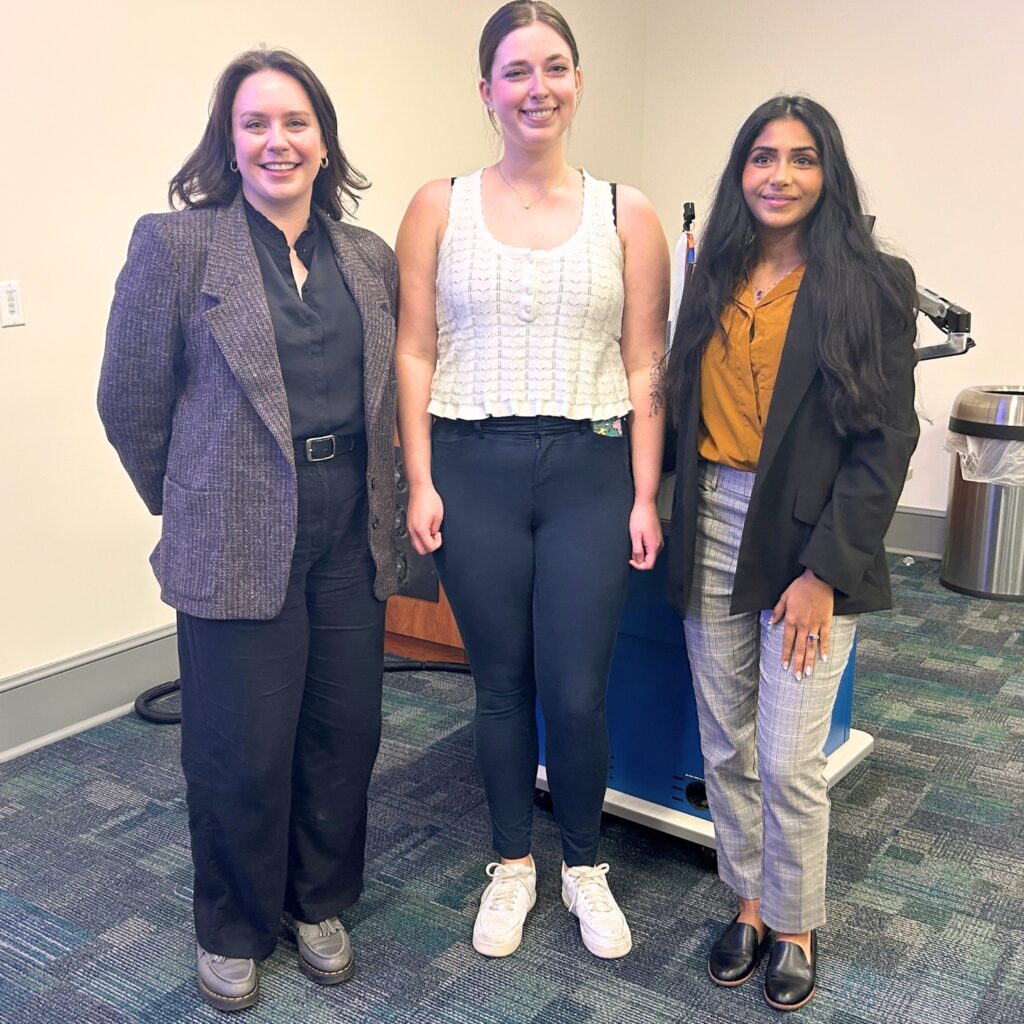
- Kylie Wright won first place and $800 for her aging research on proactive chronic pain treatment at a UF student competition.
- Tyler Busch earned second place and $400 for studying brain training to support long-term independence in older adults.
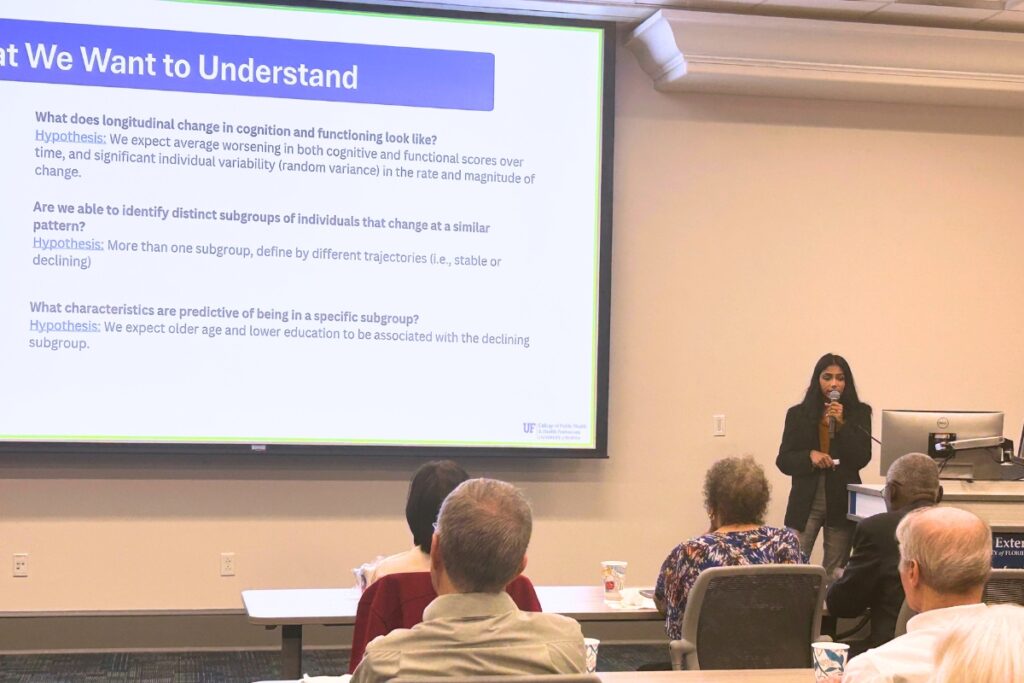
- Batul Yawer placed third with $200 for research on clinical dementia, identifying participants who improved over time.
Chronic pain, the bane of so many older adults, caught the attention of post-doctoral student Kylie Wright as she dug into her research on aging.
That work got Wright top honors in a student competition on aging studies sponsored by Oak Hammock’s Institute for Learning in Retirement (ILR), the University of Florida, and the Retired Faculty of the University of Florida (RFUF).
“It’s such a surreal feeling,” Wright said after learning she had taken first place and nabbed $800 in prize money. “This is an offshoot project from my dissertation. And to see it grow to fruition and find that people are really interested in it. That’s so great.”
Wright will continue at UF as a post-doc researcher. She was one of three students invited to give oral presentations to RFUF after an initial competition in which 53 undergraduate, graduate, and post-doctoral researchers submitted their abstracts on aging.
Seventeen were selected to give poster presentations at an earlier ILR meeting. Three, including Wright, were chosen to give brief talks on their research at a meeting of RFUF on Wednesday at the Straughn IFAS Extension Professional Development Center in Gainesville.
Graduate student Tyler Busch took second place for her studies on long-term independence, winning $400 from RFUF, and doctoral student Batul Yawer’s look at clinical dementia netted her third place and $200.
The project began in 2004 when ILR first got started at Oak Hammock because the original residents wanted to foster and support aging research.
“They contacted the university and recruited students through the Institute on Aging at UF,” said Henri Logan, chair of the ILR board. “It has continued since that time with the ILR as the primary support to solicit the best aging research.”
RFUF president Pushpa Kalra said the participation in the competition was a positive thing for everyone — students, ILR and RFUF.
“The graduate students get to talk to the faculty. Faculty gets to hear from the students,” Kalra said. “It’s also a collaboration of retired faculty with the university.”
When Wright spoke about her pain research, she asked why this matters for the “millions of older adults who already live with chronic pain and the potential millions of older adults who will develop it, over the next couple of years.” Her research looks at ways to be more proactive about treating pain, rather than reactive.
The research of second-place finisher Busch looks at “brain training” and how to make it “carry over into everyday life.” She noted that “what we really care about is staying independent.”
Third-place finisher Yawer noted that “decline in cognition and function is not the same for everyone.” Her studies found a group of participants who started with mild dementia and got better over time. “So of course that’s the group we want to focus on,” she said. “That’s the interesting group that we didn’t expect.”
Kalra said the ILR collaboration with the retired faculty organization began just a few years ago, “and it is something we hope to continue.”
If it’s any indication of future interest, RFUF members packed the room for the finalists’ presentation.