




- The University of Florida approved a 15% fee increase for new out-of-state students starting this fall, with a 10% waiver for current non-resident students.
- UF's Board of Trustees also approved a $1.45 billion renovation of Ben Hill Griffin Stadium, aiming to complete it before the 2030 football season.
During a meeting on Thursday, the University of Florida Board of Trustees approved a 15% increase in fees for new out-of-state students, with current non-resident students getting a 10% waiver for the remainder of their academic years at the university.
The increase will take effect in the fall and comes after the Board of Trustees approved a 10% hike in non-resident student fees in July 2025. This was the first time UF had increased out-of-state fees in more than a decade.
That decision came on the heels of a vote by the Florida Board of Governors to allow all universities to increase out-of-state student fees by 10% in the fall of 2025 and 15% in the fall of 2026.
In a May public notice, UF said it was looking to raise non-resident student fees “to address rising operational costs and to ensure all students make an equitable contribution toward the world-class educational experience and services expected of Florida’s flagship institution.”
The out-of-state student fee increase for this fall was included in the consent agenda for the full Board of Trustees meeting, where the trustees also selected Dr. Stuart Bell as the university’s president-elect. UF’s Committee on Governance, Government Relations and Internal Affairs unanimously approved and recommended the out-of-state fee increase earlier in the day.
Chair Mori Hosseini pulled the item from the consent agenda for discussion.
Hosseini asked Mary Parker, UF’s vice president of Enrollment Management, if she had a plan to help out-of-state students in need.
Parker said the university planned to utilize a hardship waiver that the board approved with last year’s increase in non-resident student fees. This allowed returning out-of-state students who demonstrated significant financial hardship due to the tuition hike to receive a one-year waiver.
Parker said they received roughly 200 applications last year, with 2% of those being approved.
“[We] wanted to make sure that there was truly just [a financial] hardship,” she said.
Hosseini recommended doing just a 5% increase this fall for the out-of-state students already at UF and keeping the 15% increase for new non-resident students.
Joe Glover, UF’s interim provost and executive vice president for academic affairs, said there are two methods to execute this: different tuition rates or to give waivers to the out-of-state students who currently attend the university.
After a little more discussion, the board ultimately voted to approve the 15% increase for the new out-of-state students and a 10% waiver for current non-resident students.
Despite the hike in fees, UF said in the notice that the cost of attendance at the university “will remain among the lowest in the country for out-of-state students.”
UF also said the added revenue generated from the increases in fees will be used to cover rising costs of instruction and other operational expenses acquired by the university in pursuit of its academic mission.
Also, during its full meeting, the Board of Trustees unanimously approved several action items from its Committee on Facilities and Capital Investments, including one related to the renovation of Ben Hill Griffin Stadium, also known as “The Swamp.”
The board’s vote allows contract negotiations to move forward with Manhattan Construction and AECOM, with Legends Global serving as owners’ representative, for the renovation of the stadium.
UF released renderings and a promotional video on Thursday morning for the stadium renovation, which will cost more than a billion dollars.
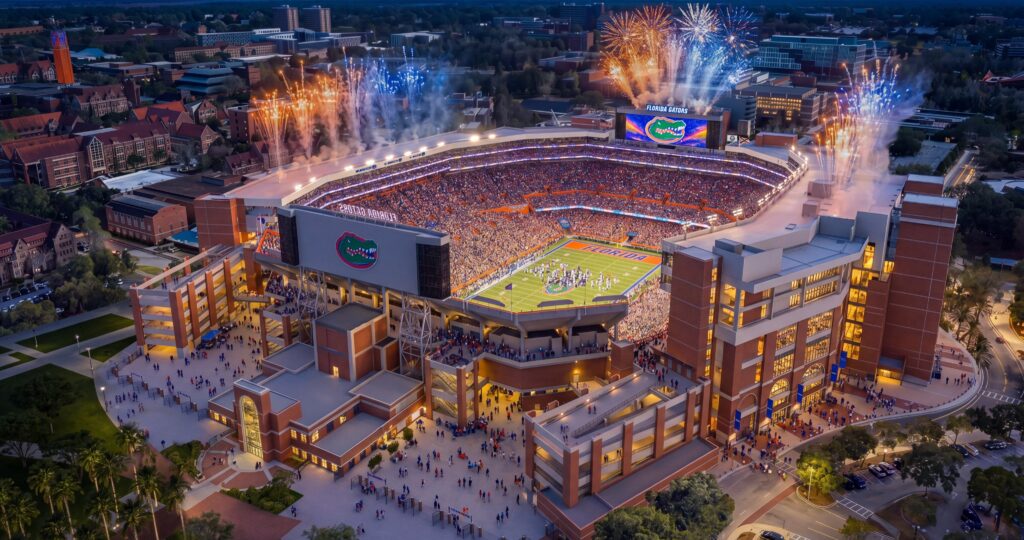
“This $1.45 billion project will breathe new life into one of the nation’s most iconic college football venues and elevate it into the premier collegiate athletic destination that sets the standard for everyone else,” Hosseini said in a statement.
While speaking during the Facilities and Capital Investments Committee meeting, Florida athletic director Scott Stricklin said the project will be funded “through a combination of private donations and long-term debt.”
According to the project’s website, theswamprenovation.com, “The renovation will modernize the game-day experience with improved entrances, wider concourses, easier seat access, upgraded food and beverage options, expanded concession offerings, faster service, enhanced connectivity and additional seating choices.”
Stricklin said they also plan to maintain the stadium’s overall capacity of 88,548.
“The objective with this project is straightforward: preserve everything that makes The Swamp special, while modernizing the facility to meet the expectations of today’s fans, student-athletes, recruits and alumni,” he said.
Stricklin said the current project timeline has construction on the stadium beginning after the 2026 football season. He added that the plan is to finish the renovation and “fully reopen” the stadium before the start of the 2030 football season.
Nick Anschultz is a Report for America corps member and writes about education for Mainstreet Daily News. This position is supported by local donations through the Community Catalyst for Local Journalism Fund at the Community Foundation of North Central Florida.
Suggested Articles
No related articles found.
Since the purpose of a university is education lets look at what this stadium money could build when it comes to the educational needs of Florida’s young people.
I am using an elementary school cost model from RSMeans Data
The $1.45 billion price tag for the stadium would provide for:
$15 million per school: Yields 96 schools (common for smaller capacities or rural regions).
$25 million per school: Yields 58 schools (the national average for a standard, state-of-the-art public facility).
$30 million per school: Yields 48 schools (expected for large metro regions, urban areas, or high-capacity campuses).
Hey that’s awesome. Does that mean UF can finally start paying some property taxes????