



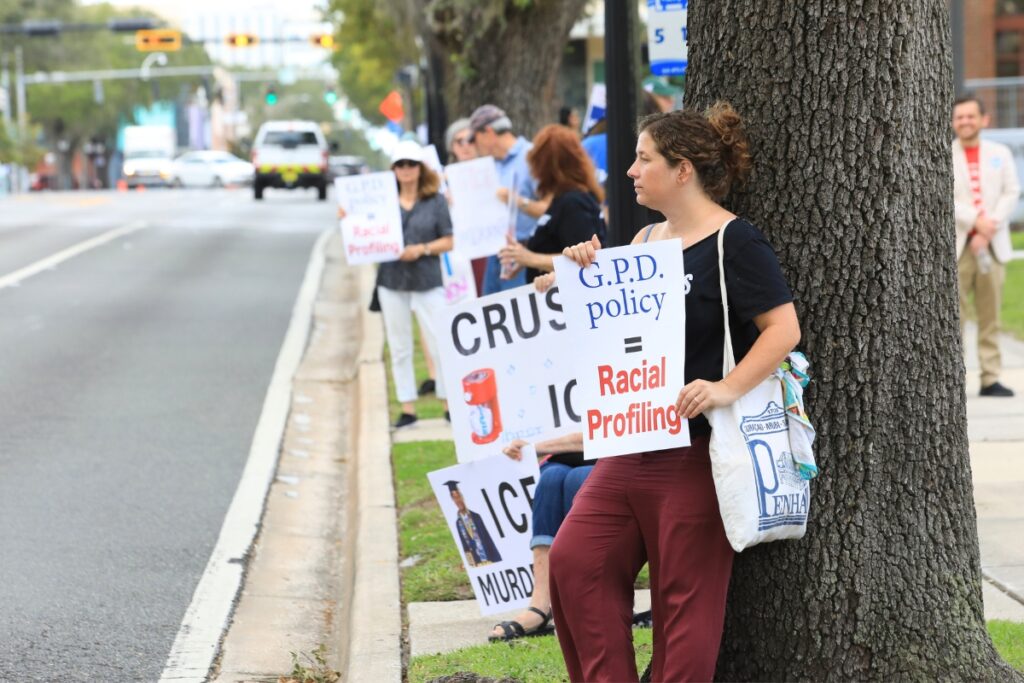
- The Gainesville Police Department implemented a policy on Aug. 27 requiring officers to report encounters with suspected undocumented immigrants to comply with Florida law.
- Community groups and residents protested, arguing the policy exceeds legal requirements and may deter victims and witnesses from contacting police.
- GPD avoids a 287(G) agreement to limit immigration duties while emphasizing the policy's intent to prevent profiling and maintain public safety.
The Gainesville Police Department (GPD) adopted a new policy that requires officers to fill out a form if they encounter someone suspected of being in the United States illegally.
GPD said the policy will change nothing practically about how officers respond to incidents, interact with residents or what questions they ask. But residents and the Gainesville Immigrant Neighborhood Inclusion initiative (GINI) voiced concerns at Thursday’s City Commission meeting after protesting in front of City Hall, coming after another protest in front of GPD two weeks ago.
GPD Spokesperson Art Forgey said the policy was adopted to comply with Florida law following a letter from the state.
Forgey said the state reached out in July and asked why GPD had not submitted any contacts with illegal aliens even though the police department had arrested individuals and booked them into the Alachua County Jail, where background checks then showed them to be in the country without authorization.
To comply with Florida’s State Immigration Enforcement Council, Forgey said GPD began crafting a policy to report the contacts. He said the department met with community leaders, including GINI, while working on the policy.
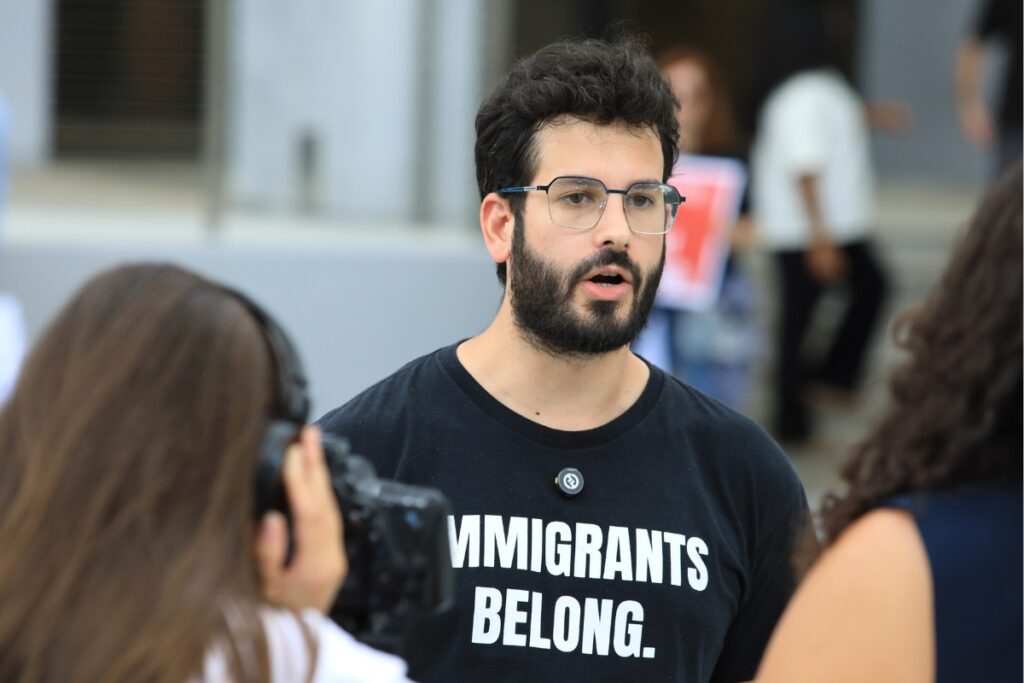
Ethan Maia de Needell, immigrant programs manager with the Rural Women’s Health Project and a part of GINI, said at the protest that the policy will impact more than immigrants.
“This policy from GPD is not required by the state, despite what GPD is claiming, and will put victims, witnesses, and anyone they’re not even arresting at risk, which will then destroy public trust and make our community as a whole less safe, regardless of whether or not you’re an immigrant,” Maia de Needell said.
While one report noted that the Ocala Police Department and Lake City Police Department lack a similar immigration policy, Forgey said those departments have signed a 287(G) with U.S. Immigration and Customs Enforcement (ICE), which includes the same reporting policies.
The Alachua County Sheriff’s Office and University of Florida Police Department have also signed these agreements, which allow ICE to come in and train certain offices to do immigration work.
Forgey said GPD wants to avoid signing a 287(G) because it feels like the department would be voluntarily taking on more immigration duties. But he said the department recognizes it must follow the state reporting policy.
“We don’t feel like we should be in the business of immigration when that’s a federal level duty,” Forgey said.
In press releases from GINI, Tess Hellgren, supervising attorney at the National Immigration Project, said Florida statutes don’t require reporting of suspected illegal immigrants anywhere near what GPD’s policy outlines.
“GPD keeps pointing to state law, but the statute they cite says nothing close to what this order demands,” Hellgren said. “Asking officers to report anyone they suspect is undocumented, even victims and witnesses, opens the door to racial profiling and stops that go further than the Constitution allows.”
Interim City Manager Andrew Persons addressed the issue after a lengthy public comment section at the meeting.
He said the statute requires reporting, but leaves implementation to the State Immigration Enforcement Council. The Florida Administrative Code spells out what must be reported, he said.
Forgey said GPD decided to create a policy so that officers across the department know the expectations.
GPD Maj. Jamie Kurnick said only two reports have been filed since the policy took effect on Aug. 27. One was from a traffic stop and the other from a traffic crash. She said GPD is not actively seeking to find immigration statutes.
Kurnick created the policy. She said the point was to prevent any kind of misuse of the department standards (i.e., profiling based on English proficiency, a foreign last name or skin color).
“Our purpose is to serve everyone in the community and be that conduit for justice for people who are victims of crime and to take all crimes very seriously,” Kurnick said.
At the protest, Maia de Needell said the policy goes beyond the state statute cited.
“If it’s not legislated or if it’s not required by law, then I think GPD and our city leaders should lead and cooperate minimally with ICE and immigration enforcement,” Maia de Needell said.
He said a 287(G) would be better and less restrictive—the opposite of what Forgey and GPD believe. Under a 287(G), Maia de Needell said only a few officers or deputies are doing the work, versus a policy that spreads the weight of immigration enforcement on the whole department.
Over the summer and before the GPD policy, GINI conducted a survey of 87 immigrant residents of varying legal status. According to the survey, 28% of respondents said they feel comfortable calling the police for help. The same survey also produced only 19% agreement with the statement: I feel safe when I see law enforcement.
Maia de Needell said the numbers have likely decreased with the policy.
He said GPD has been a leader on immigrant issues since he worked with GINI. The two collaborated on improving language access between law enforcement and the department after a 2018 miscommunication with a Guatemalan woman.
The protesters lack that sense now. Maia de Needell said he couldn’t say whether GPD had seemed to shift based on pressure from higher authorities (state or federal mandates) or from an internal change.
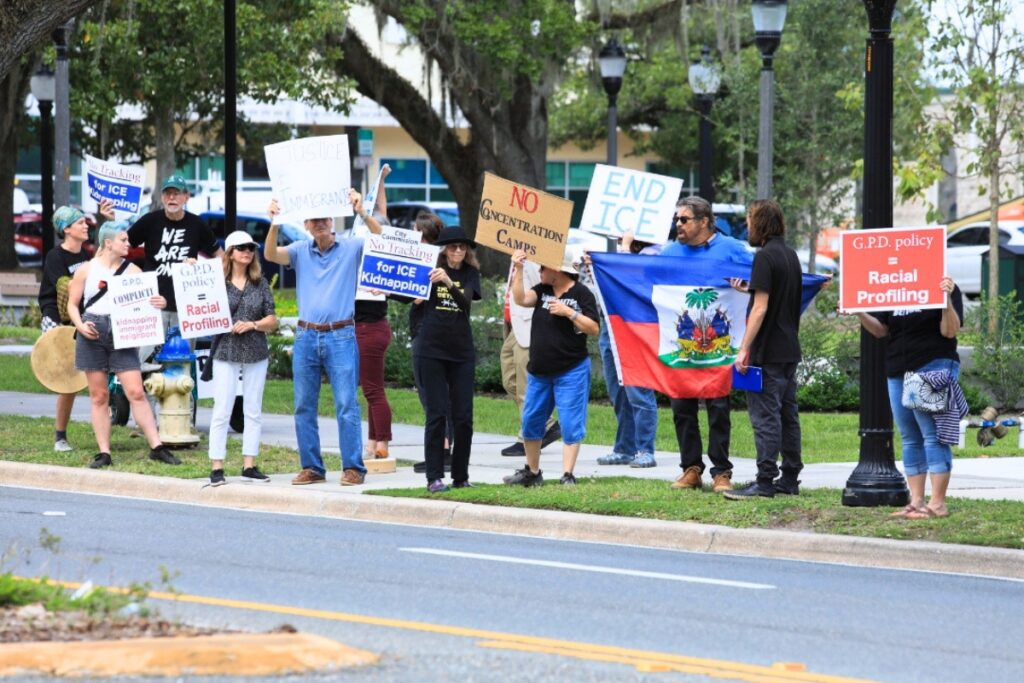
Protesters held signs that addressed the GPD issue directly, calling for an end to the “show me your papers” and “racial profiling” policy.
The protest signs also strayed into immigration territory outside GPD’s control. In front of GPD headquarters, protesters held a large “Stop ICE Terror” banner, a “Full and equal rights for all immigrants” sign from the Party for Socialism and Liberation, and a “Jail all killer ICE agents” poster.
Forgey said the policy won’t change how officers do their job but admitted it might make certain residents scared to reach out to the department. He said part of that is a misunderstanding of the policy and a local amplification of that fear.
He said he believes the vocal opponents to the policy aren’t doing their homework, especially with the reporting already being done by 287(G) agencies—more than 300 across Florida.
“I think they see this policy and for face value, all of a sudden, it’s ‘oh my gosh, GPD is now in the deportation business’ and ‘they’re working hand in hand with ICE’ and ‘the city’s falling apart.’ And it’s just simply not like that.”