


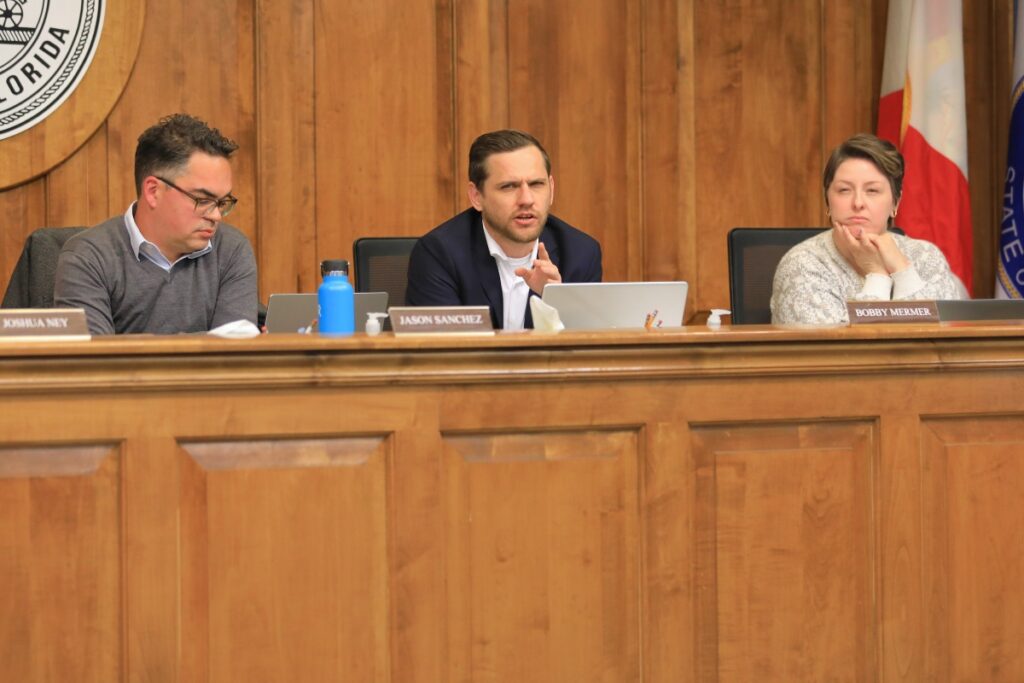
Gainesville’s City Plan Board dealt with several “oopsies” from 9 years ago and 105 years at last week’s meeting while also hearing a timeline on a new City Commission priority dealing with historic buffers.
When building a multiuse trail along SW 6th Street, the city of Gainesville built on private property. The property was bought shortly afterward by John Fleming and Heritage Investment Group of Gainesville. Fleming also serves as managing partner of Trimark Properties.
Back then, Fleming went to the City Plan Board to initiate a land swamp to settle the issue, but the agreement never went forward. Gerry Dedenbach, executive vice president with NV5 and the agent for Fleming, said last week that the property owner has restarted the negotiation to trade the piece of land that Gainesville developed for an adjoining sliver of land that borders another property owned by Heritage Investment Group of Gainesville.
Residents showed up and expressed their concerns. The sliver of land given to Fleming might give just enough acreage for a development project they don’t want. In 2017, when the parties tried to resolve the issue, the future development in mind was a three-story parking garage, Fleming told the City Plan Board.
He said that deal was a little different and included another strip of land to the north. That land is zoned commercial and would be a completely difference project—though Fleming said he had no immediate project in mind. The property considered last week is zoned residential, and Fleming said he might be able to fit two apartments on it that fit with the character of the Porters neighborhood.
One public commenter said the city should keep the land and refuse the land swap in order to be able to lean on the developer later to get a better project. That leverage would be lost once the swap occurs.
But Dedenbach said if the city doesn’t agree to a one-on-one agreement, the next stop would likely be the courts.
Assistant City Attorney Sean McDermott advised the plan board that this type of issue is fairly common. Neighbors accidentally place fences or boundary lines that cross onto the next property, and those disputes must find a resolution both parties agree to or that a court arbitrates.
“So, the risk is money, really,” Chair Jason Sanchez said. “I mean, if we don’t accept a free gift, we’re going to pay for it, essentially.”
The board voted 5-1 to recommend that the City Commission approve the land deal. Board member Jamie Bell voted in dissent.
After the vote, Board member Bobby Mermer spoke to the possibility of lawsuits mentioned by the applicant.
“I would really appreciate it if the threats would stop and just talk to one other more civilly,” Mermer said. “That includes the applicants and talking to the community and being a little bit more proactive than is required by law with community engagement.”
According to the presentation, the applicant posted notices about the upcoming meeting and held a neighborhood workshop as required. The workshop garnered four attendees—one of which was Fleming.
Board member Robert Ackerman responded to Mermer. He said the board hadn’t been threatened; it had been presented with all the options in order to make an informed decision.
“It’s a clear possibility, and in fact, it’s a right. If we, in fact, turn this down, Mr. Fleming would have every right to sue us,” Ackerman said. “That’s not a threat. We shouldn’t treat it as a threat. We should treat it as full information of what we’re facing.”
The second correction before the plan board was a 10-foot strip of land that was offered to the city of Gainesville in 1905. But according to documents, the land was never accepted, but utilities were placed underneath. Now, as a new planned development gets ready to break ground, planners found that the 10-foot strip, with underlying utilities, is also encroached upon by an adjacent parking lot.
The issue is just north of UF’s Library West where a 14-story apartment complex received approval in a split vote in 2025. But the plan board quickly approved the staff recommendation with a slight change that allows the developer to continue with construction and reinstall any underground utilities and easements during construction—preferably a few feet west and in the established right-of-way.
“It’s really like ‘oopsie’ is kind of the theme of tonight’s meeting,” Sanchez said.

Lastly, the board discussed amending the University Heights Historic District – North. The City Commission tasked staff to look into the historic district buffers and how they’re impacting development on the north side of University Avenue.
On the south side of University Avenue and east of SW 13th Street, multi-story apartment complexes have been built in the last few years. On the north side, practically no new development and nothing to that scale.
Ackerman said it’s because the historic buffer zone extends closer to University Avenue, not giving enough room for multi-story development.
Dedenbach said the historic buffers have been analyzed by a lot of developers, but nothing has been able to fit.
“Those district lines, and I have looked at every linear foot of the boundary lines, are kind of willy nilly, and they have precluded some really cool projects,” Dedenbach said.

Forrest Eddleton, director of sustainable development, said the historic buffer review is the highest priority for staff because the charge came from the City Commission with city manager support. Staff will research the issue, present to the City Commission and then work through the plan board on a proposal that would return to commissioners for approval.
“We’re not looking at some of the other historic areas, s I think they wanted to be very targeted with this,” Sanchez said. “So that’s sort of the intention with the updated language here.”
The updated language would make both sides of University Avenue more even.
The University Heights Historic District – South runs north to south, bordering only a few properties on University Avenue. The north district runs west to east along University Avenue for several blocks, with more intersecting properties that actually front the state road.
