



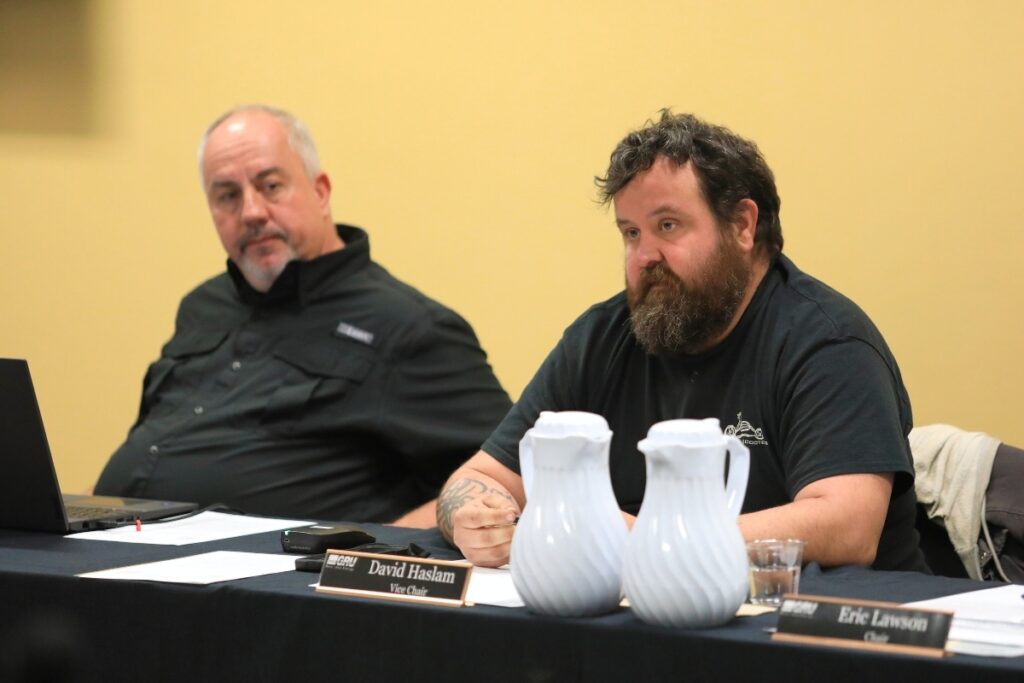
- The GRU Authority voted to change its public comment policy to move general comments to the end of meetings and require signup by attendees.
- Directors believe moving public comment to the end helps attendees hear staff presentations and reduces misinformation during comments.
- Some public commenters oppose the change, citing concerns about accommodating varied concerns and attendees needing to leave early for family commitments.
The Gainesville Regional Utilities (GRU) Authority voted to amend its public comment policy on Wednesday, with an aim to finalize the changes in March.
Public meetings vary from board to board on how public comment is conducted, and GRU attorney Derek Perry walked the authority directors through different options used by cities, counties and other entities in Florida.
The GRU Authority settled on having attendees sign up to give public comment (the same system used by the Gainesville City Commission) and moving general public comment to the end of the meeting instead of the beginning.
The Gainesville City Commission went through several public comment changes in 2022, and boards are able to amend their policies at will.
The authority directors also considered moving the time per public comment to two minutes but decided to keep the current three-minute standard. But the authority’s current rules allow the chair to lower the public comment time if there’s a packed meeting.
Director David Haslam and Jack Jacobs said moving general public comment to the end of the meeting could allow the attendees to see staff presentations and have questions answered. Regular public comment on every motion made by the board would still happen during the meeting and before votes on those items.
As Haslam has said at many past meetings, many attendees will show up and speak during the general public comment before quickly leaving and not, at least in person, hear what staff says and how the directors reply.
“If they would stay here in the meeting, they would have probably heard some of the things that they’re saying just are ridiculous or misinformed, possibly,” Haslam said.
Many of the public commenters’ questions and statements are based on misinformation or incomplete information, according to Jacobs. He said staff or directors will address the comments and then the same issue gets brought back up.
He added that, right now, most of the public comments when a lot of people show up centers not on utility issues, but the fight over who manages GRU, the authority board or the City Commission.
“Once the lawsuit gets settled, I’ll be curious to see exactly how many people actually still come,” Jacobs said. “Because right now, the majority just want to fire us and get our resignations.”
Director Chip Skinner said moving public comment to the end could be beneficial to people watching the meetings at home who want to hear the discussion and decision items but have to listen through half an hour or more of public comment first.
The GRU Authority can get right to business, inform people and then take public comment at the end before each director gives their comments to close the meeting.
“We can always change this back if it’s not working,” Skinner said.
Speaking to the item, three public commenters opposed the changes.
Chuck Ross said the authority should keep public comment at the start of the meeting to accommodate the public. He said people come to speak about more than just specific agenda items.
“People come here to speak about their concerns, and some people want to go home with their family and that’s just the way it is,” Ross said. “It’s not always just to walk out on this board.”
Ross said there needs to be more public comment, especially when people want to touch on a range of issues. He said public commenters should have a way to also talk about topics that the GRU Authority discusses but doesn’t make motions on. He said those topics often show up on the consent agenda and, if approved, leave to availability for comment.
Ross also directed comments to Haslam concerning the back-and-forths the two had had earlier in the meeting. He said Haslam hadn’t followed procedure when he directly called out audience members in the crowd.
Haslam responded afterward.
“Mr. Ross, your borderline arrogant, uninformed attitude all the time. We can talk afterwards, if you like, we’ll have a police officer there if you like, too.”
He said the public commenters’ attitude and actions while sitting in the crowd were getting unacceptable.
Nancy Deren also spoke about the item. She said public comment often brings a matter to a board’s attention and can bring solutions to issues. She agreed with Ross about attendees needing to be home with family as well.
“Working people, families with children and retirees can’t sit for what can be several hours of a meeting or stay late into the night just so they can make a public comment,” Deren said.
Perry will bring forward the requested changes at the GRU Authority’s March meeting.
Editor’s note: This story was updated to clarify that normal public comment on motion will still take place during the meeting and before a vote on that item.
Suggested Articles
No related articles found.
The obvious reason that are pushing back public comment is because they don’t like being criticized. Poor guys, they just wanna steal our utility, give out lush paychecks to their friends, and give our energy plants to FPnL in peace without any mean words being said about it. What a joke.
Right!
Great idea! I have seen those with negative comments have their three minutes talk and then leave shortly afterwards without hearing the staff reports.
If their concern that audience members are not staying around to hear the directors’ and CEO’s comments at the end of the meeting, they can simply move that item to occur immediately after public comment.
In other words:
Public Comment
Directors Comments
CEO Comments
(then, other business on the agenda)
If anyone wishes to stay for the staff presentations, they should be allowed to comment during directors’ deliberations on each of those particular agenda items.
Alas, there is little expectation that the authority will adjust their agenda to serve the interests of the public. They not only defied the public’s voices in 2024 and 2025 when we voted resoundingly to abolish the authority, but sued the city to prevent implementation of the legal outcome of the referendum.
Finally, for Haslam to call a citizen, Mr. Ross, “arrogant” is rude and unbecoming of anyone in public service.
At the December and January meetings a large group of customers attended to show thier support for the approx. 10 people that spoke and asked the Board to drop the lawsuits and resign based on the results of the 2025 election where approx 75% of the vote was Yes to remove the board that would result in the return of the Utility back to local governance. This was on the back of the 70% result of the 2024 referendum. The audience was respectful and the meeting was not burdened by the speakers as there is an existing 30 minute time limit for public comment (PC). This action was unnecessary and they should maintain the status quo for the reasons stated in the article.
In my opinion, the GRUA has responded by moving PC to the end of the meeting to discourage a large turnout, and punish those that choose to speak out against the board.
This is ridiculous. People want to make comments BEFORE the Board makes their decsions. What good does it do to comment AFTER the decisions a re made. Also punishes people who can’t sit through a 2 hour meeting just to make a comment.
Who keeps overriding and changing the comment vote count on these GRU articles?
The reason I decided to move general public comment to the end of the meeting is simple. Many of the topics that are brought up during public comment are addressed during the course of the meeting, and questions are often answered without needing to be asked separately.
This change does not affect business discussion comments or the allotted time for those comments in any way.
Public comments often cover repeated topics, unrelated matters, or questions that are addressed later in the agenda. If individuals stay and listen to the full meeting rather than leaving early, they may find that their concerns are addressed and may even develop more informed questions.
As volunteers, we have worked hard for GRU and for the community, and we hope to accomplish even more moving forward.
Spare us, David. You are the least qualified member of the Board (a pretty low bar) and yet spend the greatest amount of time of anyone berating the audience members. Could there be a connection there?!?
If you spent 1/10th as much time asking hard questions of Ed B during your GRUA meetings as you do insulting audience members (but always after you pray for us, of course!) or trolling around online, there might be a bit less public angst.
But please don’t pretend that it’s just an issue of people not sticking around to hear what you have to say. And definitely don’t come here looking for any sort of kudos for your important “volunteer” work. The people of this community have spoken repeatedly and agree overwhelmingly that we’d prefer to see your volunteer efforts spent elsewhere.
I understand that not everyone will agree with my approach or my perspective, and I respect your right to voice your concerns.
Serving on this Board is something I take seriously. I prepare, I ask questions, and I make decisions based on what I believe is in the best interest of the entire community — even when those decisions are unpopular with some.
I do not berate members of the public, nor is that my intention. I do, however, speak directly and candidly. There is a difference. Public service sometimes requires difficult conversations, and I won’t avoid those simply because they may be uncomfortable.
As for my volunteer role, I neither seek praise nor expect universal approval. Disagreement is part of public life. But I will continue to show up, do the work, ask questions when needed, and represent the constituents who elected me to serve.
If you or anyone else would like to discuss specific concerns about my conduct or decisions, I am always open to a respectful conversation.
“I prepare. I ask questions.”
-As I’ve mentioned before, David, I’ve watched every single one of your meetings and have receipts to prove it. I can count on one hand the number of times I’ve heard you ask questions of any substance. I and other members of the public don’t have any idea of what’s going on with you and Ed behind closed doors. But that’s kind of the point that you just don’t seem to get.
“There is a difference.”
-Right, I totally get it. If you’re saying it, it’s speaking ‘directly and candidly.’ If a member of the public says it, they’re being rude and disrespectful. Hence why you decided to make it harder for us rude and disrespectful people to address you.
“represent the constituents who elected me to serve.”
-Are you freaking kidding me?!? Did you really just say that? Who, sir, are these constituents who elected you exactly?!? Are you truly that out of touch with reality?!?
Jason,
I respect your engagement and your right to disagree.
When I say I prepare and ask questions, much of that work happens before meetings — reviewing materials, speaking with staff, and addressing issues in advance so meetings run efficiently. Not every question is asked publicly, but that does not mean the work isn’t being done. Any discussions I have are conducted within legal requirements.
Being direct and candid is not the same as being disrespectful. I welcome disagreement, but civility matters on all sides.
I represent the entire community — including those who disagree with me. That responsibility requires making decisions based on what I believe serves the broader interest, not individual approval.
If you’d like to discuss specific concerns, I’m open to doing so constructively.
— David
I understand that not everyone will agree with my approach or my perspective, and I respect your right to voice your concerns.
Serving on this Board is something I take seriously. I prepare, I ask questions, and I make decisions based on what I believe is in the best interest of the entire community — even when those decisions are unpopular with some.
I do not berate members of the public, nor is that my intention. I do, however, speak directly and candidly. There is a difference. Public service sometimes requires difficult conversations, and I won’t avoid those simply because they may be uncomfortable.
As for my volunteer role, I neither seek praise nor expect universal approval. Disagreement is part of public life. But I will continue to show up, do the work, ask questions when needed, and represent the constituents who elected me to serve.
If you or anyone else would like to discuss specific concerns about my conduct or decisions, I am always open to a respectful conversation.
General public comment is to speak about items NOT on the agenda, so to have people wait until the end of the meeting does nothing to address statements that people need to stay around to listen to the agenda items. You cannot speak to agenda items during general public comment. I have seen many times at meetings over the years, where general public comment brought an issue to the attention of the meeting, that raised questions or important situations that then staff were asked to address.
Putting general public comment at the end omits any opportunity for the board to address or ask questions about items brought up, that could be relevant to their own discussion and to the meeting. The meeting is over.
For example, I asked 2 questions at the last meeting’s public comment, asking for a report on the cost of fuel, especially natural gas, and how GRU protected reliability during this recent freeze, that led to one board member asking for that information, and about what was the status of the budget process and schedule for presentations, that led to the Director of Finance being called up to provide that information.
If public comment had been at the end, nothing would have come of either question. Public comment at the end of the meeting is about silencing and discouraging public questions and insulating the board in their own bubble.