



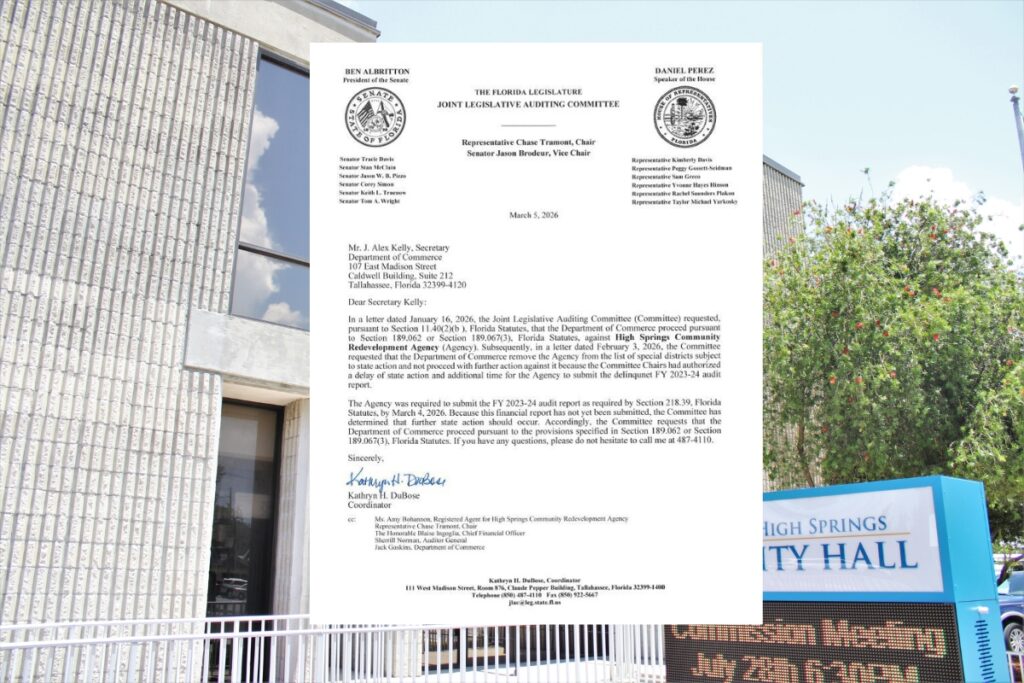
- The state is withholding funds from High Springs CRA and may sue if the missing 2023–24 audit is not submitted by May 4.
- High Springs CRA was established in 1986 to revitalize a district and is funded through local and state tax increments.
- High Springs faces budget deficits, and the audit issue was highlighted at a city meeting with the next steps on the agenda for April 23.
Several state agencies are taking action against the city of High Springs’ Community Redevelopment Agency (CRA) over its missing 2023–24 audit, including withholding funds and issuing a notice of potential legal action if the audit is not submitted.
High Springs established its CRA in 1986, aiming to economically revitalize a specific district for the overall health of the rest of the community. The CRA is funded locally and by the state through a tax increment system that collects tax revenues from increased value in the district.
On April 5, the Florida Department of Revenue (FDR) started withholding Revenue Sharing and Half Cent Sales Tax distribution funds from the CRA at the direction of the state’s Joint Legislative Auditing Committee (JLAC), according to emails from FDR a few days earlier.
FDR Tax law specialist Fili Arsa said in the email about Revenue Sharing funds that the notice aimed to help High Springs achieve compliance before the monthly funds are distributed around the 15th. She said the funds are withheld for each month the CRA fails to comply.
FDR Tax Administrator Carmen Parada said in an email that Half Cent Sales Tax funds typically distributed by the 25th of the month will be revoked for each non-compliant month.
“We strongly encourage you to address the compliance issue as soon as possible to avoid any forfeiture of funds,” Parada said.
A few days later, Florida Department of Commerce (DOC) attorney Ashanti Breeden emailed High Springs CRA Manager Amy Bohannon that JLAC had directed her department to file a petition for enforcement against the CRA if the city didn’t submit the audit by May 4.
Breeden asked if the CRA had an attorney and, if not, asked it to provide an update on the audit status. Bohannon forwarded the email to High Springs City Manager Jeremy Marshall and City Clerk Angela Stone.
The state made High Springs aware of the tardy audit months before acting.
In January, JLAC called on the DOC to execute consequences against the CRA, according to a letter from JLAC Coordinator Kathryn DuBose to DOC Secretary Alex Kelly.
One month later, DuBose said her organization removed High Springs from its list of districts designated for special action because it’d been granted a delay until March 4 to submit the audit. Still, no audit came.
“Because this financial report has not been submitted, [JLAC] has determined that further state action should occur,” DuBose wrote Kelly on March 5.
DuBose also sent a letter to Department of Financial Services Chief Financial Officer Blaise Ingoglia and Department of Revenue Executive Director Jim Zingale, directing them to withhold any High Springs funds not pledged for bond debt service until the missing financials were secured.
The CRA and audit issues surfaced from a few citizens during High Springs’ regular City Commission meeting on Thursday.
Former Commissioner Sue Weller called a missing audit unacceptable and detailed a list of public records tracing the state’s recent actions toward the CRA.
“That’s alarming,” Commissioner Tristan Grunder said after hearing the list.
Because the city already faces deficits, Weller said the city needed to get whatever people it could to finish the job. Almost $900,000 in emergency reserves covered a surprise bill in November 2025 and last month, the commission said it would hold a workshop to consider eliminating its fire and police departments and address budget gaps.
“I understand we don’t have a finance director. I understand there’s been problems. But you all are facing budgetary problems and now you’re looking at money being withheld from the budget, from the city, from the citizens,” Weller said.
Local business owner John Millett also spoke on Thursday, saying the issue is no longer minor and impacts all who invest in High Springs. He asked three questions be answered by the next commission meeting.
“The last time I raised this, there was no response. Silence is not a response to a compliance issue,” he said. “What is the current status of the CRA reporting, who is responsible for bringing it into compliance and what is the timeline to fix it?”
Millett told Mainstreet that speaking out about the CRA has negatively impacted his business, Serendipity Soda & Sweets.
After he first raised the issue at a commission meeting, Millett also addressed the commission in a February Facebook post. He wrote that he and his family invest in the community because they believe in it, but that multiple city projects had stalled and shouldn’t have over the past year, including CRA reporting.
Millett said he deleted his post because of attacks against his business, including multiple negative Google reviews from fake users.
On Thursday, Vice Mayor Wayne Bloodsworth Jr. said he’d spoken with the auditor, who told him the 2023-24 audit would be completed this month. Grunder assigned the CRA reporting and the state’s recent actions as an item on the April 23 meeting agenda.
Editor’s note: This story was underwritten by a grant from the Rural Reporting Initiative at the Community Foundation of North Central Florida.
Suggested Articles
No related articles found.