



- The Gainesville City Commission voted to collect garbage and stormwater fees through annual property taxes, ending monthly utility billing for these services.
- The Commission approved plans to eliminate roam towing and immobilizations, requiring businesses to request vehicle removals directly from towing companies.
- The change in garbage fee collection may increase rates for all residents and shift payment responsibilities from tenants to landlords, impacting apartment lease negotiations.
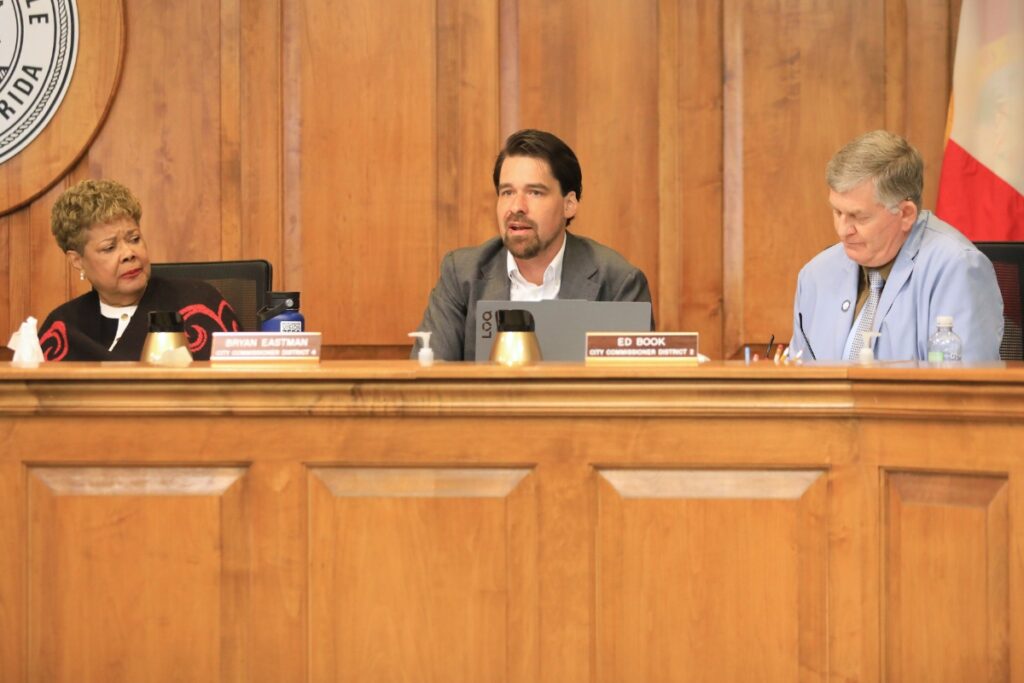
The Gainesville City Commission voted on two sweeping changes to how city government, and the city at large, operates by continuing with its plan to eliminate roam towing and voting to collect garbage and stormwater fees through annual property taxes instead of monthly payments on the utility bill on Thursday.
Garbage and stormwater payments
The vote on garbage and stormwater collection came after the Gainesville Regional Utilities (GRU) Authority failed to approve a new contract earlier in May. The decision came after two of the authority directors wanted to enter the new contract, while the other two said the utility should stop collecting the payments.
The five-member board has operated with only four directors since a resignation in June 2025. It’s up to Gov. Ron DeSantis to appoint a new member, and he’s also expected to consider a bill that would cement the GRU Authority’s position as head of the utility—a change from the City Commission control that happened until October 2023.
The gridlocked GRU Authority means the contract with the city to collect those stormwater and garbage fees will end, but city commissioners directed Mayor Harvey Ward to send a letter to the authority and ask it to convene a special meeting to reconsider.
Commissioner Bryan Eastman made the motion for the letter, at Ward’s suggestion, and Eastman said it should also include impacts from the billing changes and a timeline for when the city needs a decision.
Eastman said he agreed with GRU’s staff, who called the new contract a win-win, allowing the utility to earn more revenue from providing the service while also saving the city of Gainesville an estimated $1.4 million in switching costs to the property tax, a service performed by the Alachua County tax collector.
“This is going to mean rate increases across the board for everyone—tenants, landlords, everyone,” Eastman said.
Commissioners said the $1.4 million in lost revenue from switching systems would need to be recovered, likely with higher rates. Meanwhile, the state of Florida gives a 4% discount if landlords pay their property taxes early.
Tax Collector John Power told the GRU Authority that around 65% of accounts pay early. Commissioner James Ingle said the city would need to adjust for that as well. He said that could mean higher costs for the other 35% who don’t pay early.
Ingle also had a pointed suggestion for Ward’s letter.
“It’s a mistake and a mess, and I’m sorry we’re being shoved in this position,” Ingle said. “I’m fine with you sending a letter to the GRU Authority. Use simple sentences and small words.”
Another shift highlighted by Ward is that landlords would now pay the cost instead of tenants on their utility bills. He said many contracts for the next academic year are already in place, meaning a large, unexpected cost to landlords. Ward said those landlords would then likely make up the costs the next year, and renters would still bear the cost.
Johnmichael Fernandez, director of local government affairs for the Apartment Association of North Central Florida, said he knows the commission’s hands are tied on the issue. He said the organization has also reached out to GRU about the unbudgeted increase apartment owners will see.
Fernandez said a complex of 300 units will see around a $25,000 increase in the property bill. He added that many apartments in September will already be signing leases for 2028.
GRU directors Jack Jacobs and David Haslam said the change will allow its customers to see what they’re actually paying for utility services. The stormwater and garbage fees have been on the utility bills for decades, but GRU said customers often associate the total bill with utility services, not realizing Gainesville general services are also included.
While an issue for years, the GRU Authority began pushing to end the contract with Gainesville after the city increased garbage rates by 20% at the start of 2025. Jacobs said the increase offset utility rate reductions, effectively erasing the utility’s work.
He said he wanted the City Commission to no longer have influence on GRU bills.
But directors Eric Lawson and Robert Skinner said the utility would lose around $1 million in revenue. While GRU has some costs to run the city’s payments, CEO Ed Bielarski said it’s very little operations costs.
He said no one would lose a job from the impact, but several full positions would reduce the workload.
Lawson said the authority is supposed to operate from a purely financial standpoint. He said the best course of action financially would be to keep $1 million in revenue. But Jacobs and Haslam said the utility could recoup the money by taking it out of the money transfer sent to the city of Gainesville each year.
The city of Gainesville’s vote on Thursday was the first needed to implement the new system. Commissioner Ed Book said he hoped the commission wouldn’t arrive at a second vote and the two entities could strike a deal.
Roam towing and immobilizations
The City Commission moved ahead with a plan to end roam towing and immobilizations, and the change would be final after city staff return with a new ordinance that needs two separate votes.
Ending roam towing and immobilizations means towing companies will not be able to rove about and find vehicles in violation of parking regulations. Instead, individual businesses will need to contact their towing company and ask them to remove each vehicle in violation.
The same applies to devices used to paralyze vehicles but keep them in place, like boots and barnacles attached to tires.
The Gainesville Police Department (GPD) presented two options: completely eliminate the roaming portion or allow roaming only between 7 p.m. and 7 a.m. at large, multifamily residences.
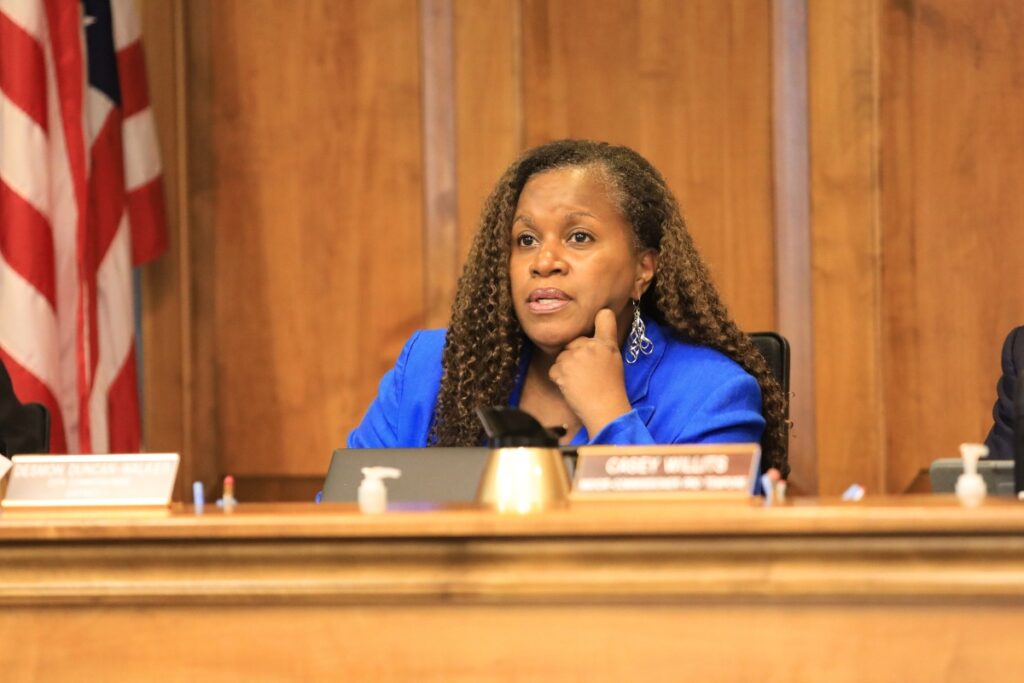
Ward quickly said he wanted nothing to do with roam immobilizations. He said he’s heard too many horror stories. Commissioner Casey Willits added that anecdotal evidence becomes data at some point, with all the stories heard about roam towing.
During the city’s April discussion, GPD said local companies immobilized 667 vehicles during the first 19 days of March. During the first 27 days of March, companies also trespass towed 126 vehicles. Trespass towing means without owner consent and includes roam towing.
Book said he would want to see more incremental and pragmatic changes than a complete elimination. He also made a motion to create a training program on the issue and to reevaluate the changes in a year. That motion passed.
The motion to end roam towing passed 5-2, with Book and Commissioner Desmon Duncan Walker in dissent.
The City Commission also voted to update the fees and charges towing companies can charge.
The charge for trespass towing a normal vehicle would be a $160 base rate, $30 per day for storage and an administrative and lien fee of $75 after 48 hours. These rates match Alachua County.
For immobilizations, the county allows the same price as towing—$160. But Gainesville staff recommended $65. City commissioners said it seems low, suggesting $78 from Eastman and $80 from Commissioner Cynthia Chestnut.
Kevin Whitesides with Superior Towing said the charge for immobilizations used to be $84.50 before the city reduced it to $80.50 before no set rate. Now, he said the city wants to reduce how much towing companies charge while expecting them to follow new rules and change roam practices.
“You want us to go above and beyond, but you don’t want to let us get paid to be above and beyond,” Whitesides said.
He added that $65 wouldn’t allow companies to get close to breaking even on costs. He said $78 wouldn’t be much better.
The City Commission landed on $80 in its ordinance. That ordinance will return for a second reading to be finalized.
Suggested Articles
No related articles found.
This issue about garbage fee collection exists because GRU is now thinking only about GRU, and not the people.
The city’s fees should be the same as the actual costs of garbage and stormwater services (with normal overhead costs). In the recent past, the city was tempted to arbitrarily raise fees to make up for the loss of the GRU transfer dividends. They should not do that again.
To James Ingle You are so smart. You must know that the use of sarcasm blocks all communication. You are spending our money. Get serious. You are not sitting in a bar with a drink in your hand. Such a seedy image.
I thought Commissioner Ingle’s suggestion to Mayor Ward was perfectly valid and an excellent idea for the letter, considering the personnel makeup of the “Authority.”
The city commission is so arrogant that they spew insults to the people that can save them money. That’s just plain stupid. Stop the war with GRUA. Get over your petty selves. You lost GRU by your own hands!
“It’s a mistake and a mess, and I’m sorry we’re being shoved in this position,” Ingle said. “I’m fine with you sending a letter to the GRU Authority. Use simple sentences and small words.”
Very mature Mr. Ingle