



- Developer Sayed Moukhtara and Tara Forest LLC sued the city of Alachua for up to $10 million over delays in approving the Tara April project.
- The lawsuit claims the city demanded extra geologic tests outside regulations and delayed hearings since the 2022 application.
- Tara April is central to plans for 1,000-plus homes and stormwater infrastructure near Mill Creek Sink, a protected environmental area.
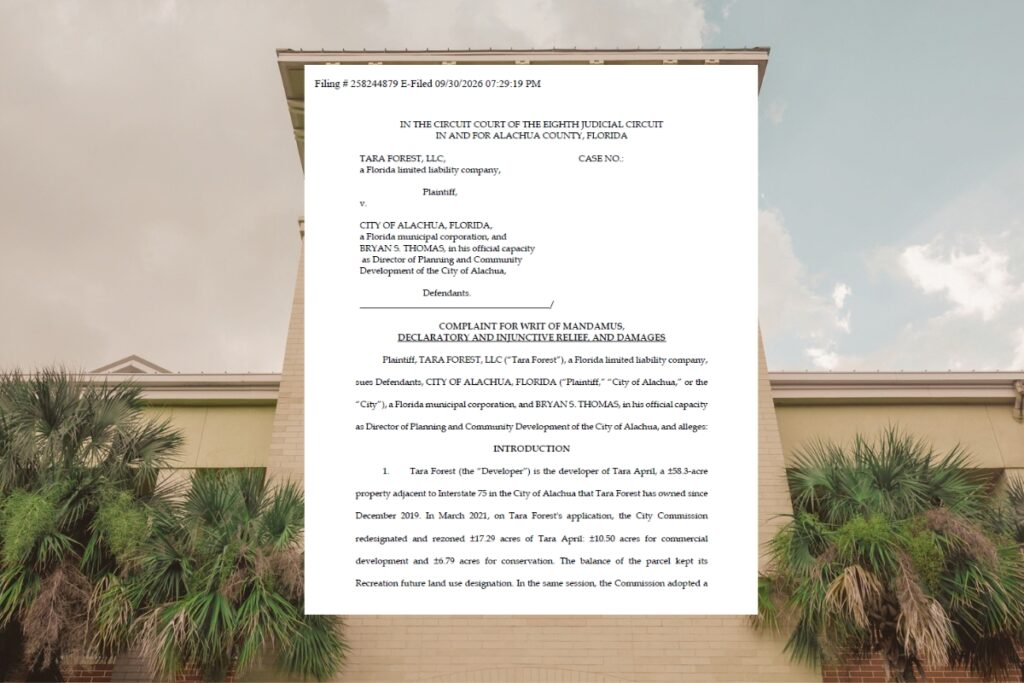
The developer behind five planned Tara projects in Alachua is suing the city and Planning Director Bryan Thomas, asking the courts to force the city to set a hearing so that the Tara April project can move forward.
Gainesville attorney Jeff Childers filed the lawsuit Wednesday on behalf of developer Sayed Moukhtara and his Tara Forest LLC.
According to the suit, the city of Alachua has held the infrastructure plan for the potential Tara April development in limbo, requiring special geologic testing outside of written regulations and delaying a hearing. The suit also says the city has shifted the requirements needed to get a hearing since the application was first submitted in 2022.
The lawsuit has six counts. The first three ask the courts to force the city to move the application through its development hearings, and the last three ask for a trial to seek monetary damages—up to $10 million—from the city’s alleged mismanagement of the application.
“Tara Forest will suffer irreparable harm if the City continues to withhold the hearing,” the complaint says. “The refusal forecloses the use of property the City has already designated for that use, prevents performance of an obligation the City’s own Comprehensive Plan imposes, and the passage of time cannot be restored.”
Tara April is the key to Moukhtara’s larger development plans around Mill Creek Sink that are divided into multiple sections. Tara April, a 58-acre parcel, was designed to supply stormwater infrastructure for the majority of the developments, with more than 1,000 homes and commercial components expected.
The development plans have caused pushback from residents because of the location and potential environmental concerns. Alachua County even allocated $1 million to litigation surrounding development in the area. Mill Creek Sink is a sinkhole that connects to an underground karst cave system and feeds into the Floridan aquifer.
In April, the city of Alachua placed a stop-work order on the Tara Phoenicia property for unauthorized clearing of land by the developer. Click here for a complete timeline on the Tara developments.
On Jan. 6, the city required geologic testing of the property and the surrounding Tara Phoenicia and Tara West parcels to approve or deny the Tara April application.
Two weeks later, amid community and government opposition, the board denied a special exception permit for Tara April’s stormwater basins.
According to the new suit, the developer conducted geologic testing to Alachua’s standards using the city’s experts from Apex Consultants, unlike when it presented a study from its own firm at the Jan. 20 hearing.
The Apex study included 24 miles of ground-penetrating radar, 10 electrical-resistivity transects, and 38 standard penetration test borings on the Tara April property.
The study found no evidence of sinkhole activity or conditions and cost around $74,000 at Tara Forest’s expense. The suit said Alachua had never required an application to test land outside of the property under review as it did for Tara Forest.
Childers sent the study results to Thomas, the planning director, on July 20 and requested a hearing at the soonest possible date to approve or deny Tara April’s application.
In a letter dated Aug. 19, Thomas said Tara Forest couldn’t apply for a hearing unless the Planning and Zoning Board granted a time waiver. He said denying Tara April’s special exception permit in January meant that an application for all or part of the property in question couldn’t be considered for one year without the waiver.
Thomas also said that because geologic testing had only been conducted on Tara April’s land and not the entirety of the Tara project—including the surrounding Tara Phoenicia and Tara West—no hearings should be scheduled, because they would prove futile.
“While it is the legal right of the applicant to request an immediate hearing, and therefore the City will comply if requested, it will be with a recommendation by staff to deny the application pending completion of the geotechnical evaluation on the entire project area,” Thomas wrote.
In a Sept. 10 letter, Childers requested an immediate hearing. He said Tara Forest fulfilled the sole condition of geologic testing on Tara April and refuted that it lawfully needed to be done anywhere else, even though the Planning and Zoning Board called for it when denying the special permit.
Childers objected to Thomas’s preliminary announcement that staff would recommend Tara April’s application for denial when a hearing had not been granted.
He also said the application fulfilled the Comprehensive Plan amendment adopted by the City Commission in March 2021 specifically for Tara April, which provides the needed on-site stormwater treatment for the whole project.
“Consistency with the Comprehensive Plan is the first of the five standards governing this application,” Childers wrote. “A recommendation to deny an application that carries out a policy the City adopted for this parcel by number calls for an explanation the City has not yet offered.”
Thomas responded on Sept. 17, saying the current infrastructure plan would need to obtain special exception permits for providing stormwater management facilities on properties with less intensive zoning district designations.
He said Tara Forest already applied for such permits that the Planning and Zoning Board denied on Jan. 18.
Thomas also said Alachua would not permit a stand-alone stormwater management facility to exist as a principal use because, as a minor utility, the city would also need to consider the properties served by the facility. He said the city can’t do that currently, as the infrastructure plan serves properties dependent on special exception permits.
Childers said in the suit that city code and ordinance do allow for the stormwater facility, and failing to move forward with a hearing for Tara April, where one would be built, is unfounded.
“The delay has extended, and continues to extend, with no date certain on which it ends,” he said. “The City refuses to set a hearing, no matter how many hoops Plaintiff jumps through.”