



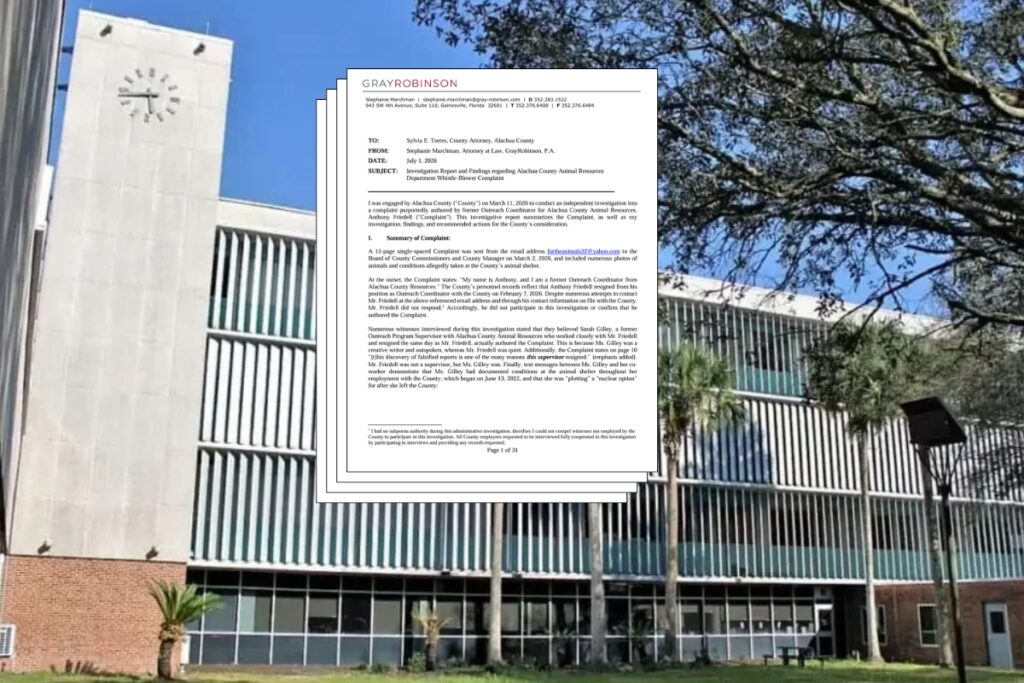
- An investigation lasting over 60 days found that Alachua County Animal Resources staff complied with all federal, state, and local laws regarding animal care.
- The whistleblower complaint prompted a $53,300 investigation which substantiated three claims but largely disproved allegations of animal mistreatment.
- The report highlighted leadership vacancies, a rat infestation issue, and made eight recommendations to improve shelter operations and staff protection.
An outside whistleblower investigation into Alachua County Animal Resources (ACAR) finished last week after more than 90 days and concluded that current county staff have upheld federal, state and local laws and regulations.
The investigation, conducted by Stephanie Marchman of the law firm GrayRobinson, began after a 15-page whistleblower document landed in the inboxes of Alachua County commissioners in March, triggering the county’s whistleblower policy set in 2020. This was the third time the policy has led to an investigation.
In her 31-page report, Marchman said she found no evidence of malfeasance, misfeasance, gross waste of public funds or gross neglect of duty by current employees.
“Instead, we believe that the County employees named in the Complaint and those currently working at ACAR should be commended for their service,” Marchman said. “With that said, there is always room for more resources and improvement, and we will identify those opportunities in this report.”
Both the whistleblower complaint and subsequent investigation are linked at the bottom of the story.
The investigation largely exonerates current county staff against the 27 complaints listed in the whistleblower report and all complaints regarding the mistreatment of animals.
From here, each of the Alachua County Board of County Commissioners (BOCC) will meet individually with Marchman, and the investigation could end up on a future meeting agenda for public discussion. Marchman also listed eight recommendations.
So far, the whistleblower investigation has cost about $53,300—including a paralegal and outside animal expert in addition to Marchman. But the investigation remains open as Marchman meets with the county commissioners, likely resulting in more billable hours.
Marchman concluded that 13 of the complaints are unsubstantiated to the extent they suggest wrongdoing by current ACAR staff, seven are largely unsubstantiated, five are unsubstantiated, three are substantiated, one is partially substantiated and one is largely unsubstantiated due to lack of evidence.
Because certain complaints had multiple points, Marchman gives two findings each, resulting in the 30 listed results from the 27 complaints.
At places, Marchman seems to point back to past leadership as perhaps running afoul, or closer to conflict, with practices for tracking adoptions.
“However, there is evidence that prior leadership processed lost animals as adoptions,” the report said.
Marchman also concluded that the initial complaint was not written by Anthony Friedell as listed but by Sarah Gilley. Friedell and Gilley both worked on the ACAR outreach team and quit on the same day, Feb. 7, 2026, which was three weeks before the complaint arrived. The investigation also named Blake Jacoby, the other member of the outreach team, who quit two days later.
According to Marchman’s interview with Jacoby, he didn’t help write the complaint. Gilley and Friedell didn’t participate in the investigation after being contacted, the investigation said.
Marchman reviewed text messages marked from Gilley to an unnamed person. The texts show Gilley saying she has information to release but that she must be careful to avoid defamation. She also mentions a “nuclear option” and said she doesn’t want to be labeled as problematic if other shelters want to hire her.
“We really need to get organized and plan our strikes lol,” one text read. “Anthony and Blake have less to lose because they are both definitely leaving soon. I have yet to receive an offer from Marion, I cant afford to get fired right now.”
In another text, Gilley says she’s been gathering evidence since she started working at ACAR in 2022.
“I have it all,” the text said. “I learned my lesson at Humane, I didnt document anything there. Here? Ive been documenting since my first day of employment.”
When released, the complaint sparked heated public comment from ACAR volunteers and concerned citizens. The investigation included interviews with six concerned citizens/volunteers.
The BOCC recently revised the whistleblower policy to explicitly include volunteers as being protected from any retaliatory actions based on participation in investigations after public concern on the point.
The investigation also included interviews with 10 county staff who were employed when the whistleblower complaint arrived along with a former staff member.
Three substantiated claims
- Use of “lynching ladies”
The complaint document zeroed in on two county staff in particular, Gina Peebles and Brittany D’Azzo. Both were cleared in the report of mismanaging the shelter or providing incorrect care to animals.
One claim accused Peebles of targeting employees and of microaggressions but were unsubstantiated. However, a substantiated portion of the claim verified that Peebles used the term “lynching ladies” in reference to a group of volunteers that continued to attack her work.
The report said the term lacked any racial meaning and instead was used with a modern definition to mean a collective action taken against someone to punish or harm their reputation, especially online.
Marchman said the attacks against Peebles meet the slang/modern use of “lynch” but noted the historical weight of the word.
One of the emails received on Peebles’ work email was listed as follows in the report: “You disgust me! The sign of a true sociopath is someone who abuses animals. Your family must be so proud. Leave Gainesville. We don’t need any more criminals or stay. Maybe you will get to see the inside of our jail system and we will be sure your toilet doesn’t flush.”
Marchman placed any management response on the county.
“Accordingly, Ms. Peebles’ use of the term to describe her situation, which in no way rises to the level of what African Americans historically endured in the United States, is insensitive and inappropriate, especially given her position in public management,” Marchman wrote in the report. “It is recommended that her use of this term ‘lynching ladies’ be addressed with Ms. Peebles as the County deems appropriate.”
Alachua County confirmed Peebles left county employment on July 3 for another position.
Peebles served as chief of staff and supervised former ACAR Director Julie Johnson. After Johnson was fired in August 2025, Peebles was appointed to oversee the department until a new director was found.
Peebles asked to be recused from that position in April after the 15-page complaint and public comment addressing her leadership. Dianne Sauve was hired in May as the interim director of ACAR, and Alachua County said a search for a permanent director is currently paused.
Marchman notes that some of the pictures used in the whistleblower complaint came from before Peebles or D’Azzo began management of ACAR.
- Leadership vacancies
As outlined above, the director position was vacant, which is why Peebles oversaw the shelter and ACAR more directly. Also, ACAR had been without an in-house veterinarian from August 2025 to 2026.
Marchman substantiates these facts but said there was no evidence that Peebles was leaving the position vacant on purpose in order to promote D’Azzo at a future time. Marchman also said that staff had access to veterinary services despite lacking a staff veterinarian.
“Witnesses stated they felt like if an animal needed medical care during this time period, they could obtain it,” the report said.
- Rat infestation
The whistleblower complaint is quoted in the report as saying, “The pest infestation is still ongoing. Despite insulation being removed, there is still daily evidence of rat infestation in the kennels… Former staff members have documented rats present in the medical suites, break room, and in the ceiling over offices.”
Marchman said the complaint is substantiated, with at least one rat trap seen when touring the facility. But she said the issue is common at animal shelters and that ACAR meets the expected standard of care for an animal shelter.
She also highlights efforts by Peebles and D’Azzo to mitigate the infestation with weekly treatments and said rat incidents have been more isolated.
Recommendations for Alachua County
Marchman lists eight recommendations, with her first aiming to protect current ACAR staff.
“Take reasonable security measures to keep ACAR employees safe and continue to refrain from making personnel decisions based on unsubstantiated allegations in the Complaint or based upon public outcry,” Marchman said.
The second recommendation focuses on euthanasia of shelter animals, a major part of the complaint. Marchman said the county should evaluate its driving ambition for its “no-kill” goal and live release rate goal of 90%.
“‘No-kill status’ should occur authentically as a result of systems management, but it should not be the only justification for decision-making,” Marchman said. “Statistics are a tool and guide for overall population management, but they should not be prioritized over welfare decisions.”
The rest of the recommendations are as listed.
- ACAR should adopt the 5 Domains of animal welfare as a guide for establishing positive welfare in lieu of the 5 Freedoms. The 5 Domains acknowledge that behavioral health is an adjunct to physical health and a critical component of positive welfare. Additionally, utilize the sound recommendations proposed by the Slomba Shelter Solutions consultation (performed in November 2025) and the ASV (Association of Shelter Veterinarians) Guidelines to Standards of Care in Animal Shelters to achieve this goal.
- If not already doing so, provide regular training to ACAR employees on animal care and cleaning. This is especially important given the turnover in the kennel technician position due to the nature of the work and the transient nature of the individuals filling these positions (for example, students).
- Advise ACAR staff conducting euthanasia to not code them as owner requested on the euthanasia report unless they are actually owner requested to avoid confusion and promote transparency. Additionally, the “lost” categorization should be reserved for patients that escape the facility, cannot be documented, or otherwise have become physically untraceable.
- Consider shifting the behaviorist role from outreach to medical or modifying the position for a dual purpose so that behavioral evaluations are included in the animal’s medical record to promote congruency between behavior modification and pharmaceutical provisions.
- Suggest ACAR staff share the process for establishing rescue partners. There seems to be a lot of confusion surrounding these decisions. Providing knowledge of the process may improve the community’s feeling of involvement, transparency, and trust.
- There is a gap between the information in the public and what is actually happening at ACAR, as well as a general lack of trust. Perhaps this gap can be closed through a new leadership meeting with volunteers and answering questions.
Suggested Articles
No related articles found.
Alachua County spent more than $53,000 of taxpayer money investigating complaints at Animal Resources, only to hire GrayRobinson the same law firm the county repeatedly uses for its internal investigations.
If county leaders were truly committed to transparency, they would have turned the investigation over to the Florida Department of Law Enforcement (FDLE) or another completely independent agency. The allegations involved potential animal cruelty, not a routine personnel dispute.
Instead, the county hired its go-to investigator yet again and declared that staff complied with animal care laws. Whether the findings are right or wrong, the public is left wondering how independent the process really was.
Real transparency means allowing an outside agency with no ties to county government to follow the facts not paying the same investigator with taxpayer dollars and expecting the public to simply trust the outcome. Another Taxpayer funded whitewashing of an investigation.