

- Christina Ramos and the Alzheimer's Impact Movement advocate for the ASAP Act to improve early Alzheimer's detection using an FDA-approved blood test.
- More than 580,000 Floridians over 65 have Alzheimer's, but early diagnosis is hard and critical for accessing treatments and trials.
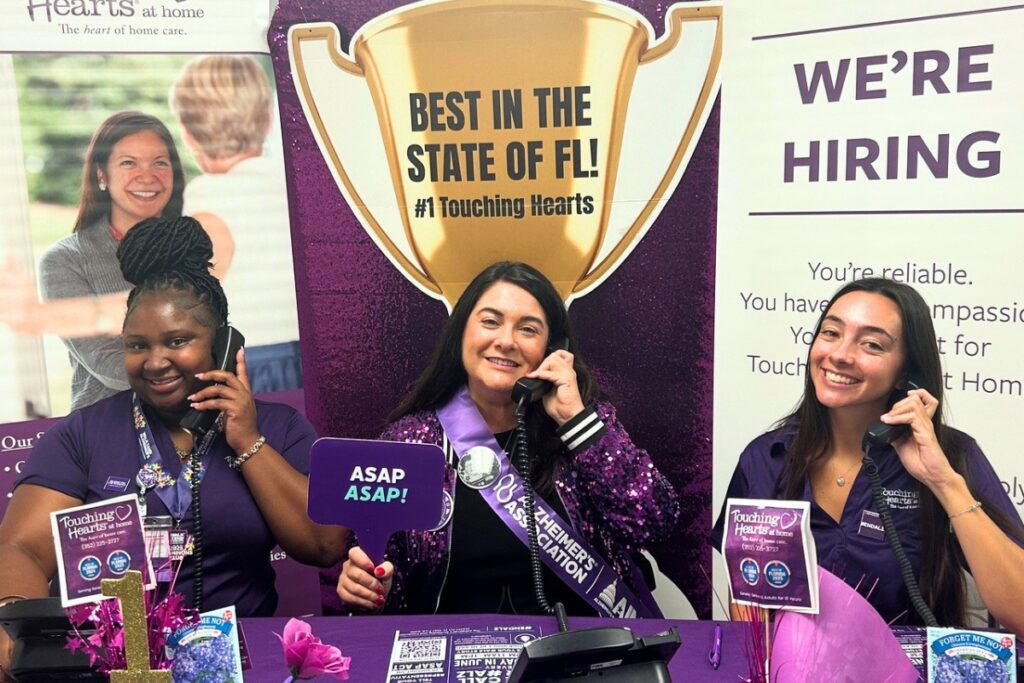
Christina Ramos was sparkling on June 12 as she got ready to make her telephone pitch to get congressional support for legislation to make the detection of Alzheimer’s disease easier and quicker.
Ramos, the executive director of Touching Hearts at Home, a home health care agency, was wearing a purple glitter jacket to jazz things up as she pushed Congress to green-light the Alzheimer’s Screening and Prevention (ASAP) Act, to improve access to earlier Alzheimer’s detection and treatment through an FDA-approved blood test.
Ramos and her team want ASAP to happen ASAP.
“Right now, getting a diagnosis for Alzheimer’s dementia is the hardest part of this journey,” she said. “And the sooner you can get that diagnosis, the better. It’s critical because the early onset stages are the stages where you can enroll in clinical trials. “You can get access and prescriptions for the drugs that are only able to treat the disease in the early stages. And you can also get referrals to the specialists and the neurologists. The problem right now is our primary care physicians are not able to diagnose dementia or Alzheimer’s.”
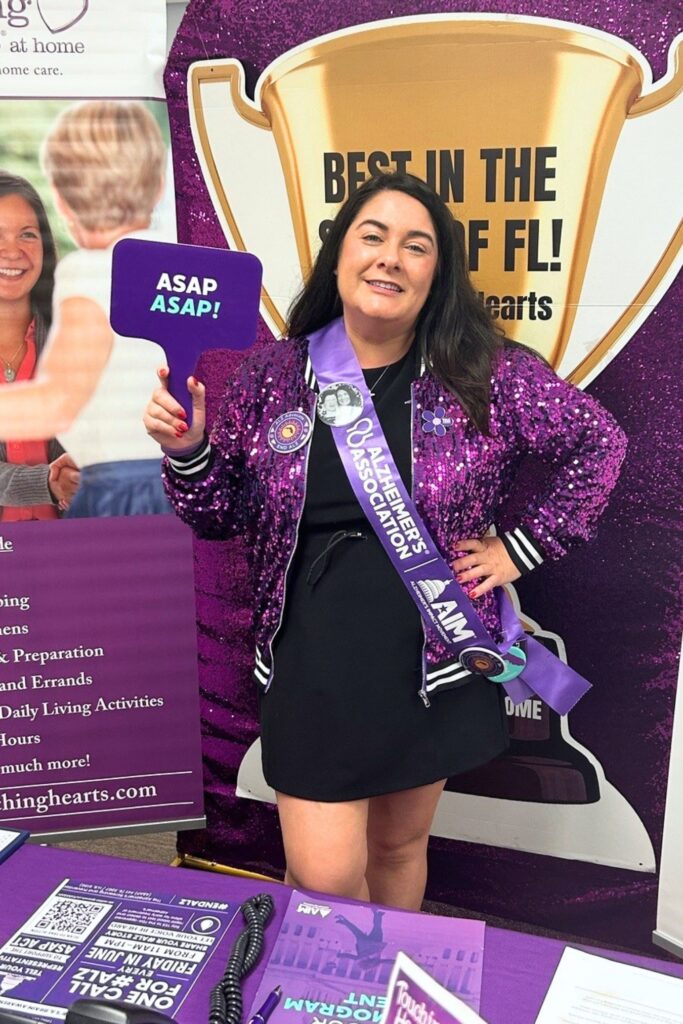
Ramos, representing the Third Congressional District, participated in a recent lobbying effort in Washington, D.C., by the Alzheimer’s Impact Movement (AIM) Advocacy Forum, where she met with members of Congress and congressional staff to advocate for legislation that they say could transform Alzheimer’s care across Florida and the nation.
The Alzheimer’s Association and AIM see the new blood test as “our mammogram moment,” a reference to how much mammograms have helped with the diagnosis of breast cancer. They say the blood test that the ASAP Act would allow would have a similar impact on brain health.
Ramos’ organization is a family business that started 15 years ago because of their own experience with Alzheimer’s disease, which afflicted their grandmother
“So, in my grandmother’s case, it took about three years for us to finally get her diagnosis. That three-year window was the critical period where she needed to be taking these drugs to treat and prolong her life,” she said.
Now Ramos has joined a campaign in honor of Alzheimer’s & Brain Awareness Month that asks people to join the “One Call for #ALZ” campaign by making phone calls from 11 a.m. to 1:00 p.m. every Friday in June to contact elected representatives to support the bill.
“Share your Alzheimer’s story, let your voice be heard. You know, I’m not only doing this for my grandmother, but for my own mother and for myself,” Ramos said. “We are so close to ending Alzheimer’s, and this is just the first step in the right direction.”
More than 580,000 Floridians have been diagnosed with Alzheimer’s disease, or 12.5% of the population over age 65. In Alachua County, about 4,800 people have Alzheimer’s, or 11.6% of the population in the same age range.
So far, Florida has lagged. Sen. Rick Scott and Congressman Vern Buchanan have supported the bill; others, like Congresswoman Kat Cammack, have not voted on the measure. But that doesn’t mean Ramos and her cohorts won’t keep trying.
Ramos emphasized that while Alzheimer’s blood tests are not a cure, they have the potential to provide earlier answers, improve care planning, connect patients with available treatments and clinical studies sooner, and help families make informed decisions about their future.
“The science exists, the technology and FDA-approved test exist, the overwhelming need exists,” Ramos said. “Science is moving faster than our healthcare system, and Alzheimer’s patients and families don’t have the time to wait, as the treatment window is limited and valuable time is being lost. Congress must act. We need our state representatives to vote YES to the ASAP Act, ASAP.”
Suggested Articles
No related articles found.