

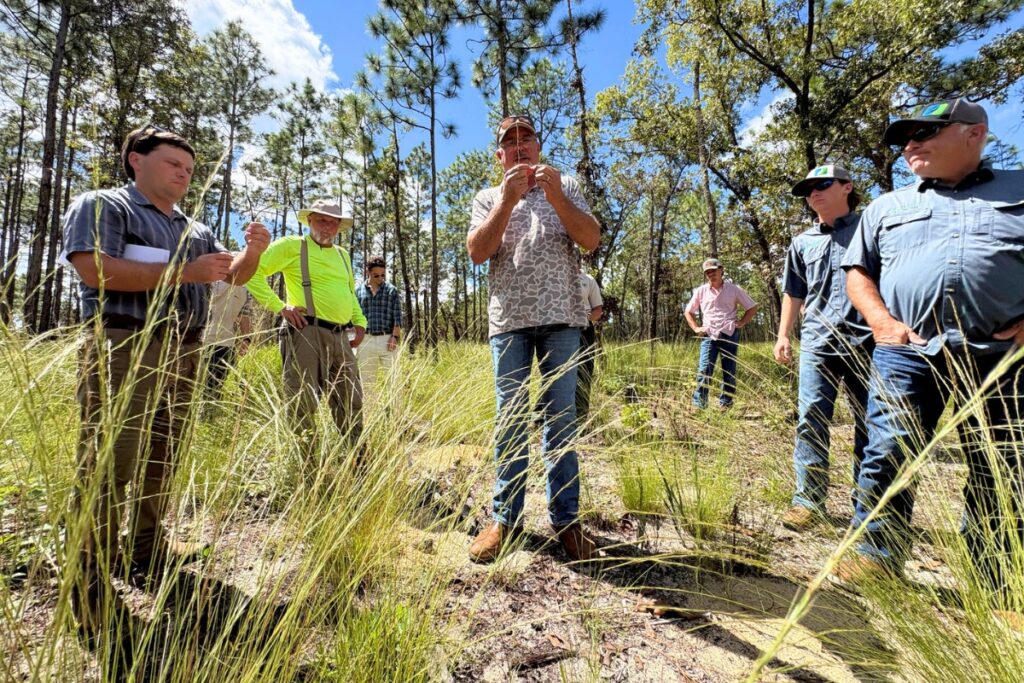
Two dozen Florida native plant and seed industry professionals attended the inaugural Wildland Seed Harvesting Best Management Practices Certificate Training Day on Sept. 22, an effort that aims to help seed harvesters gain access to public lands.
The training held at UF/IFAS Ordway-Swisher Biological Station in Melrose, Florida, was developed by UF/IFAS School of Forest, Fisheries, and Geomatics Sciences (SFFGS) and the Florida Native Seed Partnership (Partnership). It included lessons in harvesting case studies, site orientation, pre-harvest field assessment, equipment and seed harvesting demonstrations, seed handling, and sanitation and field records training.
“This training helps get seed harvesters and private companies access to public lands,” said course designer and presenter SFFGS Groundcover Enhancement and Restoration Post-Doctoral Associate Gage LaPierre, who also manages the UF/IFAS Native Plant Nursery.
“In the past, they were allowed to harvest on public lands but faced restrictions in recent years.”
LaPierre also discussed harvesting safety and ethics. “Trust and communication are key,” he said about seed harvesters regaining access to collect on public properties such as state and local parks and preserves.
LaPierre is hoping that a program with public land management agencies will be in place soon. If so, seed harvesters would bid on sites and compete for access.
“The winner of the parcel would be invited out to harvest,” he said, adding that the Florida Wildflower Foundation would develop the bidding process and emphasize stewardship.
“This would be a unique opportunity, since public land bidding currently does not include seed harvesting,” he said.
Ali Rieman, Partnership coordinator, said that training is an important step toward building a knowledgeable workforce that can responsibly collect Florida native seed while protecting wild populations.
“We hope to build a qualified, trained workforce that can participate in future native seed collection opportunities on public lands,” she said. “Future classes would be especially valuable for seed producers, land managers, restoration professionals, nursery professionals, and others interested in native seed collection.”
Attendee Paul Abel, an employee of The Natives out of Polk County, Florida, hopes the certificate will open doors for access to more harvesting locations.
“We want more harvest lands,” he said. “We need material so that we can do restoration and we also have a native plant nursery.” Abel has been in the industry for more than 40 years.
Josh Cook of Sandhill Native Growers in Arcadia, Florida, said he attended the training because he wanted to learn how to do harvesting the right way. “It adds to the knowledge,” he said.
LaPierre acknowledges that it was collaboration with USDA Forest Service, non-governmental organizations such as the Florida Native Plant Society and the Florida Wildflower Foundation, plus UF/IFAS and the Florida Fish and Wildlife Conservation (FWC) that contributed to the training manual content and the certificate training itself.
LaPierre added, “This certificate gives weight to their activity and if they harvest from other public lands, the certificate can help demonstrate a baseline of knowledge and gives credibility.”
Learn more about the Florida Native Seed Partnership: https://www.flawildflowers.org/native-seed/