



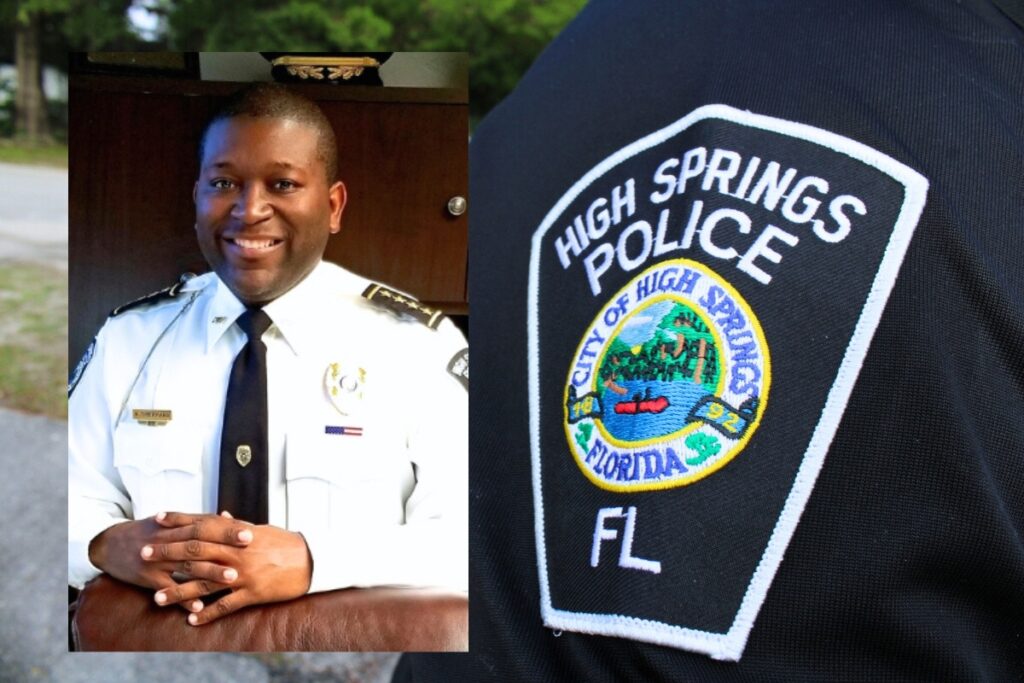
- The High Springs Police Department secured nearly $200,000 in grants and citation funds in 2025 to support city safety initiatives for 2026.
- HSPD entered a Mutual Aid Agreement with Williston Police Department in December 2025 to share resources, personnel, and training.
- Between July 2024 and June 2025, HSPD issued 2,669 speeding citations through school zone cameras, reducing speeding by 99%.
- The High Springs Police Department's 2025-26 budget allocates $3,394,944, with discussions on cutting personnel and eliminating the fire department to address a $723,000 deficit.
As the High Springs Police Department (HSPD) prepares for 2026, it looks to 2025’s nearly $200,000 acquired in grants, new partnerships formed with neighboring municipalities and funds received from school zone camera citations for funding city safety in the new year.
HSPD Chief Antoine Sheppard reported to the city commission in October that his department had been awarded nearly $90,000 in grant funds to cover new equipment. A $100,000 Request for Quote is also in progress.
In December, the City Commission voted to enter into a Mutual Aid Agreement with the Williston Police Department. The departments will share personnel for emergency responses and major events, resources and equipment, and collaborate on training through the partnership.
Between July 2024 and June 2025, 2,669 citations for speeding were distributed at $100 each because of the city’s school zone speeding camera.
HSPD used $30,000 from paid citations to fund equipment, uniforms and training for school resource officers while decreasing speeding in the school zone by 99%, according to the 2024-25 Annual School Zone Speed Enforcement Report.
In High Springs’ 2025-26 budget, the police department was allotted $3,394,944. The city commission will meet on Thursday for a regular meeting, with police and fire department budgets again on the agenda.
It previously discussed cutting back on police personnel and eliminate the fire department to mitigate a $723,000 deficit in the budget and replenish general fund reserves.
Sheppard told Mainstreet that being proactive about grants, partnerships and citations, like HSPD did in 2025, could cover department costs and increase safety while returning as many funds to the city as possible in the new year.
HSPD’s partnership with Williston is not its first time teaming up with other departments.
Except for the University of Florida Police Department, Sheppard said HSPD maintains Mutual Aid Agreements with every law enforcement body in Alachua County, including the Alachua County Sheriff’s Office.
With High Springs sitting around 35 miles north of Williston, Sheppard said the partnership will mostly help bolster personnel at major events.
The agreement, which runs through May 2027, came in handy last month when the cities sent officers to help at each other’s Christmas parades. High Springs’ parade usually calls for 25 to 30 officers, which Sheppard said the city can’t pull together on its own.
He said the relationship allows the departments to help one another without sacrificing the safety of their cities because typically reserve and volunteer officers are sent instead of full-time staff.
“It does save us a tremendous amount of manpower, gas and additional industry officers,” Sheppard said. “That’s three officers we don’t have to pay for probably about six hours.”
Sheppard said the partnerships also help departments practice coming together for when they have to respond to natural disasters like hurricanes.
When major events do happen, he said it’s essential that law enforcement at the local, state and federal levels already have established relationships in place.
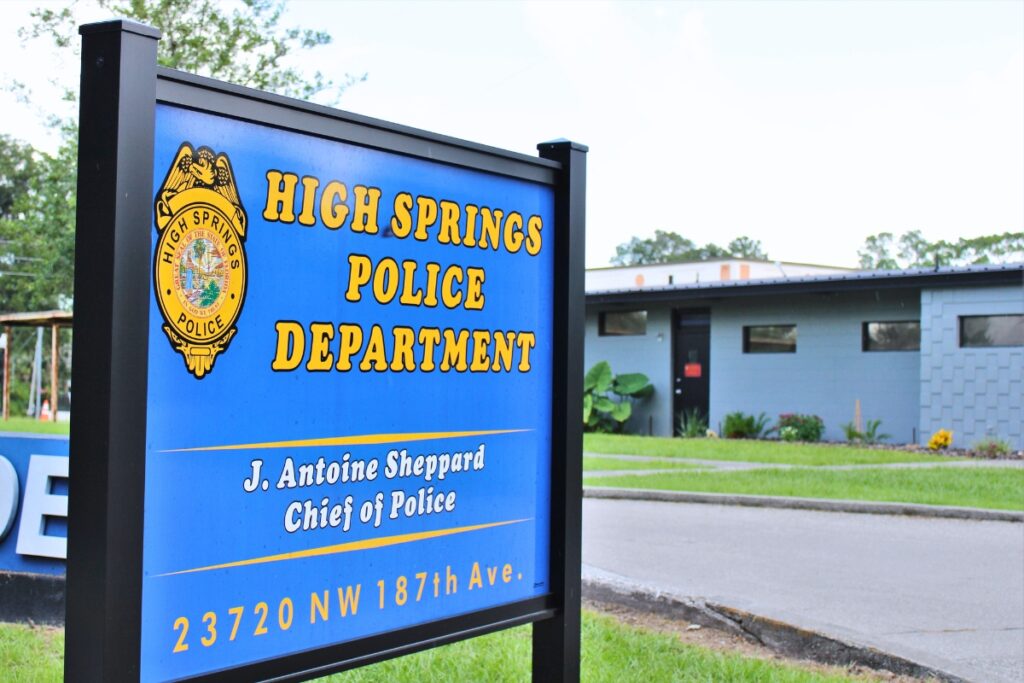
“It’s important to have that collaboration between law enforcement partners and other municipalities, other entities, so that when things do break bad, at the push of a button, we can all jump in,” he said.
As for grants, Sheppard said HSPD will keep applying for them to save the city from recurring costs.
He said 89% of the police stations’ back equipment is grant-funded, and the roughly $200,000 of grants received in 2025 will fund new radios and a Harley-Davidson motorcycle. The potential $100,000 would purchase new drones that Sheppard said are helpful in solving missing persons’ cases.
According to the Florida House of Representatives, High Springs requested $1.6 million in appropriations during the 2024 session and $1 million in 2025 for a new police station and demolition of the old one.
The request said the city needs a facility three times the size of its 2,800-square-foot building, which has asbestos, plumbing issues, frequent back-ups and is not hurricane-rated.
Gov. Ron DeSantis vetoed $250,000 of the request last year out of the $8.5 million vetoed for all of Alachua County.
Sheppard said funding from citations distributed through the city’s School Zone Speed Detection Program has also helped invest safety back into the city.
The program uses a camera installed at High Springs Community School (19559 Main St.) to take pictures of license plates of cars going 10 or more miles per hour over the zone’s speed limit during the school day. Violators receive $100 citations that can be contested.
Currently, High Springs is the only city in Alachua County with the cameras. Gainesville is poised to follow suit, after approving in September installing two school zone cameras and two red light cameras as a test. Sheppard said the Tallahassee Police Department also reached out wanting to learn how to implement the program.
According to the school zone’s annual report, 2,019 citations of the 2,669 given in High Springs were paid.
Out of each $100 citation, $60 goes to the city or county for public safety, $20 to the state general fund, $12 towards local school district security, $3 to the Florida Department of Law Enforcement (FDLE) Criminal Standards and Training Fund, and $5 for school crossing guard recruitment and retention.
Sheppard said any funds that aren’t used towards the city’s two crossing guards go into savings and can only be used for public safety equipment and to improve school zone safety.
Some drivers have expressed concerns about the camera’s accuracy, how long they run and whether they are fair.
Sheppard said HSPD has been intentional in educating the community about the cameras. He said the small number of contested citations—five were either contested and dismissed or contested and upheld in the past year—indicated the program’s fairness and effectiveness.
Sheppard said because the cameras can’t detect race, sex or income, they can be fairer than a human officer when it comes to implicit bias.
“This is not about revenue, and it should never be about revenue. I am 110% against policing for profit,” Sheppard said. “I believe in engagement with the community. I believe in traffic enforcement. That’s why we have traffic units in our agency, because it saves lives.”
Editor’s note: This story was underwritten by a grant from the Rural Reporting Initiative at the Community Foundation of North Central Florida. To learn more or get involved, click here.
Suggested Articles
No related articles found.