


What if elementary school students could learn the fundamentals of artificial intelligence and large language models just by moving their bodies?
As artificial intelligence is increasingly shaping how people learn, work, communicate and make decisions, University of Florida researchers are asking how best to help young learners develop a foundational understanding of how AI works and how it affects society.
Kristy Boyer, Ph.D., in UF’s Department of Computer & Information Science & Engineering is part of a recently funded National Science Foundation project called AI-PLAY. The project is an outgrowth of UF’s AI-Powered Athletics Initiative, which was originally funded through a presidential strategic initiative.
AI-Play aims to connect AI concepts to learners’ own movements and experiences, making abstract ideas more concrete while broadening participation in AI education at an early age.
Other project team members include Biomedical Engineering Associate Professor Jennifer Nichols, Ph.D., Educational Technology Assistant Professor Anthony Botelho, Ph.D., and Spencer Thomas of the University Athletics Association.
The AI-PLAY team will design, iteratively refine and study an after-school program, based in Alachua County public schools, that teaches fourth- and fifth-graders three foundational AI concepts: how computers perceive the world through sensors, how AI systems learn from data and how AI can impact society.
But how does movement teach kids about the inner workings of AI?
First, the data.
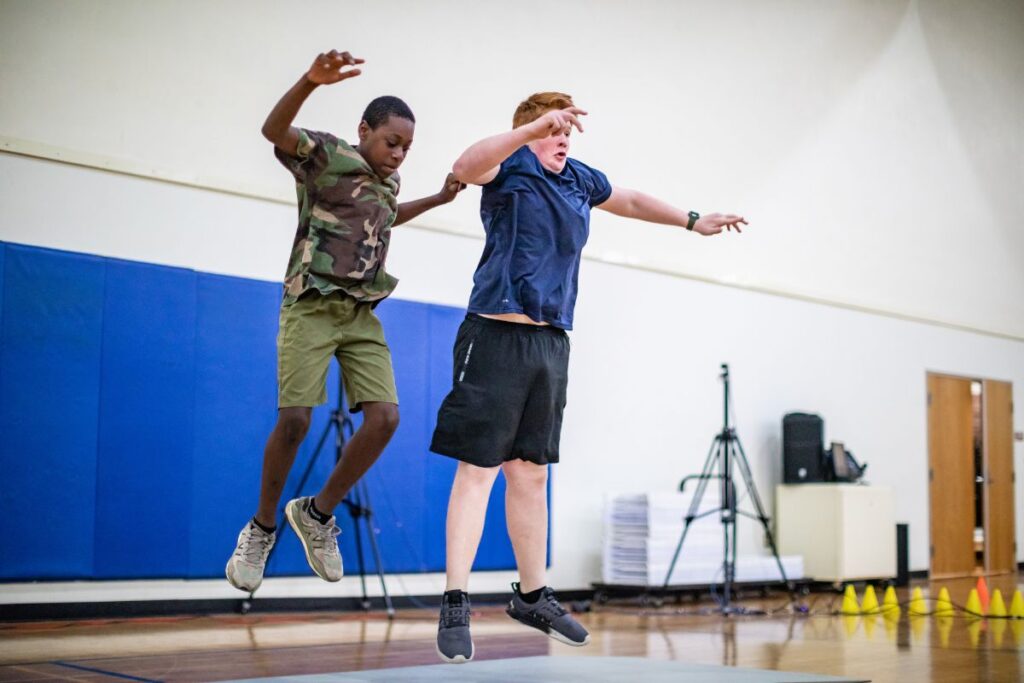
“The idea of helping kids create data through movement is that we use low-cost sensors and have the kids move around,” Boyer said. “It generates thousands of data points, and they know where it came from because they just watched it get generated by their own body.”
Students observe how the data changes, depending on whether participants run, walk, jump or squat down. As different kinds of sensors are deployed, students see for themselves how the data changes.
For a wider variety of data, the activities call for additional sensors, including grip sensors, jumping pads or full-body cameras.
“We get to grapple with all kinds of super interesting-but-hard-to-bring-home-for-kids things,” Boyer said. “What if only the taller kids in the class fed their numbers into the AI? Is that going to be a very good model for the shorter kids in the class? And now we’ve introduced the idea of bias in training sets and systematic error.”
After the data is collected, the team plans to introduce students to the concept of self-supervised learning, widely used in today’s state-of-the-art AI.
Researchers hope the project’s association with the UAA will motivate participants, apart from all the fun and movement. Some of the same sensors and testing methodologies used by Thomas’s UAA staff will form the backbone of AI-PLAY.
Enthusiastic teacher partners from Alachua County have been identified. In the coming weeks, project staff will design the combination of hardware and software that will move the sensor data into the actual coding environment that students will use. The after-school program begins in January.
Editor’s note: This is the latest in a series of columns sponsored by the University of Florida.