



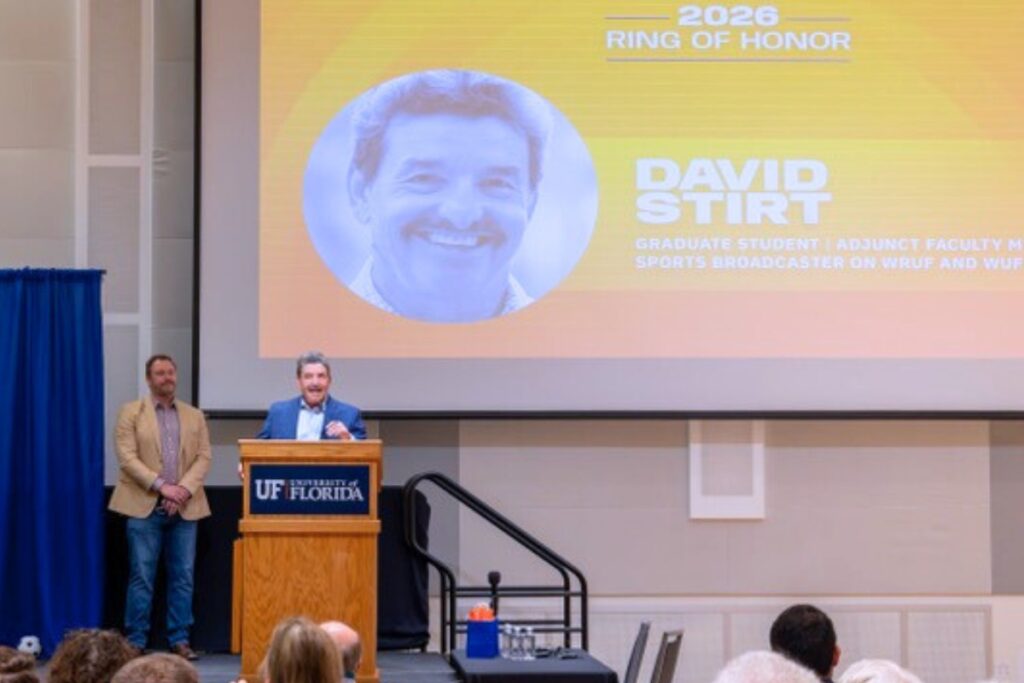
- David Stirt founded Gator Bait Magazine in the early 1980s with a weekly readership of 80,000 University of Florida athletics fans.
- In 1990, Stirt created the Gator Bait Hotline, the first phone service providing daily college football recruiting info for $2/minute.
- The hotline generated close to 10,000 calls and $35,000 in revenue on signing day and expanded nationally to $21 million annual revenues.
- After selling Gator Bait in 1998, Stirt later coached basketball at Oak Hall School and created the Florida Mr. Basketball award in 1983.
David Stirt founded Gator Bait Magazine in the early ‘80s.
It was only the fourth publication of its kind at the time.
Although it had a weekly readership of 80,000 University of Florida athletics fans, his 900 number for college football recruiting became his biggest endeavor.
“Without being too humble, that’s what I’m legendary for in the college sports media business, far more than Gator Bait,” Stirt said. “There’s been national articles written on this.”
In 1990, he created the Gator Bait Hotline, which was the first phone service of its kind to provide daily college football recruiting information.
“We would publish it in the paper; we had the best recruiting news of anybody,” Stirt said. “I published the Gator Bait Hot 100, Cream of the Crop. Bill Buchalter was big out of Orlando, but I covered far more than even he did.”
The reason he created it was out of necessity, to help clear up the phone lines. People used to call his office to get recruiting information, but their two phone lines became too busy to handle it, and they couldn’t get any work done.
“So, I’m looking up an editor and publisher one day, and I see this company called Advanced Telecom Services (ATS) out of somewhere in Pennsylvania, 900 numbers,” he said. “And, of course, everybody thought 900 numbers was porn. That’s what 900 numbers were known for.”
But he found out there were fundraising numbers, sports scores, and they had 900 numbers for stuff besides pornography.
Three weeks before National Signing Day, Steve Spurrier’s first signing day, Stirt called and asked if they would be interested in doing a 900 line for football recruiting.
And the rest, as they would say, is history.
“It was $2 for the first minute, and 99 cents for every minute thereafter,” Stirt said. “It was a static message I would send, like a five-minute message that I recorded every day about recruiting.”
The ad was published in Gator Bait to promote the 900 line and the first day that the line was up, they got about 500 calls, which was like 10 days before signing day.
“By Monday of signing week, we’re getting about 900 to 1,000 calls a day on this line,” he said. “I promised, in our paper, not only will we have all the recruits first, because UF couldn’t release them until they got the copy from the school and got the letter of intent in their hand. But I was in touch with all the coaches, and I would start calling at 7 o’clock. Did he sign? ‘Oh, yeah, he signed.’ Well, I can put it on my phone line, so I’m the first one; they wait until 5 p.m. in the afternoon, and I’ve already got all of the signees, and all the signees at Miami and Florida State, the whole works.”
He also had contacts around the state, former students of his who worked at newspapers, and they agreed to print the 900 number in their paper – in Jacksonville, Orlando, Miami, St. Pete Times, and the Tampa Tribune.
“Signing Day comes, I get close to 10,000 calls — $35,000 in revenue,” Stirt said.
After generating more than $75,000 in revenue during its initial startup year, ATS grew the business to $21 million in annual revenues by expanding the service on a national basis to more than 50 collegiate publications.
According to Stirt, the hotlines were the precursor to the proliferation of Internet recruiting services, including the development of Rivals.com, Scout.com, 247Sports.com, ESPN recruiting coverage and numerous other online entities.
“At one point, at the height, without telling you any dollar figures, I made more money in a year off my hotline than I did putting out 40 issues of Gator Bait,” he said.

Stirt saw the internet was coming and the numbers were starting to go down on the hotline because you could get the info for free on the internet, so he sold Gator Bait in 1998.
He got in at the right time, but he removed himself before it all fell apart.
After a 5-year non-compete, Stirt established a monthly magazine in 2003 as part of Scout Media, Inc. family of magazines called Fightin’ Gators (2003-2013), which grew into the No. 2 revenue-producing publication in the Scout publishing family.
From 2016-2024, he was on the sidelines coaching basketball at Oak Hall School with former Gator basketball assistant Monte Towe (under head coach Norm Sloan), where they won the school’s second district title in program history in 2024.
“I really liked basketball and my son, Ben, played, and that was always my favorite sport,” Stirt said. “But when Oak Hall had an opening, I had been on the board, and I knew the school, and I had seen Monty in town because he’d come back because his wife wanted to be by their granddaughter…I told Monte all you have to do is show up at practice and show up at games. I’ll be your director of basketball operations.”
Stirt moved to Tampa, but he’s still actively involved with the Florida High School Sports Awards program, which honors athletes and coaches in 30 sports in the state of Florida. In 1983, he created the Florida Mr. Basketball award to honor the top boys’ high school basketball player in the state.
He still serves as the executive director of the program.
And in his spare time, which is not spent with his grandchildren, he tours the country playing United States Tennis Association (USTA) seniors’ tennis.
“I have become very competitive,” he said. “I’m not a great player, but as I get older, I run better than anybody in my age group.”
Just like his illustrious career, he always seems to be a step ahead of the competition.
Suggested Articles
No related articles found.