




- GRU has not raised its electric base rate since December 2024, though the fuel adjustment has increased several times recently due to rising natural gas costs.
- GRU moved $16 million from its Electric System Rate Stabilization Fund to cover economic stressors impacting its electric system reserves.
- Public backlash arose over multiple recent fuel adjustment hikes, with calls for clearer policies and advance notice to customers before changes occur.
Last week, GRU Authority Director Jack Jacobs said if anyone wanted the utility to raise rates, then they were at the wrong meeting.
“I’ll just say if you’re looking for us to constantly raise rates and try to keep raising rates, you’re at the wrong meeting,” Jacobs said. “You need to go to a city commission meeting.”
On Tuesday, six days after Jacobs’ statement, state Rep. Yvonne Hayes Hinson issued a press release calling for a public financial recovery plan before the Joint Legislative Auditing Committee. She cited four rate increases in the last four months as her first reason the plan is needed.
Gainesville Residents United, the Alachua County Democratic Party and Commissioner Bryan Eastman have all cited multiple GRU “rate” increases this year as cause for concern.
According to GRU CEO Ed Bielarski, the utility hasn’t raised rates this year and the electric base rate has remained the same since December 2024, when it went down.
Why the contradictions? Or is it just politics?
Components of electric bills
Electric bills have three components: the base rate, the customer charge and the fuel adjustment. Combined, they form the electric portion of bills, but a GRU bill within the city of Gainesville limits will also include water, wastewater and garbage collection.
The base rate is typically set annually, and the customer charge is absorbed into it. The GRU Authority, and formerly the Gainesville City Commission, sets the base rate.
The rate is used to pay for the infrastructure involved in producing power, from generating plants, to electric lines, trucks and salaries. Plus, revenue from the base rate pays down debt and covers costs for future infrastructure.
The base rate covers everything needed for power besides the actual fuel, primarily natural gas. That’s where the fuel adjustment comes in.
GRU doesn’t earn profit on fuel adjustments. If it costs $10 to buy fuel in one month, then the utility moves the fuel adjustment to recoup that money. But it’s always a moving target as fuel costs fluctuate daily and the fuel adjustment only changes monthly.
The fuel adjustment is set by the utility CEO and doesn’t need a vote by the GRU Authority.
Because of the moving numbers involved, the fuel adjustment is an inexact science. GRU might keep the fuel adjustment level for several months while losing money then raise the level for several months to return to neutral. Or the reverse, GRU earns more from the fuel adjustment for several months before lowering the fuel adjustment and paying the cost with the funds customers already sent.
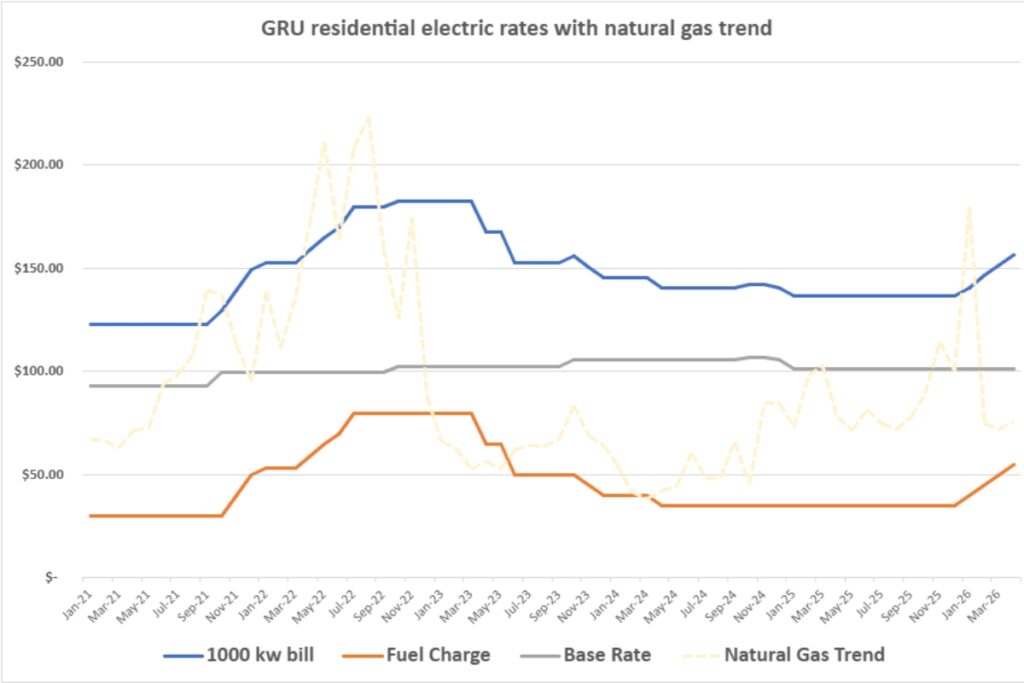
The fuel adjustment is a slow-moving mechanism by design, Bielarski said. It aims to recover funds from market spikes over the course of a year, then slowly return to a new normal. If the utility tried to recover all its costs right away, a natural gas spike like that seen in January would jump electric bills by over $20 within just the fuel portion.
The fuel adjustment is set in mills, similar to property taxes. For every mill, a customer using 1,000 kilowatt hours of electricity pays $1—one thousandth of the amount of energy used.
Right now, the fuel adjustment is at 45 mills, so that same customer pays $45 monthly plus the base rate. Customers using less electricity pay less in the fuel adjustment. All numbers in this story use a 1,000-kilowatt-hour bill as the example.
Fluctuations in an electric bill are more often from fuel adjustments than base rate changes. Since 2021, the overall electric bills mirrored the ups and downs of fuel costs (see graphic below).
Economic stressors for electric
At last week’s regular GRU Authority meeting, the directors voted to move $16 million from its Electric System Rate Stabilization Fund to the Electric System Unrestricted Operating Cash Fund.
In the cash and liquidity report, Mark Benton, GRU’s director of accounting and finance, outlined that the electric system had been hit with three economic stressors that put it below internal cash reserve targets.
The electric system was $16 million behind its target reserves. But Benton said the utility is hopeful to hit an aspirational 250 days cash-on-hand target for the first time in the coming years. Currently, the utility has enough cash on hand to operate for 188 days plus a $150 million line of credit that it’s never touched.
Bielarski stressed that GRU had used its fiscal strength to soften the fiscal blow of energy markets for customers. He even suggested a headline to encompass GRU’s outlook.
“This is all risk adjusted on our part to make sure that we have access to funds to do the things that we need to do,” Bielarski said. “I’m sure the headline in the Gainesville Sun after this presentation will be ‘GRU has used its financial strength to return millions of dollars to its customers to keep its rates low.’ I’ll wait for that headline.”
He’s still waiting after the Sun opted for “Lack of notice for fourth fuel hike angers GRU customers.”
Bielarski’s statement of millions of dollars returned to customers came from spending down the fuel adjustment reserves and a one-time paydown of $10.6 million to the fuel adjustment.
Natural gas and GRU’s fuel adjustment hit a low around May 2024 following nationwide highs in 2022. But fuel prices started to rise again. For the rest of 2024 and all of 2025, natural gas rose and fell periodically while the fuel adjustment stayed at 35 mills for 20 months in a row.
Bielarski said the fuel adjustment fund had a $9 million surplus that was spent down to keep that 35 mill level. He said there’s no reason to keep customers’ money on the books when it can be returned by offsetting the fuel adjustment.
But by December 2025, the reserves were got and it was time to raise the fuel adjustment again. Bielarski authorized a 5 mill increase for January when a record cold snap hit the United States.
Natural gas jumped to its highest level in two years, and GRU continues to raise its fuel adjustment month by month—5 mills each time.
Bielarski told the GRU Authority that the utility didn’t want to shock customers with a $20 increase from one month to the next. He pointed to other Florida utilities showing how everyone followed suit and raised the fuel adjustment.
But he highlighted GRU’s lower increase. JEA in Jacksonville went from $41 in January to $50 and then $60 while Lakeland’s fuel charge rose from $47 to $52. Like GRU, Lakeland’s fuel adjustment stayed flat (at $43.50) for over a year before increasing in January and then again in April.
GRU recently moved itself from being a member of The Energy Authority to a partner. With that process, the utility received reimbursement for its investment in TEA, around $10.6 million. Bielarski said that money was put into the fuel adjustment fund in October 2025 to buy down the rate and return the money to customers through savings—otherwise the fuel adjustment would have risen earlier.
Bielarski said the money went to the fuel account because that’s where the funds originally came from and that’s the proper place to return them.
Fuel adjustments bring push back
Bobby Mermer, coordinator for the Alachua County Labor Coalition, said customers feel like the month-by-month increases are a death by a thousand cuts. He summarized the feedback he’d heard, saying customers don’t know when the increases will end and feel like they’re being nickel-and-dimed.
“There needs to be a formula, or some sort of policy, for how the fuel adjustment is calculated and how it’s announced and how much notice is given,” Mermer said. “This goes back to the first time [Bielarski] was the general manager of the utility, where the fuel adjustment charge remained low and it seemed like it was too low and then all of a sudden, you have to have these back-to-back hikes. And then people just can’t plan.”
He said he thinks Bielarski kept the fuel adjustment artificially low to help with optics as the utility worked on legislation that appeared in House Bill 1451, preempting any changes to the GRU Authority structure.
The idea of GRU rates or fuel adjustments being kept artificially low surfaced earlier this year at a Gainesville City Commission meeting. GRU’s Benton spoke strongly against the notion at the time.
House Bill 1451 passed the Florida House and Senate and now awaits approval from the governor.
Mermer said GRU should have begun to raise the fuel adjustments a few months earlier and more gradually—5 mills every three months to recoup funds over the course of three years.
Another big component to why so many groups jumped on the fuel adjustment issue, Mermer said, was that no notice was given for the most recent 5 mill increase that started April 1. He said press releases and notices should be required.
Gainesville Commissioner Bryan Eastman weighed in last week on Facebook, calling it a secret rate increase.
“GRU ratepayers have been using electricity all month without knowing their costs went up. Check your bill, because this one might hit harder than you expect,” Eastman said.
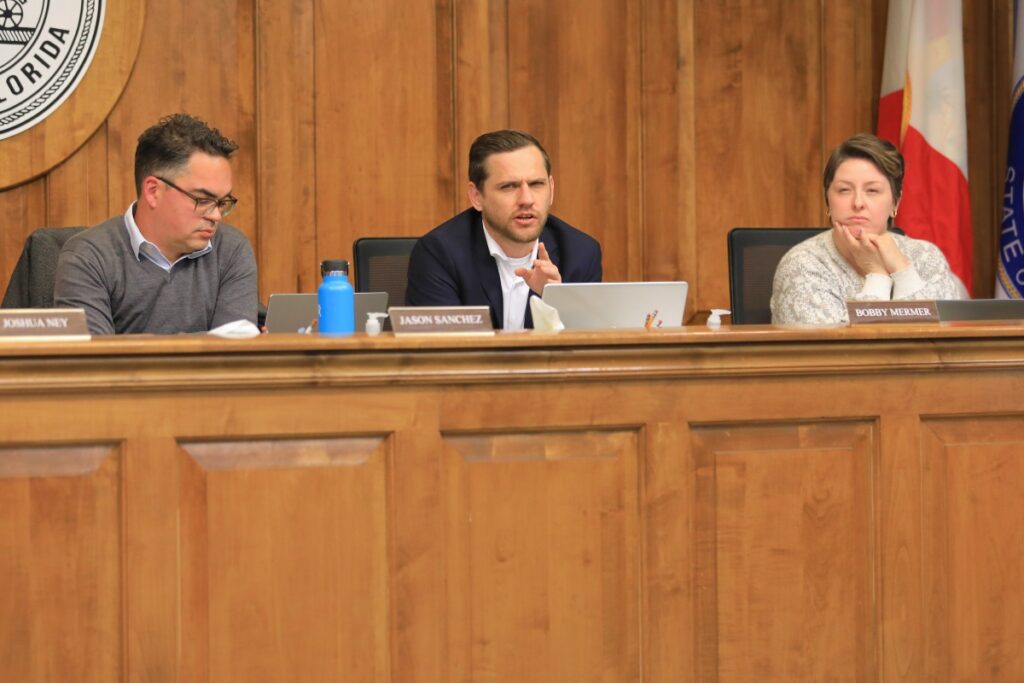
Mermer and many of the other public commenters at last week’s meeting, mostly from the Sierra Club Florida Suwannee St. Johns Group, opposed the GRU Authority when it was first created. They’re also frequent commenters at meetings, leading to verbal clashes primarily with GRU Director David Haslam (and prompting Chair Eric Lawson to tell Haslam to count to 10).
But Mermer said the issue goes beyond the GRU Authority.
“I don’t think really any of it is politics,” Mermer said. “I mean, the fuel adjustment was an issue for a long time.”
He said the same issue of multiple fuel adjustment increases was a problem years ago as well. However, he said it’s also more than a policy issue and referred back to his thought that Bielarski artificially kept the fuel rate low for political reasons.
The Alachua County Democratic Party called the GRU Authority directors cronies of Gov. Ron DeSantis.
“The [directors] are not in their positions to help the taxpayers of Gainesville—they literally admitted as much,” one Facebook post read.
Listening to meetings, though, the directors often say they want to help customers while strengthening the utility.
GRU Authority Director David Haslam said the utility is having a “soft ramping up” on the fuel adjustment and supported the decision. Chair Eric Lawson agreed but asked Bielarski to give a heads-up on when the fuel adjustment might change.
They both saw the step-by-step increase as an aid to customers, using GRU reserves to prevent a drastic jump from one month to the next.
The last time GRU raised the fuel adjustment, it lasted from November 2021 through July 2022. The process started under Bielarski, who was fired by the City Commission in January 2022, before continuing under former General Manager Tony Cunningham.
Last fuel adjustment increases:
- October 2021—30 mills
- November 2021—40 mills
- December 2021—50 mills
- January 2022—53 mills
- February 2022—53 mills
- March 2022—53 mills
- April 2022—59 mills
- May 2022—65 mills
- June 2022—70 mills
- July 2022—80 mills (where it stayed for nine months)
Bielarski said he thinks the fuel adjustment charge is an odd topic to suddenly come into the political focus. He says it could be because GRU Authority opponents haven’t had anything else to grab onto.
“The fuel adjustment isn’t a rate; it’s a pass-through, and we haven’t had any base rate increases for the past two years on the electric or natural gas side,” Bielarski said. “So there’s not much you can grab onto, and our fuel adjustment has been pretty darn static.”
Suddenly, four changes come within four months, everybody is sending out messaging, he said. But he said the people who’ve called out the fuel adjustments failed to recognize that every other utility is doing the same.
He also downplayed any concerns about GRU’s liquidity and reserves despite not hitting their internal targets. Bielarski also addressed Hinson’s press release filed on the Florida House of Representatives website (see below).
“In the midst of a crisis, you’re saying, ‘Oh, our reserves aren’t where they should be,’” Bielarski said, paraphrasing the pushback. “Well, because we’re using them. And when that’s over, you fill back up, and that’s what we’re trying to do.”
Suggested Articles
No related articles found.
The liberals complaining are getting the globalism they always wanted to keep from MAGA. Although the U.S. is “energy independent” we still must purchase gas at the global commodity price. Solar panels too. Isn’t that the globalism they want to keep, so we still go into foreign wars? The “petrodollar” allows the Treasury to print money out of thin air, too. So we can fund social welfare programs and NGO fraud for campaign kickbacks.
If you really want peace, don’t buy global. Then we can reduce the Pentagon budget.
“ GRU earns more from the fuel adjustment for several months before lowering the fuel adjustment and paying the cost with the funds customers already sent.“ Interesting word choices here. If the fuel adj Is simply a pass-through expense, then how is GRU “earning” from it? Also, do you as a customer “send” GRU funds or do you get charged? Sugar coating isn’t needed.
Very interesting, detailed article. All utilities are impacted by natural gas prices, which go up and go down. Like the article says, natural gas prices are a moving target which is difficult to forecast in advance. Sometimes, the fuel adjustment temporarily exceeds what is necessary, and sometimes it falls short of what’s needed. The cost averages out to a net zero in the long run. Public involvement helps to clarify the situation and keeps everyone honest.
Well stated