



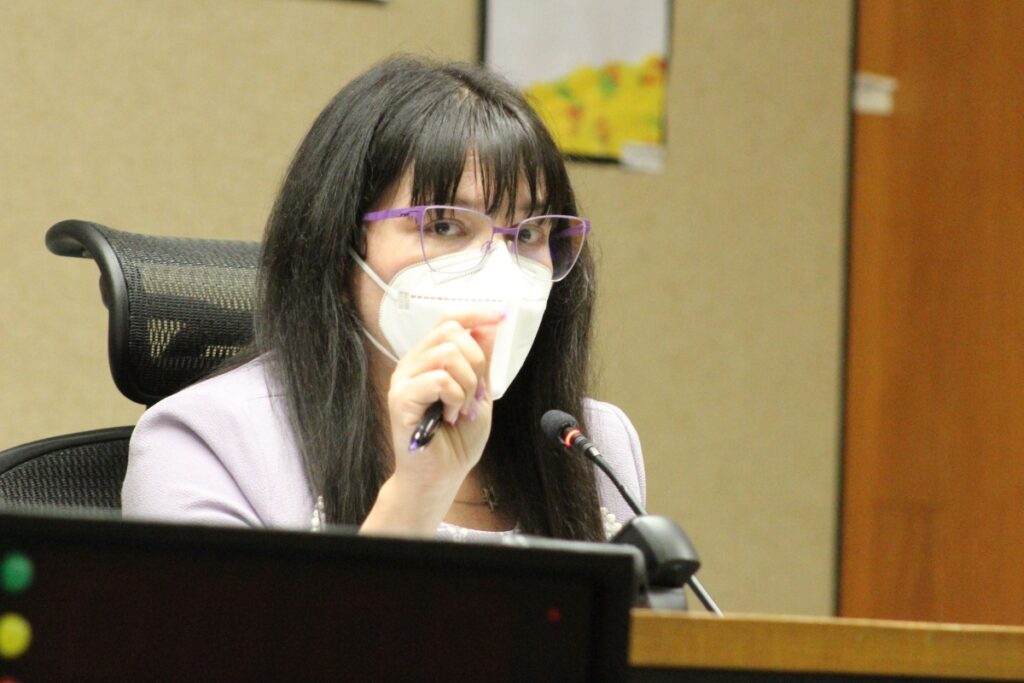
The School Board of Alachua County (SBAC) heard a presentation on school and district grades for 2025-26, including areas of success and areas for improvement, at a meeting on Tuesday night.
David Shelnutt, director of data analytics, accountability and evaluation for Alachua County Public Schools (ACPS), gave a brief presentation to the board on the grades that were initially released in July.
For areas of success, Shelnutt noted that five schools increased their letter grade from the last year. These schools were Archer, Foster and Shell Elementary, along with Lincoln and Oak View Middle.
Foster – which closed at the end of this past school year as part of a right-sizing plan – and Shell raised their grade to a C, allowing the schools to exit Florida Department of Education (FDOE) turnaround status. Districts are required by law to implement turnaround plans for schools that receive two consecutive D grades or an F grade.
“Shell was even just a couple points away from a B grade,” Shelnutt said.
Shelnutt also noted that seven schools maintained their A grade. These schools, he said, were Hidden Oak Elementary, High Springs Community School, Meadowbrook Elementary, Talbot Elementary, Fort Clarke Middle, Buchholz High and Professional Academies Magnet (PAM) at Loften High.
Three schools – Chiles Elementary, Kanapaha Middle and Gainesville High – were one point shy of an A, Shelnutt said.
“That deserves a lot of credit,” he said, while also acknowledging the eight schools that maintained B grades – Chiles, Glen Springs, Norton, Parker and Wiles Elementary, as well as Bishop Middle and Newberry and Santa Fe High.
Shelnutt also highlighted ACPS’s success in standardized assessments in writing and English language arts (ELA), particularly with students at the secondary level.
“We really saw [the] most significant growth in our district in our secondary ELA, which quite honestly may be one of the toughest areas to show improvement in,” Shelnutt said. “We were either at or above the state average in proficiency for eighth, ninth and 10th grade ELA, and we grew at a faster rate than the state in several of the middle school grades and a little bit into intermediate and elementary as well.”
Board member Sarah Rockwell credited the improvement in secondary ELA to the reading coaches who are in the district’s secondary schools, adding that these coaches are also in the elementary schools as well.
The district also has plenty of areas for growth, Shelnutt said.
A total of four schools will be in turnaround status for 2026-27, including Williams, Lake Forest, Metcalfe and Rawlings Elementary.
Shelnutt noted that while Williams improved by one percentage point, the school remained a D and will continue to be in turnaround status. He said Lake Forest and Metcalfe Elementary dropped from a C to a D grade while Rawlings Elementary went from a C to a F.
“Obviously, the district is going to be very, very focused on all schools, but helping these schools as well,” Shelnutt said.
Shelnutt also noted that there was improvement in third and fourth grade ELA, but the students were “slower than the state increase.”
Other growth opportunities Shelnutt pointed to were kindergarten ELA and math scores, as well as overall math proficiency.
In terms of overall math proficiency this past year, ACPS was 10 percentage points below the statewide average of 62%, according to FDOE data.
“While we did improve in several areas of mathematics, we were really not improving as fast as the state is, and in some cases, fell further behind the state…,” Shelnutt said. “So, that’s an important area of improvement.”
Interim Superintendent Kamela Patton said the district only has five math coaches, noting the difficulty in finding people. She added that they have a different strategy to get some assistance with math.
“If we can’t find the people, we have another way,” she said. “You just don’t say it’s OK.”
Both Rockwell and board Chair Thomas Vu mentioned the University of Florida as a possible resource as well. Vu noted that the UF Lastinger Center for Learning is currently focused on expanding into math and that he’d love to see the district partner with them to see what they can offer.
Shelnutt noted that he has already come up with goals for the upcoming school year. The first two goals, he said, are “increasing the achievement in all grade levels” and “decreasing the gap” between the district’s white and African American students and the students with and without disabilities.
In his presentation, Shelnutt included a slide that had a breakdown of ACPS’s ELA proficiency rates by Every Student Succeeds Act (ESSA) subgroups, including race, ethnicity, students with disabilities, English language learners and economically disadvantaged students.
“These would be students that passed with a three, four or five on the third grade through 10th grade ELA test for PM [progress monitoring] 3,” Shelnutt said.
The data showed a wide gap in ELA proficiency among student subgroups, with 76% of white students proficient compared to 38% of Black students. Meanwhile, only 25% of students with disabilities (SWD) were proficient in ELA, compared with 76% of white students and 38% of Black students.
Rockwell acknowledged that while it might not feel like enough districtwide, the African American ESSA subgroup actually gained six percentage points in reading last year.
“I know we’re focused on, well, Rawlings is still an F school, and we’ve still got D schools, but six percentage points for an ESSA subgroup that in our district has struggled for as long as we’ve been monitoring subgroups, that is a huge, huge gain, and we need to celebrate that and recognize that we are on a path that is starting to show results,” she said.
Rockwell also said for the first time since the district has monitored subgroups, the African American subgroup at Eastside High School is not being monitored.
“So, yes, we have a huge mountain to climb [in reading], but for the first time, I feel like we actually have our climbing gear,” she said.
Teacher reassignments
During the public comment period of Tuesday’s meeting, Dr. Crystal Tessmann, president of the Alachua County Education Association (ACEA), thanked the board and district for the reversal of the “involuntary” teacher transfers that drew concern and criticism from educators and the community.
“It is hard to admit that something didn’t work as planned, but it is so important to do so,” Tessmann said. “It is greatly appreciated by every teacher you allowed to stay at their home school.”
According to a list Mainstreet obtained on Wednesday morning from ACPS, a total of 25 teachers who were reassigned last week have been returned to their original schools.
Nick Anschultz is a Report for America corps member and writes about education for Mainstreet Daily News. This position is supported by local donations through the Community Catalyst for Local Journalism Fund at the Community Foundation of North Central Florida.
Suggested Articles
No related articles found.
Sarah Rockwell has been on the board for four years. This year, Rawlings was the only public school in the state to get an F. There are three other schools in the district that are all near the bottom in the state. This has all happened under her tenure.
Quite right Mickie! The Alachua County Public Schools are no longer schools. They are indoctrination centers where innocent minds are poisoned every single day. This board spends its time making poor decisions to cover other poor decisions, and now Tina Certain wants to jump to the County Commisson, where she can make even more bad decisions.
Rockwell is a disgrace and an embarrassment deserving no place in public service whatsoever. But, the Marxist voters in the county will put them all right back into positions of dominion over our children.
Thank you speaking the truth, all local government in Alachua county and Gainesville are totally staffed by ideologues who have destructive to quality of life in their incompetency and blind devotion to ideology
Sarah Rockwell nees to be removed, overpaid and under performing, failing our children.
She’s up for relection so do it people! (PS: she looks totally different in the yard, at TJMax, etc. sans mask – we all laugh at the Masked Bandit out here!).
The Alachua County School Board has a failure rate for education that would have had each and every one of them fired long ago from the private sector.
But then, politics is where failures go to hide, isn’t it? This latest bunch thought it would be clever to close schools as a way of reducing the need for teachers. What a fabulous idea!
Make no mistake, the State of Florida is watching Alachua County very, very closely. They are intense folks who do not grant favor on school boards that play fast and loose with education.
Get the popcorn!
First, why is Rockwell wearing a mask? She is overpaid and needs to go. Our school system is shrinking, too much money tied up in high pay for non teachers, Not to mention the kids cant read