



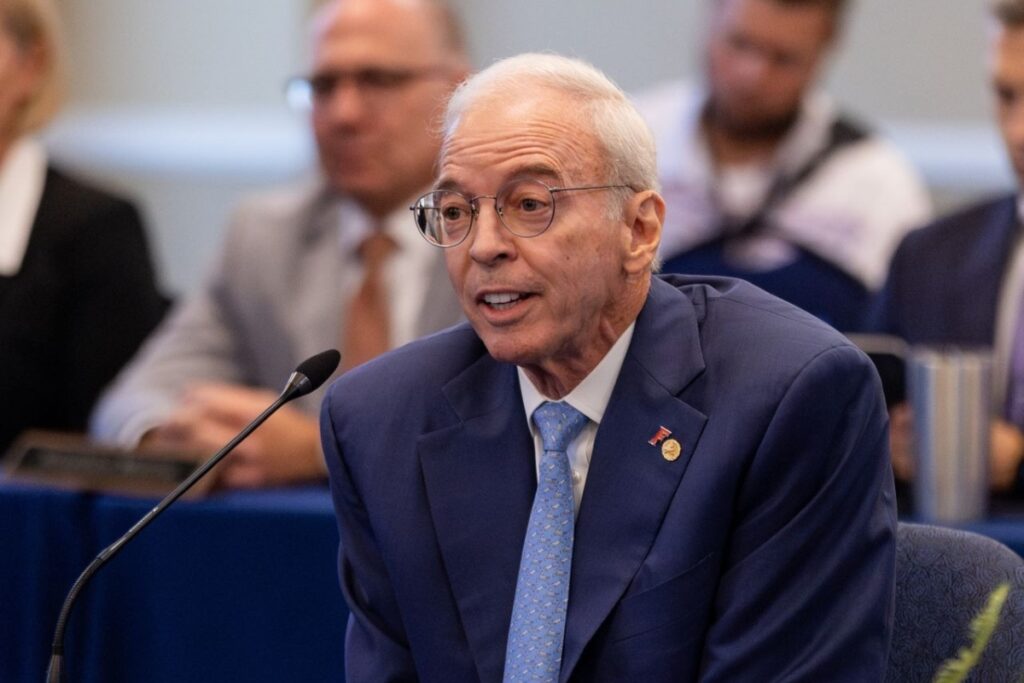
- Donald Landry will receive a $2 million severance and a $500,000 bonus after not being selected as UF's permanent president.
- Stuart Bell was unanimously approved as UF's 14th president and confirmed by the Florida Board of Governors on July 1.
- Governance concerns arose over Landry's contract delegation, prompting scrutiny from U.S. Sen. Rick Scott and delaying Bell's confirmation vote.
Former University of Florida interim President Donald Landry was not selected for the permanent UF presidency position. As a result, he is set to receive a hefty severance package due to a clause outlined in his interim contract.
Landry was appointed interim UF president last year after the nomination to make Dr. Santa Ono the university’s next president fell short before the Florida Board of Governors. Before coming to UF, Landry was a professor at Columbia University in New York.
Landry’s roughly one-year contract as interim president at UF included an annual base salary of $2 million plus a $500,000 bonus if he met performance goals. Additionally, the agreement noted that if Landry’s service as interim president ended on Aug. 31, and he is not chosen as UF’s permanent president, “UF shall pay him a severance in the amount of the Annual Base Salary” through Aug. 31, 2027.
In May, the UF Presidential Search Advisory Committee unanimously recommended Dr. Stuart Bell, former president of the University of Alabama, as the sole finalist to become UF’s 14th president. Bell received unanimous approval from the UF Board of Trustees and was confirmed by the Florida Board of Governors on July 1. His confirmation was effective immediately.
Meanwhile, the Board of Trustees held a virtual meeting on July 2 – one day after Bell’s confirmation – with the lone item on the agenda being “Leadership Transition.” During that meeting, a UF spokeswoman confirmed with Mainstreet that the board unanimously approved a transition agreement between Landry and Board of Trustees Chair Mori Hosseini that ended Landry’s interim contract and his appointment as interim UF president on June 30.
In the agreement, which was included with the July 2 meeting agenda, Hosseini stated that Landry would be paid his severance amount of $2 million as outlined in his contract. Additionally, Hosseini said Landry will receive a $500,000 bonus provided by the agreement.
Hosseini said in the agreement that Landry also fulfilled the role of senior vice president for health affairs during his tenure in Gainesville, “saved the university money by not having to fill a position that has a compensation and benefits package worth approximately $2 million annually.”
In the agreement, Hosseini said Landry’s severance will be paid in compliance with UF’s “normal payroll cycle.” Hosseini added that “such payments shall begin on July 24, 2026, and will be subject only to legally required tax deductions.”
Landry’s interim contract states that “all severance payments shall be paid with non-public funds.”
Hosseini said in the agreement that both Landry’s severance and bonus “shall be funded by non-public UF Health and Foundation funds.”
At their Aug. 25, 2025, meeting, in which they voted unanimously to appoint Landry as UF’s interim president, the Board of Trustees also voted to delegate authority to Hosseini to finalize a contract with Landry.
In a four-page letter sent in May by U.S. Sen. Rick Scott to Raymond Rodrigues, chancellor of the State University System of Florida, Scott questioned UF’s presidential search process and took issue with Landry’s contract, saying there needed to be an investigation into the agreement.
“It’s my understanding that the UF Board [of Trustees] delegated its authority on a multimillion-dollar contract solely to its Chair,” Scott said. “I don’t understand how that process is in the best interest of the university, its students and taxpayers. It begs the question as to why UF even bothers to have a governing board.”
In a separate letter to Rodrigues, which multiple media outlets reported was sent on June 17, Board of Governors Chairman Alan Levine outlined governance concerns involving the Board of Trustees and its delegation of authority. Levine stated that the contract for Landry had granted Hosseini “sweeping authority to approve the hiring and compensation of university personnel, from the provost down to mid and lower-level unit academic and administrative unit leaders.”
Levine’s concerns led Bell’s confirmation vote to be delayed roughly a week. Amid the delay, the Board of Trustees voted unanimously to appoint Bell as interim UF president while the governance issues were addressed.
Following his tenure as interim president, Landry has agreed to serve as a special advisor to UF Health through June 30, 2027, according to the agreement. This is an unpaid position.
Hosseini said in the agreement that the scope of Landry’s services will include “providing strategic counsel and executive-level advisory services on health services matters, including medical administration, academic reviews, including student admissions and resident matching, and advertising in the form of outreach, recruitment and introductions to Nobel laureates, members of relevant academies, philanthropic opportunities and federal and industry research opportunities.”
Nick Anschultz is a Report for America corps member and writes about education for Mainstreet Daily News. This position is supported by local donations through the Community Catalyst for Local Journalism Fund at the Community Foundation of North Central Florida.
Suggested Articles
No related articles found.
What a crook.