



- The School Board of Alachua County approved a 90-day inspection agreement with Gainesville for Citizens Field without committing to purchase or build a stadium.
- Environmental testing showed no soil or groundwater impact from a former fuel oil tank, but potential landfilling concerns could cost $10,000 to $15,000 to investigate.
- District teachers expressed concerns over recent reassignments mandated by Florida's value-added models and staffing needs, leading to a reversal of some transfers.
The School Board of Alachua County (SBAC) voted 4-1 on Thursday night to move forward with an agreement with the city of Gainesville involving Citizens Field.
It was repeated during the meeting that approving the agreement is not a commitment by the board to purchase the property from the city or to build a new stadium. Rather, it allows the SBAC to proceed forward with an initial 90-day inspection period. The inspection period can be extended twice, up to 270 days for staff to conduct surveys, engineering and environmental studies, and other examinations of the property.
Gainesville currently owns the 4.7-acre property, but Alachua County Public Schools (ACPS) has taken care of the upkeep and programming under a 40-year lease of Citizens Field – the primary athletic home to all three of Gainesville’s public high schools for football.
The SBAC lease for Citizens Field ends in December following a six-month extension at the June 2 school board meeting.
Under the purchase agreement, the board can elect to terminate the contract at any time during the inspection period “for any reason or no reason by providing written notice of such termination to the City.” If this happens, the SBAC can receive the $100,000 deposit – required to be put in escrow – back.
The SBAC received an update regarding environmental issues at the Citizens Field property during Thursday’s meeting.
Jay Nordqvist, CEO of Gainesville-based GSE Engineering & Consulting Inc., said the company reviewed the phase one and phase two environmental site assessments that the city initially conducted on the property.
“In doing our review, one of the things that became apparent is that there was a fuel oil tank that had been operated on the property,” said Nordqvist, who attended the meeting via Zoom, adding that the tank had been removed in the late 1980s.
After doing further testing on the southwestern part of the property – where the tank was located – Nordqvist said it was determined that there was “no impact to either the soil or the groundwater in the immediate area” of the old tank. However, he did note that there may be concerns related to “landfilling” that used to take place on the northern part of the city property.
Nordqvist estimated that further testing to address this area of the property would cost around $10,000 to $15,000.
“It would involve getting a piece of equipment out there [and] digging test pits,” he said.
The city agreed to pay for the cost of the environmental evaluation up to $15,000, which was also reflected in the board’s vote on the agreement.
In terms of a timeframe for the testing, Nordqvist said this usually “runs four to six weeks depending on scheduling.”
Suzanne Wynn, executive director of planning, construction and maintenance for ACPS, asked if the testing would interfere with the playing field.
Nordqvist said there wouldn’t be any interference, adding that the area where the testing would occur is outside and to the north of the stadium.
During Thursday’s meeting, there was also conversation regarding a brownfield grant. The U.S. Environmental Protection Agency (EPA) offers grants and technical assistance to communities, states, tribes, and others to assess, safely clean up and sustainably reuse contaminated properties.
It was noted at the SBAC’s June 16 meeting that Citizens Field had reportedly been labeled as a brownfield, meaning the property may be contaminated.
Interim City Manager Andrew Persons, who was present at Thursday’s meeting, said Citizens Field did not receive the brownfield designation. Since there are still environmental issues at the property, he noted that the city attempted to apply for a brownfield grant to help with some of the costs. However, they were unsuccessful, Persons said.
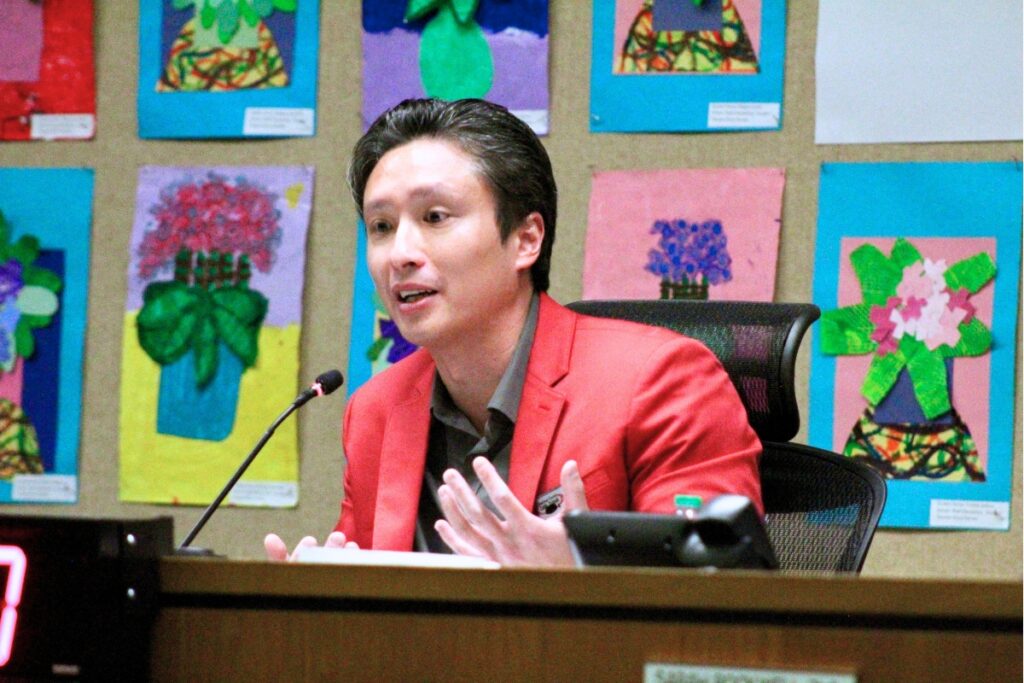
Board Chair Thomas Vu was the only member to vote against approving the agreement with the city. He was also among the four board members who voted against it in June.
Vu said he still had a lot of “misgivings” with the agreement. He also said he is looking at what would be best for the district “50 years down the road,” which would be for every school to have its own stadium.
When the board rejected the agreement with Gainesville in June, it asked staff to bring back all additional stadium options, including another alternative location for a shared stadium, a three-stadium option at the three public high schools and a plan for Citizens Field.
It was noted in Thursday’s meeting that approving the agreement is not the board’s commitment to choosing Citizens Field, as other options are also being considered.
Concerns over teacher reassignments
During the public comment portion of Thursday’s meeting, several people shared concerns over the recent teacher transfers that have occurred in the district.
In a post on her campaign Facebook page prior to Thursday’s meeting, board member Sarah Rockwell said 18 teachers were informed on Wednesday that they would be changing schools just days before pre-planning begins.
According to Rockwell, 10 of the teacher reassignments “were required by the Florida Department of Education (FDOE)” due to the state’s value-added models (VAM).
In Florida, “VAM are used to measure the contribution of a teacher or school to student learning growth,” according to the FDOE. This is done by “measuring the difference in each student’s actual performance on a statewide assessment from that student’s expected performance, which accounts for specific student and classroom factors that impact the learning process.”
Rockwell noted in her post that on top of the 10 reassignments required by the state, Interim Superintendent Kamela Patton also chose to move eight additional teachers “to address staffing shortages at our fragile schools.”
“I do not support those additional reassignments, and I’m actively working to see whether those decisions can be reconsidered,” Rockwell wrote in her post.
Rockwell later updated her original post, saying that ACPS had reversed the eight additional teacher transfers.
“Teachers have advocated for themselves flawlessly. I have advocated with [ACPS’s] assistant superintendent of HR Deborah Terry, as well as Superintendent Patton,” Dr. Crystal Tessmann, president of the Alachua County Education Association (ACEA), said during the public comment portion of Thursday’s meeting. “Parents have rallied, the media has gotten involved, and board members have pushed back. That is why so many of these moves were reversed.”
Many of the speakers at Thursday’s meeting, including teachers themselves, criticized the district’s lack of support and respect for students and instructors and called for better transparency.
“If decisions like this [teacher reassignments] must be made, they should be made with transparency and information,” said Katie McDonald, a teacher in ACPS. “Administrators should have had more information and been involved in these changes, identifying which teachers might be more or less suitable for this.”
Later in Thursday’s meeting, Vu said he believes the district can do a better job at letting the teachers know about the reassignments.
“Just so it’s not blindsiding people,” he said.
Nick Anschultz is a Report for America corps member and writes about education for Mainstreet Daily News. This position is supported by local donations through the Community Catalyst for Local Journalism Fund at the Community Foundation of North Central Florida.
Suggested Articles
No related articles found.
This is quintessential Alachua County. Great idea (not)! Let’s take the albatross that is Citizens Field from around the City of Gainesville’s neck and put it around the Alachua County Public School’s neck! Heck, it can’t possibly matter to the peasants, right? They’re going to pay for Citizens Field no matter who holds the paper, right? Bad decision incoming…!
The ACPS Board of Bad Decisions thinks that maybe, just maybe, buying an old landfill that was once used to store fuel is a better idea than just having our three high schools draw straws to see which school will get a shiny new shared stadium without a mystery back story.
Chairman Vu is showing some vision and leadership.. No crystal ball is needed to know that at some point, nuclear medical waste or hyper-caustic chemicals will be found. But if we build a new stadium on land we know is clean, no issues! So of course, the ACPS Board votes to go ahead with buying a poisoned site.
Of course! This is how the board works. Make a deal with the city on a Friday night over Chardonnay in some dark corner and voila!
Some things will never change…