


- Alachua County approved negotiations for a $1 million lease on a 12-acre UF property to build a $30 million Animal Resources Shelter.
- The new shelter will be designed and constructed over two years at the former Swine Unit near UF's main campus.
- The county adopted a hybrid model with the Sheriff's Office for animal control, splitting criminal and civil animal complaint responses.
- Concerns exist about the UF site's size, traffic, and university partnership stability, but its central location favors transparency and student involvement.
Alachua County decided to proceed with a $30 million Animal Resources Shelter just south of the University of Florida’s main campus at the former Swine Unit property.
The county also heard an update on how the Alachua County Sheriff’s Office will start responding to animal calls.
The Board of County Commissioners (BOCC) voted 3-1 to enter negotiations for a $1 million lease for the 12-acre property. UF will tear down the existing buildings as the county prepares design plans for the new shelter. The lease is for 30 years.
Commissioner Marihelen Wheeler voted in dissent, and Commissioner Chuck Chestnut was absent for the vote.
The county has outgrown its outdated facility, originally built as a kill shelter. Everyone at Tuesday’s meeting agreed that the facility fails to meet the current needs.
But finding a new location has taken time, and many public commenters said the county should keep looking, versus the two options presented Tuesday: the former Swine Unit at UF (2345 SW 23rd Terrace) or the Weseman Tract (4700 NE 63rd Ave.) off Waldo Road north of the airport.
Commissioner Anna Prizzia said the county needs to decide and begin moving forward, with design and construction lasting another two years before the new shelter would open.
“We could keep on shopping, but every day that we keep on shopping, we keep on moving the needle on the shelter that we needed when I started,” Prizzia said. “It was one of the first conversations we had when I got on this commission five and a half years ago.”
The BOCC started looking at the UF site a little more than three years ago.
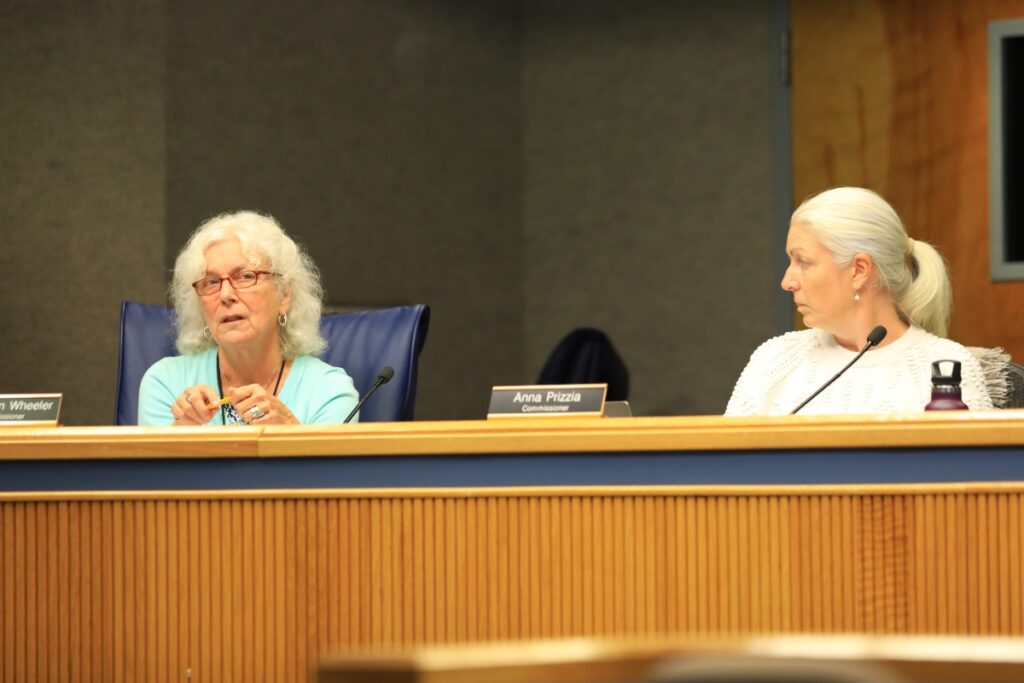
Wheeler said one of the reasons she is reluctant about the UF property is what she called moving goal posts when dealing with the university. She said it’s taken a long time to get this contract ready and pointed to other projects where UF and the county tried to partner.
“Now we’re looking at a couple of presidents later and a board that’s changing at the vet school,” Wheeler said. “I just don’t know how you guys can put that much confidence in partnering with a group of folks that are still pretty unstable themselves.”
Wheeler also voiced this concern in early 2025. The county has had a draft agreement with UF for two years and said she had concerns with the UF property being so close to Archer Road and its traffic. The site will only be 12 acres, with some wetlands to mitigate, and Wheeler questioned if that was enough land.
Chuck Clemons, vice president for government and community relations, spoke at the beginning of the discussion. He said UF is committed to being a part of the animal shelter through its College of Veterinary Medicine and added that the university leaves it to the county to decide on the best site.
He said the dean of the College of Veterinary Medicine announced that she would step down, and he said UF will fill the role and make sure the new dean knows to continue the important relationship.
UF is also searching for deans to lead the College of Arts and the Herbert Wertheim College of Engineering.
Alachua County is also searching for a permanent Animal Resources director, with Gina Peebles serving in the interim, along with her role as assistant county manager.
County Manager Michele Lieberman said UF will be a major part of the county’s animal shelter, no matter where it’s located. Part of the BOCC motion on Tuesday ratified a contract for a partnership with UF’s College of Veterinary Medicine.
As for the contract for the land, Lieberman said if anyone is responsible for the long timeframe, it would be her. UF had previously asked $3 million for the lease of the property, and Lieberman said she felt the price was a little high and wanted to find a way to add value before bringing it to the BOCC.
She pointed out that the work to make the Weseman Tract a viable option has also taken at least two and a half years.
“The relationship with UF is very important, but it’s going to be very important regardless of if we’re on the Weseman Tract or the UF site,” Lieberman said, saying to evaluate the two options based on the property’s pros and cons.
In 2025, Lieberman referenced a possible shift in direction on the animal shelter toward the Weseman Tract. The UF site remained the first option, though, and she said at the time that the $2 million in savings comes while bearing more of the operational costs.
Prizzia said the UF site has a lot of benefits, and Chair Ken Cornell and Commissioner Mary Alford agreed.
Prizzia said the proximity to UF allows student engagement without needing cars and a 20-minute or more drive. She added that the Swine Unit site is on bus routes and within the Gainesville activity center.
She said the BOCC pushes developers to build on transit lines and within activity centers and the county should do the same.
Alford added that a central location where anyone can stop by at any time increases transparency. She said the reputation of the shelter is hindered by transparency issues. Anyone will be able to see how the shelter by the campus treats intakes, she said.
Alford added that adoption events wouldn’t require transporting animals to an event site. The UF site could host events in the heart of Gainesville.
Cornell agreed. He said anytime the UF partners on a project, the university adds to the value for the community. He said UF being willing to lease land to the county is a big deal and reducing the price to $1 million is also a huge deal.
“I’ve been thinking about it for the last 12 years, and it’s taken too long, too damn long,” Cornell said. “It’s time now to do it right, not for the next couple of years but for the next couple of decades.”
The BOCC was also updated on its 2025 decision to rely on the Alachua County Sheriff’s Office (ACSO) to respond to animal services calls instead of having in-house investigators under the Animal Services.
Peebles said the county and sheriff’s office decided on a hybrid model. ACSO will build an Animal Bureau Division and respond to criminal animal enforcement, like dog bites and fighting, while the county responds to civil complaints, like sick wildlife and animal neglect.
Peebles and Undersheriff Josh Crews said the two entities will hold monthly meetings as they hone the process over the first year. One of the issues will be assigning calls to the right group, but Crews said they’ll be flexible and hand off calls as needed.
Already, Peebles said the sheriff’s office will back up Animal Services, or the county will respond to a call and bring then have the Florida Fish and Wildlife Conservation Commission (FWC) take over.
Under the hybrid system, the county’s three investigators and supervisor would move under ASCO. Peebles said this plan also means no positions will be cut.
The BOCC voted unanimously to approve the memorandum of understanding for the hybrid model with ACSO.
Editor’s note: This story was updated to change College of Veterinary Science to College of Veterinary Medicine.
Suggested Articles
No related articles found.
It’s great that there’s some forward motion on replacing the old site. Since they are projecting 2+ years before a new one is ready, shouldn’t there be an immediate plan to create a way to handle the overflow until then?
How can the study of a law to allow $30 million to be spent on animals but they’re still homeless on the street still people that stay in bad housing this falling apart the roof lease is not proper air have broken appliances and as long as the landlord passes whatever code and county gives him he’s allowed to still rent these places are all throughout this city you’re so worried about a animal and do not care enough about your fellow man can you wonder why people do what they do cuz we I’m not going to say weed cuz I don’t I help people all the time but the majority those that have the money to spend it look down at those who don’t have it to spend it I hope that when you go to sleep at night you think about this 30 million dollars you spent for animal shelter and next time you pass by homeless person I want you to stop and think that person could be in that facility not out here in the cold we can have a college students in the community helping them
You’re studying a law to spend $30 million on animals while people sleep on sidewalks and families are trapped in crumbling homes with collapsing roofs, no heat, no air, and broken appliances yet landlords are still allowed to rent them because they barely pass a weak inspection. These conditions are everywhere, and you allow them and code enforcement does nothing effectively help with a problem.
At the same time, taxpayers are crushed by a sky-high millage rate, driving a $110-billion property-tax burden that keeps climbing. This isn’t abstract policy this is how people lose their homes. Seniors are taxed out. Working families are pushed into second jobs. Rent explodes because property taxes explode. Your tax policy is creating homelessness. Then you claim compassion.
Taxpayers already paid for safe housing, enforcement, and real solutions. You chose to spend their money on optics instead. Every dollar misspent is another family closer to eviction and another person sleeping in the cold.
So the next time you pass a homeless person, remember. They didn’t fail the system. The system taxed them out of it. Stop punishing taxpayers. Stop hiding behind inspections and studies. Put people before politics now and lower the property mileage.
Alachua County’s General Fund has ballooned to roughly $111 billion, while the county’s population has grown only about 15%. That kind of imbalance doesn’t happen by accident. It raises a serious question: is this systemic mismanagement by successive county managers and the Board of County Commissioners?
Despite unprecedented revenue growth, residents see declining core services and rising costs of living. Alachua County Animal Services is a prime example widely viewed as dysfunctional to the point that animal control officers were transferred to the Sheriff’s Office, effectively admitting failure after years of taxpayer funding.
At the same time, the County spent $3 million on AI “spy” vehicle cameras, justifying the expense by claiming insurance savings. But that justification collapses under scrutiny: Alachua County is self-insured. There are no insurance premiums to lower. That makes the camera program not just questionable, but a waste of taxpayer dollars with no measurable financial return.
Meanwhile, Alachua County residents are crushed by some of the highest property taxes in Florida, with the County’s millage rate ranking near the very top statewide. That’s not a badge of honor it’s evidence of a government that has become addicted to revenue instead of accountability.
When revenue doubles, population barely moves, services deteriorate, and taxes keep climbing, the problem isn’t growth it’s governance. Alachua County doesn’t have a funding problem. It has a management and priorities problem, and taxpayers are paying the price.
Following the DOGE findings, the State of Florida must explain how it will enforce accountability where county actions drive higher property taxes.
Why is Alachua County using AI vehicle cameras? What problem do they solve? What measurable benefit do taxpayers receive?
The Alachua County Sheriff’s Office does not use AI cameras on deputies, yet civilians and non-sworn employees are subject to surveillance. Work-from-home employees are not monitored at all. This lack of consistency raises serious concerns about necessity, fairness, and oversight.
Taxpayers deserve: Total program cost, Data use and retention policies ,Proof of savings or safety benefits, Justification for civilian surveillance
The State must ensure counties are not expanding surveillance while taxes continue to rise. Spend are tax dollars wisely and repair or repave our roads.