

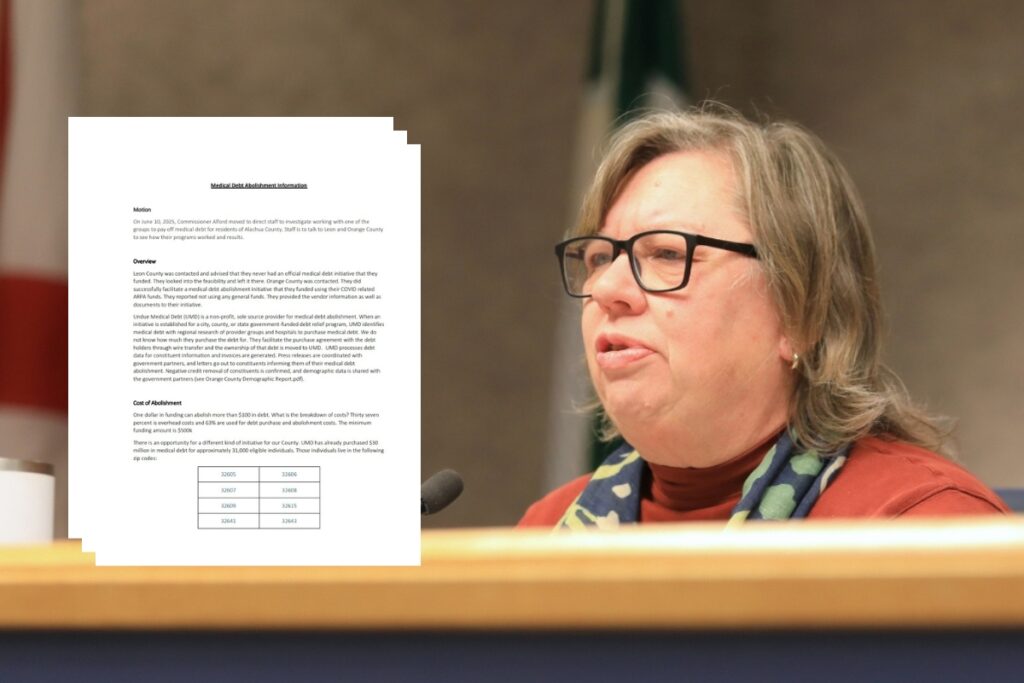
- Alachua County staff said the county could abolish $30 million in residents' medical debt for $150,000 through a partnership with nonprofit Undue Medical Debt.
- Undue Medical Debt purchased $30 billion in medical debt in 2025, including $30 million from 31,000 Alachua County residents.
- Alachua County commissioners have not scheduled a discussion on the report, but Commissioner Mary Alford plans to revisit the medical debt buyout proposal.
Alachua County’s Board of County Commissioners tasked its staff to research a buyout of local residents’ medical debt, and a February report outlines findings and says the county could “abolish” $30 million in local debt for $150,000.
But the debt—spread across 31,000 residents—is already paid in full, according to the national nonprofit Undue Medical Debt (UMD).
In 2025, UMD purchased $30 billion in medical debt in a single transaction, wiping out an average $1,100 payment for 20 million people in the United States.
Courtney Story, UMD vice president for government initiatives, told Mainstreet that the nonprofit took advantage of a special opportunity to buy all the debt from Pendrick Capital Partners. The transaction allowed Pendrick to exit the medical debt sector and prevented the $30 billion from going to for-profit debt collectors.
Florida was one of the top five states with the most debt included in the Pendrick deal.
Story said the 2025 deal included Alachua County’s $30 million listed in the county staff report. The debt bought by UMD was limited to households making less than 400% of the area’s median income. For an Alachua County family of four, that’d be $124,800 or less annually.
Because of the magnitude of the deal, Story said the nonprofit has yet to send notices to each of the 20 million individuals included in the deal. She said UMD partners with local governments to pay for the letters and also covers its portion of the debt buyout.
The nonprofit has partnerships with 29 cities, counties and states. And each government puts its logo and information on the letters sent locally, serving as confirmation of the buyout.
“It’s really up to each government partner,” Story said. “We offer a range of options, and different folks take us up on different pieces.”
Orange County has used $3 million in partnership with UMD to pay off more than $472 million in local medical debt. That deal included collaborating with specific Orlando-area hospitals in individual transactions, not just contributing to the Pendrick deal.
Alachua County Commissioner Mary Alford brought the buyout idea to the BOCC after meeting with UF students on the matter. She said she intends to bring the topic back up now that the staff report is finished.
“I think ultimately [the debt buyout] probably would cost us more than it would save us, but I think there would be savings,” Alford said. “That’s my feel of the situation, but it’s a really hard thing to quantify.”
As a cancer survivor, Alford said she understands the high costs that come from medical care. These costs can be devastating, she said, especially for families unable to follow through on a payment plan. Alford said the debt can cause individuals to put off medical care, potentially leading to higher costs if illnesses worsen.
The February report points to funding and reporting issues, but Alford said other communities have found solutions without legal knots—Alachua County could too.
Despite that, the BOCC isn’t scheduled to discuss the report it requested. Alford said county staff isn’t, to say the least, enthusiastically pushing the idea.
“I think that the idea was foreign to so many of the commissioners that they wanted to just do whatever staff said. That’s our default, right” Alford said.
Claudia Tuck, the county’s community support services director, said county staff fulfilled the BOCC motion to research and prepare a report on a medical debt buyout, speaking to Orange County, Leon County and UMD.
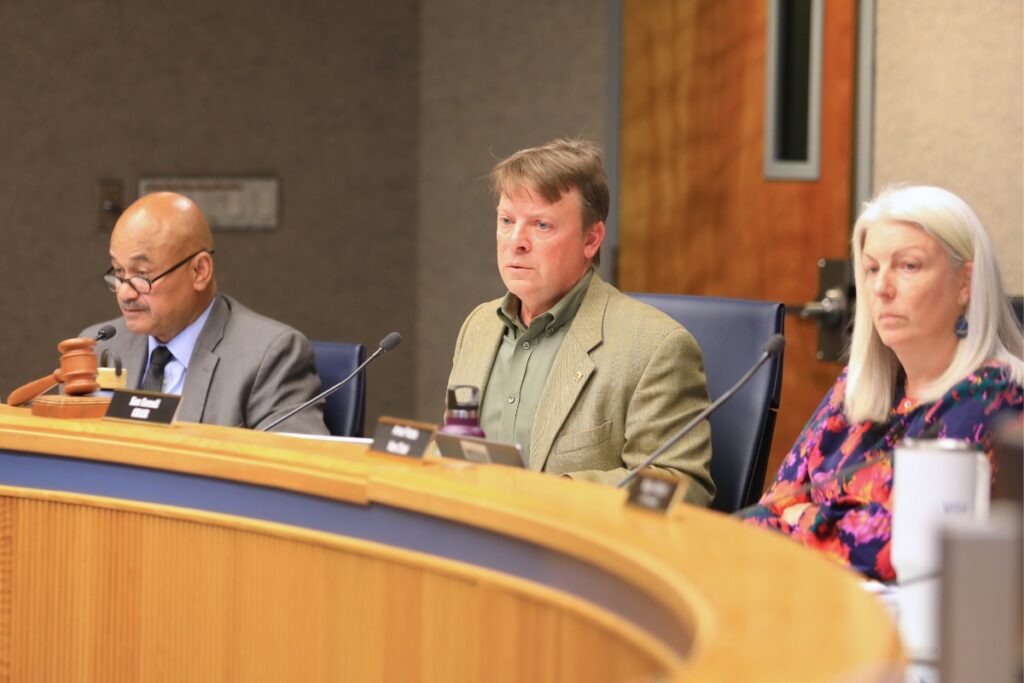
She said the next step is for the BOCC to review the report and see if anyone decides to bring the topic back for discussion.
One of the issues raised by staff was finding a predominate public purpose to spend the money. Tuck said staff would analyze a suitable public purpose if authorized to proceed, but hadn’t in its current research.
Alford said she intends to return to the topic at a future meeting. She pointed to the county’s emphasis on social services and health, like Food is Medicine and safety for pedestrians and bicyclists.
In December, the county allocated $100,000 to allow six community resource centers to purchase produce from a local farm. The goal is to supplement shelf-stable foods with healthy greens and vegetables for families in need.
“In my mind, it fits in with that whole idea of focusing on wellness in our community,” Alford said of the medical buyout.
She added that the mental health component of getting out from underneath the debt would also be a big boost for locals.
Story said UMD gave Alachua County information on what a partnership could involve and would wait to hear back after the county’s political processes play out. She said UMD constantly enters preliminary discussions with governments across the United States that are very similar and then a relationship either happens or doesn’t happen.
UMD continues to pay off the $30 billion in medical debt acquired from Pendrick in quarterly installments. Story said the nonprofit is also working through its list of 20 million individuals to send letters officially confirming the medical debt has been bought.
Story said UMD also partners with philanthropic, nongovernmental entities to send the letters. In some cities, residents have fundraised on their own to partner with UMD.
Orange County was able to pay off a dollar of debt for around a penny, and Story said the 1 to 100 ratio is common in medical debt buyouts. Hospitals or third-party debt collectors know there’s little chance of recovering the money from the actual patient years after the bill.
In the Alachua County staff report, the partnership could look like a 1 to 200 ratio, using $150,000 to cover the $30 million in debt UMD is holding.
“You can’t really get blood from a stone, so I think that’s sort of driving the cost of that debt to the pennies on the dollar figure that we tend to use,” Story said.
Suggested Articles
No related articles found.
Alachua County government is not a charity and it is not Congress.
The General Fund exists for core services: roads, public safety, infrastructure, emergency response. Period. Buying private medical debt even at a discount is not a core function of county government. It is political virtue signaling with taxpayer money.
Residents are already paying the price. Alachua County’s budget has exploded past $112 billion +, and we have the second-highest property tax millage rate in Florida. Meanwhile, roads crumble, infrastructure lags, and basic services strain to keep up.
This is how government bloat happens small “compassionate” expansions that add up while taxpayers foot the bill.
If commissioners want to run a charity drive, they can do it privately. But they should not use General Fund dollars taken from working families to solve a federal healthcare problem.
Stay in your lane. Fix the roads. Protect public safety. Stop expanding government. Please stay out of my pockets they are empty because of high inflation and property taxes.
Please proofread your rant. Alachua County’s budget is NOT 112 billion. You do know the difference between million and billion?
If you’ve ever driven through Bosnia, you’d understand the frustration. Alachua County roads resemble a war zone of potholes, riddled across every roadway. Residents pay significant fuel and infrastructure taxes, yet the streets continue to crumble, damaging vehicles and creating unsafe driving conditions. The county’s neglect of basic road maintenance is unacceptable and wastes taxpayer money.
Despite the challenges and difficulties, my family has strived to pay our medical debts.
Who knew the County Commissioners of Alachua County, FL would pay these debts for us?
There aren’t many deceptions worse than a public official believing he is being compassionate and charitable at the public’s expense. This is one of the worst kinds of evils, because it means stealing from one group to the benefit of another, and usually both suffer more in the end.
County Commissioners simply spending taxpayer funds to buy votes………..from who? Eliminate my property taxes, use the current gas tax to maintain roads, cut your budget to taxpayer needs (not your idealistic wants), AC County Commissioners don’t want Single Member District because some of the current spend happy Commissioners will lose their cushy full time pay for a part time job! Buying Votes is the name of their game!