


- The Gainesville City Commission approved a 10-year, $8.38 million solid waste contract with GFL Environmental Solid Waste Southeast by a 4-1 vote.
- Garbage and stormwater fees will move from monthly utility bills to annual property taxes, increasing rates per unit by about 8.7%.
- The new contract allows direct garbage hauling to New River landfill, supports food waste service expansion, and includes customer service upgrades.
The Gainesville City Commission voted to negotiate a 10-year solid waste contract with GFL Environmental Solid Waste Southeast and transition garbage and stormwater fees from residents’ monthly utility bills to the annual property tax.
The $8,375,439.48 solid waste contract received a 4-1 vote following a staff presentation, with Commissioner Casey Willits in dissent and Commissioner Desmon Duncan-Walker absent. Votes for the fee transitions were unanimous.
For more on the new methodology, check out this story.
Along with moving the GFL contract forward, the two-part recommendation from staff included an interlocal agreement with the New River Solid Waste Association’s Regional Landfill for where to haul the garbage instead of Alachua County’s landfill.
Jarod Lloyd, operations manager of Gainesville Public Works, said Gainesville’s garbage already goes to New River, but is taken to Alachua County’s Leveda Brown Park first. The new contract included direct hauls to New River.
Lloyd said the city’s $17.8 million disposal contract with the county is speculative and uncertain because the county’s contract with New River runs out in 2028. Where the county will dispose and for how much has yet to be determined. The $10 million contract with New River, on the other hand, is locked in and certain, Lloyd said.
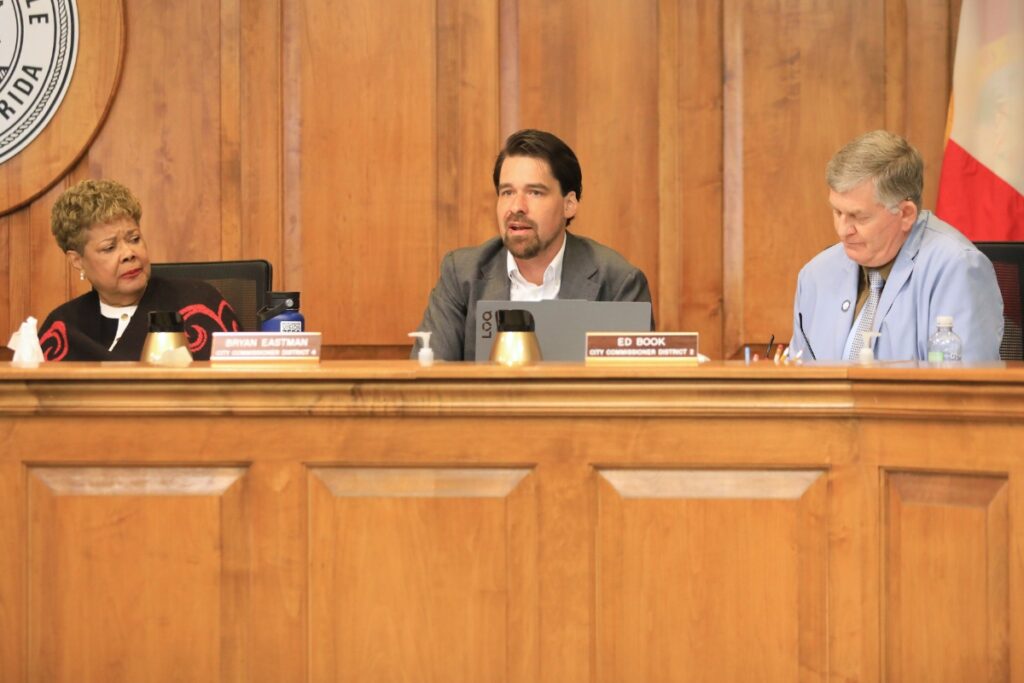
Commissioner Bryan Eastman said that because New River is cheaper and reuses captured methane, it would be the best option fiscally and economically.
He made the motion greenlighting negotiations, with caveats that the city reach out again to Alachua County and New River to create the best path forward and ensure the contract maintained flexibility for future food waste service expansion.
Eastman asked staff to return at the end of the calendar year with updated food waste pricing and data on factors like drop-out sites.
“I mean, people are passionate about their trash getting picked up, the people that pick it up are very passionate about it,” he said. “I think this is a really great relationship to have for the next 10 years. Thank you, guys, for working with us for so long.”
Under the new contract with GFL—which can be renegotiated at any time—Lloyd said the city would get multiple upgrades for customer service, recycling and food waste services.
GFL would run a three-to-five-day collection service with a fleet designated for Gainesville and fueled by compressed natural gas. The city would own the garbage carts and bins, a term Lloyd said would help if something happened to the hauler. Residents will have access to a dedicated toll-free line for customer service.
Lloyd also said residents are allowed six cubic yards of yard waste, and truck-mounted camera systems will help hold GFL workers accountable by tracking which carts were on the curb and emptied.
The city could opt into a food waste service for an extra $9.53 per household a month. Lloyd said a survey from the pilot program revealed around 20% of customers would likely participate.
Willits said the most significant term he noticed in the new contract was the 3% cap on the amount of non-recyclable items contaminating recycling bins. Past the cap and contaminated bins get tagged, and the city gets fined.
With a 35 to 40% participation rate in recycling, Lloyd said the city had stayed around the 3% contamination rate before spiking up to 13% and settling back down to the current 9% with educational efforts about what’s recyclable.
Although GFL is required to provide $5,000 worth of education, Commissioner James Ingle said the best learning tool would be customers getting kicked back a few times. Willits said he didn’t think people were ready for it, regardless.
“It is much more putting the responsibility to recycle properly back to our residents, and I don’t think people are mentally prepared for that,” Willits said. “They’re not mentally prepared to understand that they’ve been wish-casting this whole time.”
On the garbage and stormwater votes, Eastman said moving the fees to property taxes is more than a logistical issue, increasing the rates per unit by around 8.7%. Just like with failures to pay any other taxes, the city can now place liens on residents who don’t pay garbage and stormwater bills.
Mayor Harvey Ward said that although Gainesville Regional Utility could reconsider, it hadn’t responded to a letter from the city asking it to do so. He said the transition placed the burden on landlords who would undoubtedly pass it on to renters.
If GRU bills decrease and the GRU Authority tries to take credit, Willits said the city better be ready to push back.
“I think we should be prepared to be clear if GRU Authority tries to take credit for bills going down—which they usually do a really good job about separating out what portions of the bill they’re talking about when they say something goes up, down, whatever—that we’re prepared to say, no, no, just like the legislature, this is just a shift to where you’re paying for it,” he said.
Suggested Articles
No related articles found.
When does the switching of garbage and stormwater fees transfer to property taxes?
This may be a mistake:
“Garbage and stormwater fees will move from monthly utility bills to annual property taxes, increasing rates per unit by about 8.7% . . . ”
People will see the increase in their property tax bills and scream outrage. It will bring out “the usual suspects” in force, the people who perpetually b***h and p**s and moan about “gub’ment spending.”
The GNV City Commission and its Public Works Dep’t. doesn’t have a clue about food waste collection.
I don’t want to get my recyclables kicked back, so I will just throw it all in the trash. Thanks.
Why do residents have to rent the garbage bins from city? It’s crazy expensive and a waste of our money. Robbery , in fact. Why can’t we just buy them? That alone would lower our GRU bills.