




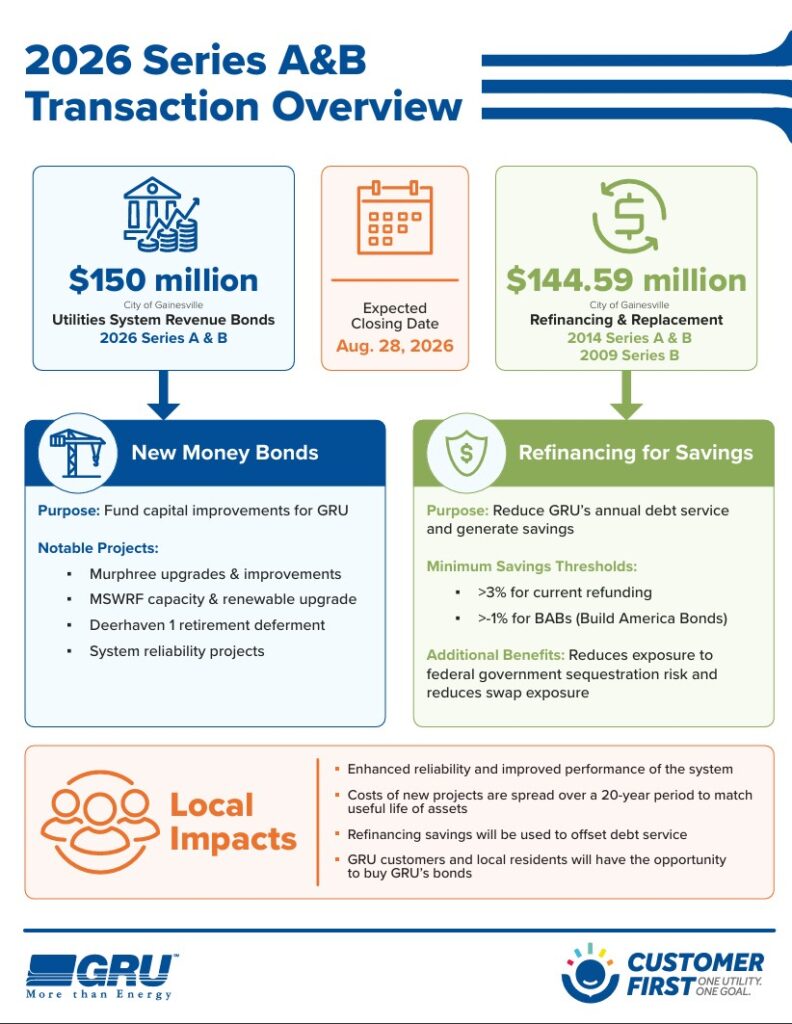
Gainesville Regional Utilities (GRU) plans to borrow $150 million in new bonds later this month, and the three rating agencies each affirmed the utilities’ current credit level.
This week, the agencies (Fitch, Moody’s, and S&P) gave a stable outlook for GRU and focused on the same key factors and future risks. GRU asked for the new ratings in advance of its anticipated August bond deal, along with another $150 million bond in 2028.
In a press release, GRU CEO Ed Bielarski said the affirmations showed that the utility is headed in the right direction.
“Overall, the reports were positive and in support of GRU’s strategic plan,” Bielarski said in the release.
The agencies confirmed their previous ratings of Aa3 for Moody’s, A+ for Fitch and A for S&P. Each of these is an investment-grade rating.
The agencies each said GRU’s electric rates have improved over the last few years but remain above the state average. But gas rates are highly competitive compared to state peers, Fitch said.
“Although multi-year rate increases are planned for the water and wastewater systems, the combined bill for the utility services GRU provides remains among the lowest in the state,” the Fitch report said.
As in past reports, the agencies pointed to GRU’s rate-setting ability, strong local market anchored by the University of Florida and robust liquidity as underpinning positives.
The GRU Authority approved a 2% and 1.75% increase for the water and wastewater systems starting in October. The wastewater system will also use a significant portion of the new bond revenues for Phase 2 of renovations at the Main Street Water Reclamation Facility.
A high debt load is one of the main negatives against GRU improving its credit rating, and the reduced revenue transfer from the utility to the city of Gainesville has been the primary mechanism through which the utility has reduced debt while keeping rates competitive, the agencies noted.
Each of the agencies mentioned the governance struggle between GRU and the Gainesville City Commission, but they said the issue hasn’t negatively impacted the credit rating to date. Impacts could come if the struggle redirects the utility from its current path of paying off debt early ($29 million of principal annually) and keeping “robust financial metrics.”
“As GRU continues to progress through its debt defeasance program, we expect its debt burden may decline modestly over time even as it debt finances almost half of its capital program,” S&P said. “We will continue to monitor GRU’s pending litigation with the city of Gainesville over the governance of GRU as the outcome is uncertain.”
Moody’s also noted that GRU will need to “carefully manage planned life-extension investments across its aging generation fleet.”
Bielarski has told the authority that the utility plans to refurbish and extend assets as it is able while continuing to reevaluate future electric generation and look for opportunities.
City commissioners had an opportunity to sound off on the extension of assets and the bond issuance in February when the utility asked the city to approve the deal. GRU said the banks wanted the backing of the authority and City Commission before moving ahead.
The meeting allowed the commission to question GRU staff and highlighted the differences in perspective on the utility’s path forward.
Suggested Articles
No related articles found.
$300 million in more debt out of GRU between now and 2028? ffs what are we doing here? What a disaster.
Hmmmmmmm….. The credit agencies say GRU is investment grade. Just as it HAS BEEN before the State’s takeover. So, once again, just why did the State feel compelled to do that? Because all that action really did was to increase combined city+utility costs by splitting shared services and the latest – moving city trash pickup costs to the tax bill.
GRU’s bond ratings are investment grade, but they are well below the highest AAA rating. On a $150 million bond issue, that difference in credit quality could translate into roughly $500,000 a year in additional interest costs compared with what GRU might pay if it carried the highest credit rating.