

- David Stirt was inducted into the University of Florida College of Journalism and Communications Ring of Honor in 2026.
- He founded Gator Bait Magazine in 1980, which became a key source of UF sports news, especially before the internet.
- Stirt taught the first college sports reporting course in America at UF from 1981 to 1990 and was an adjunct instructor for 17 years.
- He helped found the College Sports Publishers Association, generating over $2 million in advertising revenue by the fifth year.
He’s known for many things.
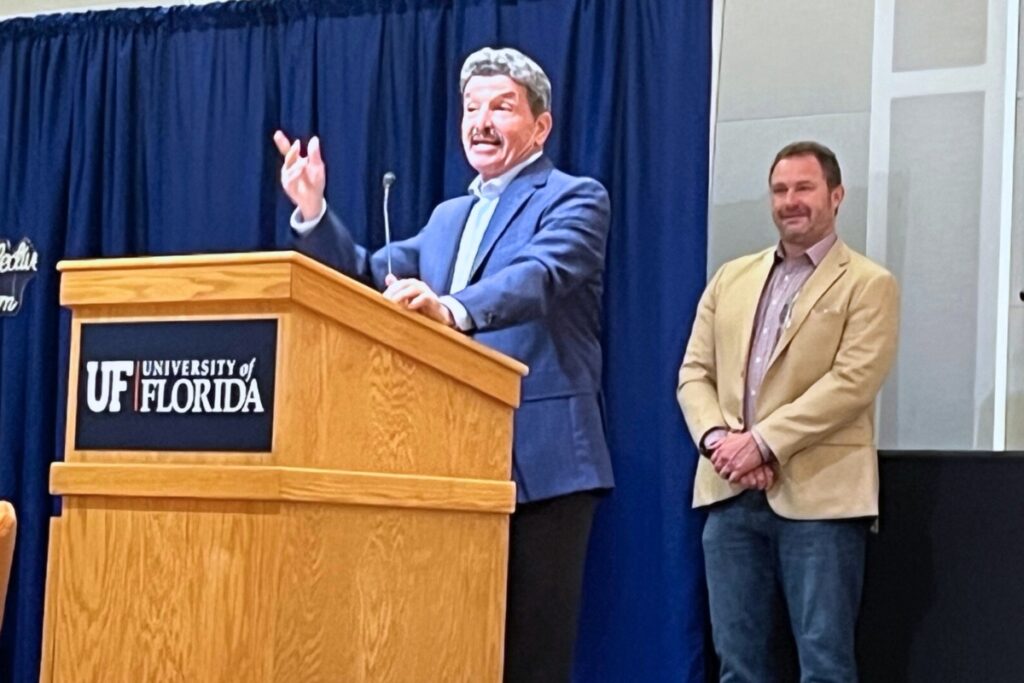
David Stirt, a pioneer, a legend, and an editor, was among four inductees in Wednesday’s 2026 University of Florida College of Journalism and Communications Ring of Honor.
I know him best as the founder of Gator Bait Magazine.
As a kid growing up in Jacksonville before the internet, the once-a-week publication was my only source for Gator sports.
Stirt received his Bachelor of Journalism degree from the University of Missouri’s School of Journalism and moved to Gainesville. He developed and taught a course in sports reporting (1981 to 1990), the first of its kind in any college journalism school in America.
As a graduate instructor, he taught sports reporting, editing and news writing courses in the UF journalism school. He was an adjunct instructor at UF for 17 years.
Arnold Feliciano, who worked at the Gainesville Sun from 1991 to 2021 and served as the paper’s sports editor for over 20 years, was in Stirt’s sports reporting class in the spring of 1982.
Feliciano said Stirt enhanced his writing career.
“He always taught me to have a little nugget in your story that nobody else would have, anybody who covered the game, the team, whatever, to have a little piece of nugget in there,” he said. “And I always did in every paper I’ve been at since then. I always told that to our writers, and even at the Sun, guys like (Pat) Dooley, he would remember, ‘Arnold, I got that nugget you want,’ so that’s a sticking point. Have something different because when you cover a game, you’re going to have a lot of the same things, but just have at least one good piece.”
Stirt also inaugurated and hosted Sportalk, the first weekly sports talk show in Gainesville on WRUF radio, and he hosted a weekly 30-minute sports program on WUFT-TV.
But before there was Gator Bait Magazine, Stirt became the editor of Go Gators magazine, a publication covering the University of Florida athletic program.
“There was a bulletin board and there was a listing for a new Gator magazine,” Stirt said. “They were looking for an editor and Kirk McNair, who was the S.I.D. at Alabama, was coordinating this with a number of schools…Vanderbilt, Washington, all over the place, and they wanted a Florida paper, and I saw that on the bulletin board and I called them up.”
Based on his experience after college as an editor for Miami-based Sports Digest magazine, he was offered the position.
The year was 1979, when the Florida football team went 0-10-1.
“It’s tough, especially after the first game of the year, they play Houston at Houston, who was the Southwest Conference champ, and lose 14-10, and I was like, ‘hey, this could be a pretty good team,’ and it never materialized.
After 13 issues, the magazine went out of business.
When Stirt was at the University of Missouri, he started his own publication called Tiger Talk and “got a taste of running a paper.”
“The key element was that Florida went 0-10-1, and there were still 54,000 people showing up every week for the games,” he said.
He pondered if that many people showed up then, “what’s this place going to be if Coach (Charley) Pell makes it go?”
So, he started Gator Bait Magazine in 1980, while he was teaching his first sports reporting class.
The first three writers at Gator Bait included Frank Frangie, who wrote for the Florida Times-Union, hosted a popular radio show in Jacksonville and is currently the “Voice of the Jacksonville Jaguars,” Nick Moschella, who became sports editor of the Palm Beach Post, and Michael Servidio, who wrote for the Tampa Tribune for many years.
The only problem was that Gainesville Sun sports columnist and editor Jack Hairston decided to start a paper as well that same year, called Bull Gator.
“They let him do it, even though he was working at the Gainesville Sun,” said Stirt, who noted it should have been a conflict of interest. “He went out and got $100,000, $10,000 from 10 different boosters, to support his publication.”
Stirt had put out a four-page sample copy in the spring of 1980, which had a picture of Gators quarterback Larry Ochab on the front.
He had the Gator Booster list, and out of those 5,000 people, he ended up getting about 500 subscribers at $20 per subscription, so he had $10,000 in subscription money.
“I talked about the things that were going to be coming up with the new O’Connell Center, I mentioned Ernie Weaver in there, Norm Sloan had just come aboard,” Stirt said. “And then the back page was the printed transcript of my interview with Bear Bryant, which I had done (when the Gators played Alabama in 1979).”
Stirt said it was a struggle because they were the only school in America that had two papers covering the Gators’ athletic program.
“Gator Bait was like the fourth or fifth of its kind in the country,” he said. “Cats’ Pause at Kentucky, Tiger Rag at LSU, and Dawgs’ Bite at Mississippi State, and then I was the fourth one to come aboard and create one of these papers.”
Stirt admits he could not have started Gator Bait in this day and age for one simple reason – access.
One of the things that made his publication so popular was that he always got the scoop.
“All the daily reporters, everybody was allowed in the locker room after the games, and you could talk to any player you wanted after practice; you could talk to any coach, you had a way of getting different stories than everybody else,” he explained. “When I went in the locker room after a game, and everybody went to, like, (quarterback) Kerwin Bell’s locker, I interviewed other players. I waited until his locker cleaned out, because I knew if I went over there and asked the questions I wanted to ask, they would appear in everybody’s newspaper on Sunday. Mine didn’t come out until Monday.”
Stirt got a lot of stuff that nobody else got.
“Coaches, everybody else dealt with the head coach, but I became close friends with every assistant coach, and they trusted me, and I found more scoops,” he said. “The beat writers had to subscribe to Gator Bait because I was scooping them.”
Among the highlights, and there were many across 18 years at Gator Bait, was when the Gators brought in Mike Shanahan as offensive coordinator in 1980.
At Sports Digest, one of the editions they had was a Minneapolis edition, and Stirt had been reading about the University of Minnesota football team, where Shanahan had been the offensive coordinator before he came to Florida.
When Stirt interviewed him, he started talking about Minnesota’s offense and his quarterback, and Shanahan was really impressed with his knowledge of the team.
“We became very good friends, and at the end of that first meeting with him, I said this is a pretty big leap to the University of Florida, so I assume this is a stepping stone to being a college head coach someday. He said, ‘No, Dave, that’s not really my plan. I’m planning on being an NFL head coach.’ Even then, he hadn’t been a college head coach, but he knew he wanted to be an NFL head coach.”
The big highlights athletically were the football national championship in 1996, the football team’s first SEC championship in 1984 and the basketball team’s first final four in 1994.
“When they won the first SEC title (in 1984), and then they took it away, there was so much going on,” Stirt said. “That was just the craziest year to cover sports. In fact, I was thinking at one point of writing a book called ‘1984.’”
Basketball was actually Stirt’s favorite sport.
“The day after they lost to Duke in the semifinals, (head coach) Lon Kruger came down to meet the press and somebody said, ‘You must be really proud of how much your team overachieved when everybody picked them,’ and he just looked at the guy and said, ‘No, not at all. I can’t go with your characterization. We did not overachieve. We reached our full potential. There’s no such thing as overachieving. You can underachieve, but if you reach your full potential, you’re not overachieving,’ and I never forgot that.”
Stirt said this industry was totally different from the newspaper industry, which made it tough to get advertisers.
“The regular newspaper industry was 80% advertising revenue, 10, 15, 20% circulation,” he said. “Our papers were 80% circulation (paid subscriptions), and very little advertising because we had such loyal fans. They could only get our news, especially if they lived out of state. You had to get Gator Bait if you were out of state, so we had to find ways to get more advertising because the circulation wasn’t enough to support us.”
So, they founded a group called the College Sports Publishers Association, which included all the papers (56 schools) of its kind around the country, a circulation of 500,000, and they were able to pursue national advertisers with the help of Stirt’s marketing guy, Dwight Johnson.
“By the time we got moving with the thing by about the fifth year, we were doing over $2 million in advertising revenue for the publishers,” Stirt said.
He said it had been a totally untapped market, so he felt like he had done something for the publishers.
“That was probably the second biggest thing I did,” Stirt said.
Wait, what?
Find out what the biggest thing was in Monday’s column.
Suggested Articles
No related articles found.