




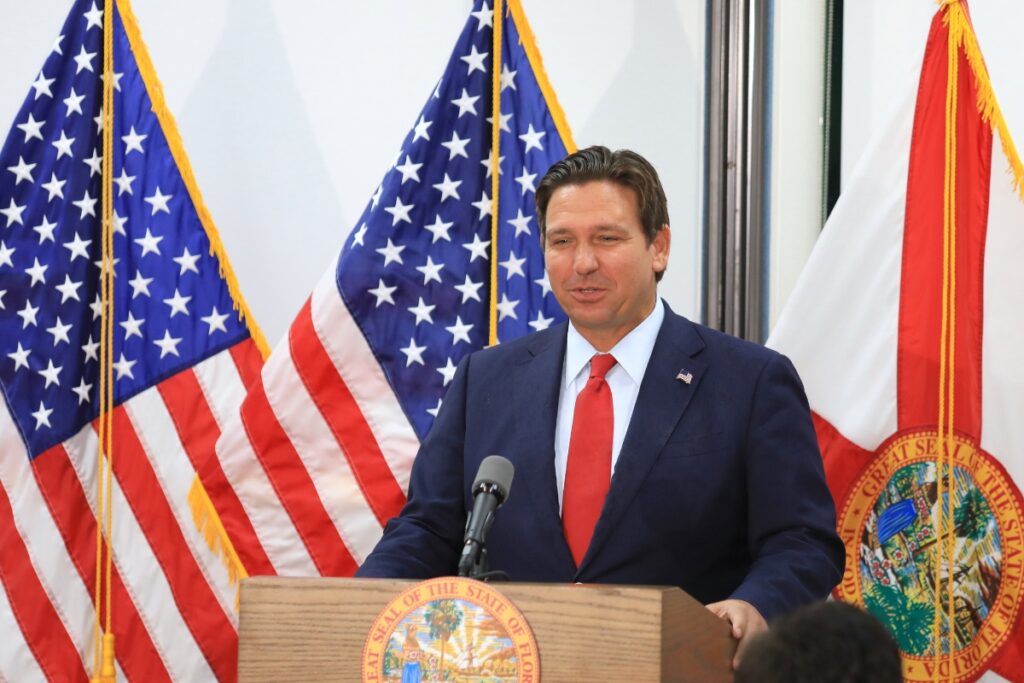
- Florida Gov. Ron DeSantis signed HB 757 to expand the Guardian Program to include armed guardians on Florida's public college and university campuses.
- The law requires public colleges to create response plans for active assailants and makes firing a weapon within 1,000 feet of a school a second-degree felony.
Florida Gov. Ron DeSantis signed a bill on Friday that will increase school safety measures at colleges and universities across the state.
DeSantis signed House Bill (HB) 757, also referred to as School Safety, during the fifth annual Florida Department of Education Commissioner’s Summit in Miami. The event was focused on school safety and security.
“We’ve made historic strides to implement school safety measures that are working to protect our schools. Today [Friday], I was proud to build on these efforts by signing HB 757, which enhances campus security requirements and best practices at our colleges and universities throughout Florida,” DeSantis said in a press release. “We can have the highest academic standards, the strongest workforce programs, and the most innovative pathways for students, but must also continue our focus on the safety of our students and educators.”
The bill, which takes effect immediately, expands the Chris Hixon, Coach Aaron Feis and Coach Scott Beigel Guardian Program to include Florida’s public higher institutions.
According to the release, the Guardian Program was established in 2018 through the Marjory Stoneman Douglas High School Public Safety Act following the mass shooting at Parkland’s Marjory Stoneman Douglas High School.
Before the signing of HB 757, the program permitted trained individuals to serve as armed guardians on K-12 campuses across Florida to deter and stop active assailant incidents. This has now been expanded to include college and university campuses throughout the state.
Participation in the Guardian Program is optional for schools.
For the institutions that do decide to participate, guardians will be required to undergo “extensive screening and training requirements provided by the local sheriffs’ office,” according to the release. This includes drug screenings, psychological evaluations and a minimum of 144 hours of “rigorous training.”
“By extending the Guardian Program to higher education institutions, we are equipping campuses with additional tools to help safeguard students and professors,” Florida Commissioner of Education Anastasios Kamoutsas said in the release. “Every student deserves the opportunity to learn in a safe and secure environment, and this legislation reinforces Florida’s unwavering commitment to protect our schools.”
Beyond expanding the school guardian program, the new law requires Florida’s public colleges and universities to create “active assailant response plans, threat management teams to identify and address potential safety risks, and family reunification procedures in the event of an emergency,” according to the release.
The law also creates a second-degree felony charge for firing a weapon or firearm within 1,000 feet of a school.
Mainstreet reached out to Santa Fe College and the University of Florida on Monday afternoon for comment regarding the signing of HB 757.
Lisa Brosky, a spokesperson for SF College, provided Mainstreet with the following statement:
“Santa Fe College appreciates the prioritization of campus safety by the Governor and the Florida Legislature. We are currently assessing all aspects of HB 757 to bolster all facets of campus safety. As one of only one of six Florida College System institutions with its own sworn police department, which has been recognized both statewide and nationally for its innovative and outstanding efforts, Santa Fe College remains committed to providing a safe environment to all students, faculty, staff and visitors to the college. The college has also established comprehensive programs focused on campus safety and mental health awareness to build a resilient campus community where teaching and learning can thrive.”
UF had not responded to a request for comment by publication time.
Nick Anschultz is a Report for America corps member and writes about education for Mainstreet Daily News. This position is supported by local donations through the Community Catalyst for Local Journalism Fund at the Community Foundation of North Central Florida.
Suggested Articles
No related articles found.