

- The University of Florida held its inaugural 24-hour hardware hackathon with 33 students forming teams to create hardware and software projects.
- The hackathon theme was "Build What’s Next," encouraging students to innovate using advanced hardware technologies of the future.
- Projects were judged by a diverse panel of five experts to provide a holistic evaluation and reduce bias in the competition.
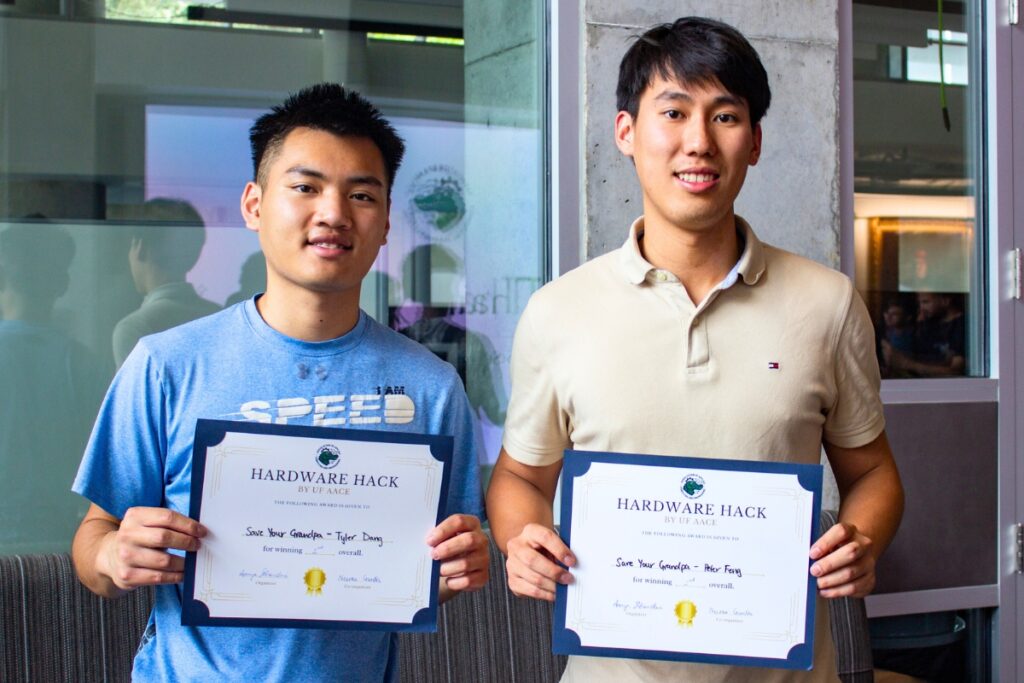
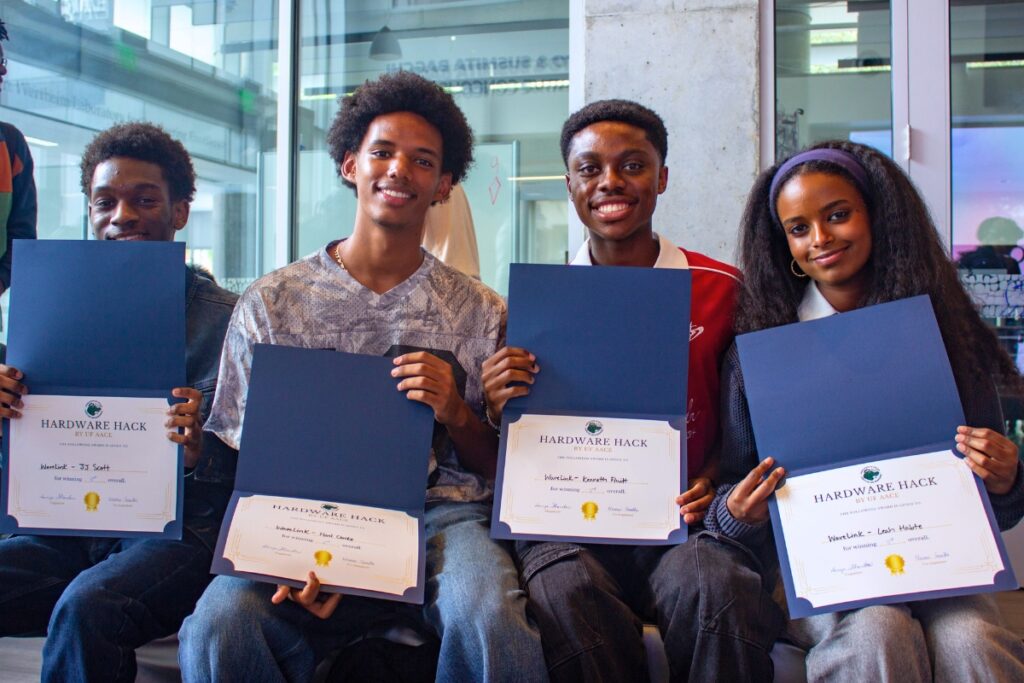
- The winning teams included Ember in first place, Save Your Grandpa in second with a wearable device for seniors, and WaveLink in third place.
Speed and creativity were on full display this past weekend at the University of Florida’s Herbert Wertheim Laboratory for Engineering Excellence, as more than 30 students took part in the university’s inaugural hardware hackathon.
The event, hosted by UF’s Association of Applied Computing and Engineering (AACE), saw 33 students form teams of two to four to design, build and demonstrate hardware and software projects – all in a 24-hour span.
“Basically, what we do is we give students some type of problem statement, a theme and a vague generality of what we’re looking for projects to be about and give them that [24-hour] time limit,” UF AACE President Aanya Bhandari said in an interview with Mainstreet. “So, it puts a little pressure [on the students] to come up with something innovative in a very short amount of time.”
The theme for this year’s hackathon was “Build What’s Next.”
“We decided on Build What’s Next because a lot of the hardware revolution has been coming around…” Bhandari said. “So, we wanted to look at what students can come up with if we think about, ‘OK, if this is where hardware is going, where does that take us 10 years from now, 15 years from now? What kind of projects can now come from this advanced hardware that we didn’t have two or three years ago?’ So, that was kind of the inspiration for this theme. And we wanted to see how students would embody it, because it means something different for everyone.”
Bhandari said the hackathon started around 9 a.m. on Saturday with the opening ceremony. She added that the 24-hour time limit began once the ceremony started.
By 9 a.m. on Sunday, Bhandari said students were wrapping up and submitting their projects.
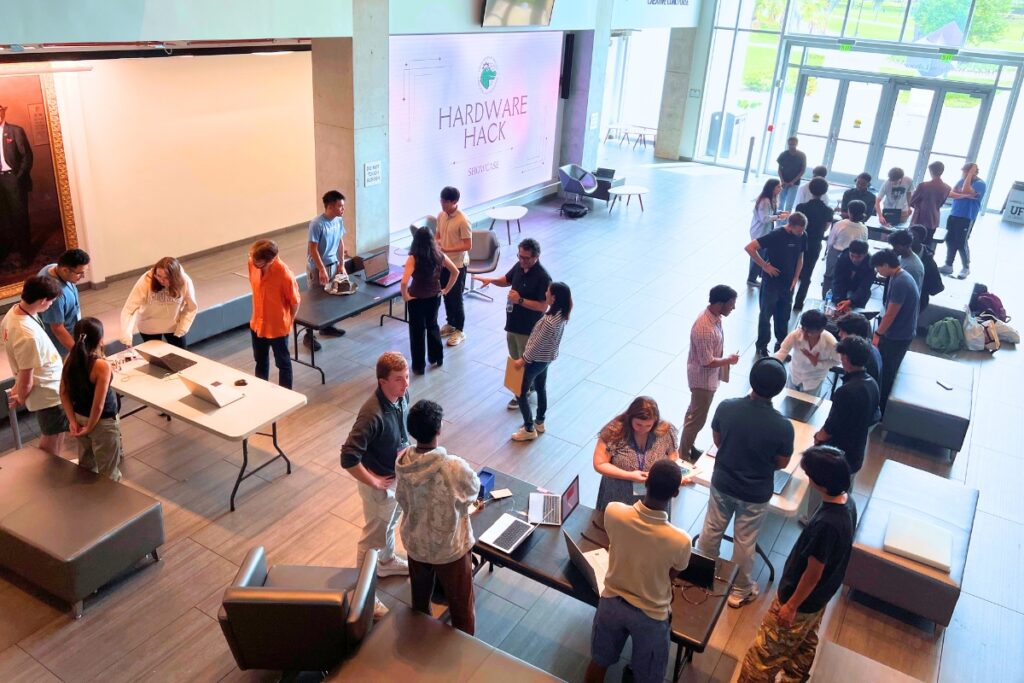
Also on Sunday, UF AACE hosted a Hardware Hack Showcase from 10 a.m. to noon in the Wertheim Laboratory for Engineering Excellence lobby, where members of the public could come and walk around and chat with the teams about their ideas, designs and builds during those 24 hours.
During the showcase, students also had their projects evaluated by five judges from different backgrounds to determine an overall first, second and third place cash prize winner. The judges included Antonio Hendricks, a Ph.D. student at UF; Jillian Prescott, manager for Career Pathways at the UF Career Connections Center (C3); Anna Hampton, a Ph.D. student at UF; and Iris Zhang, vice president and head of operations at Vobile, a leading digital content protection and monetization technology company.
“The idea of having diverse judges is so that we’re able to give a more holistic approach and review of each project, rather than it being just on technicalities or just on nontechnicalities,” Bhandari said. “And by having five judges, we’re also mitigating any type of bias…”
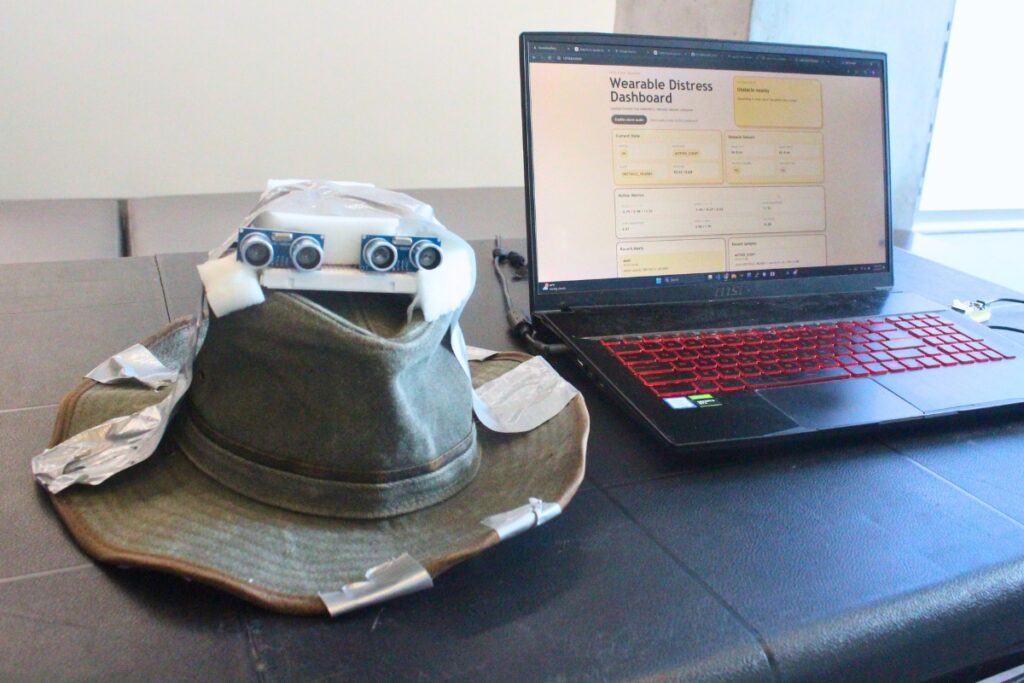
Peter Feng, a computer engineering sophomore at UF, and Tyler Dang, a computer science junior at UF, created a wearable device designed to help older adults by detecting obstacles and falls.
Feng said an older person can put the device, which he and Dang named “Help Your Grandpa,” on his or her hat. If the adult is in danger, the device will alert the wearer’s family members, no matter the distance.
According to Feng, it took him and Dang roughly 12 hours to build the wearable device, with testing and debugging taking the longest part.
Feng noted that creating the device from start to finish felt like “building a business in one day.”
Another team of two UF students – Matt Chachkin, a computer engineering sophomore, and Varun Yelchur, a computer science and statistics junior – created a behavior-based smart lock system that responds to a knock pattern rather than a traditional passcode or key.
Chachkin said the system would be targeted at individuals who might not be able to use a key or remember a password, such as children or people who are blind.
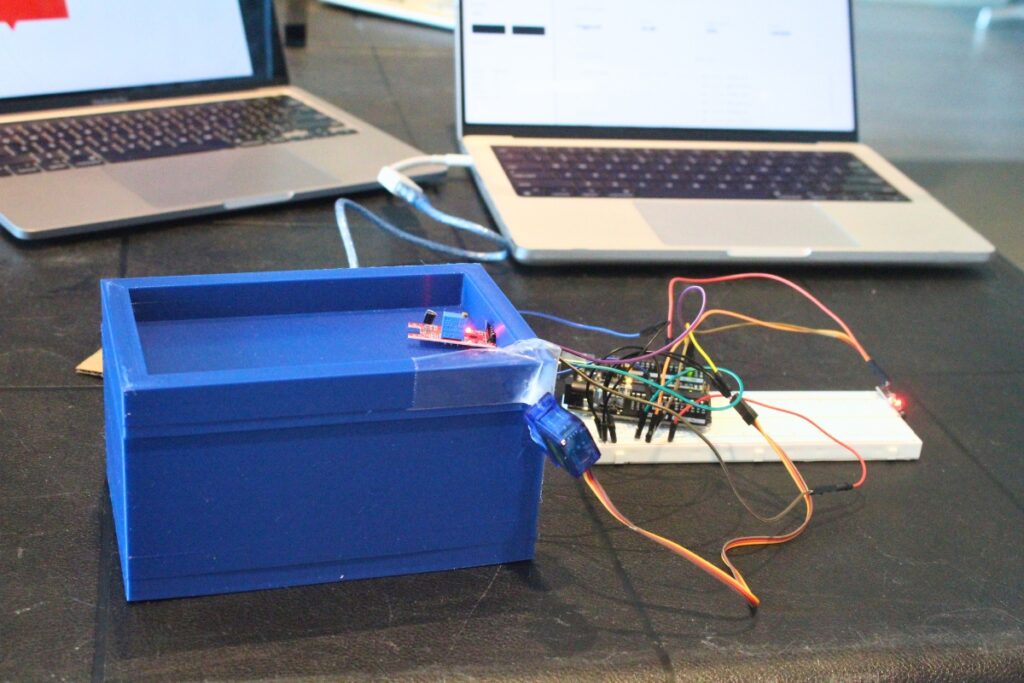
Yelchur added that the system could also be used by people who want to lock up just everyday items that might not necessarily go into a safe, but they still want to be protected.
Chachkin said he and Yelchur used “pretty much” the entire 24 hours to complete their project.
“Unfortunately, we did not get quite as functioning a prototype as we would have liked in the time. Part of that was hardware constraints, 24 hours being awake, all that,” Chachkin said.
Yelchur said this was the first hackathon for him and Chachkin. Both guys said they enjoyed the experience and would do it again.
“Next time, I would probably bring more caffeine and sleep more the night before [the event],” Chachkin said jokingly.
The first, second and third place winners from the hackathon are listed below.
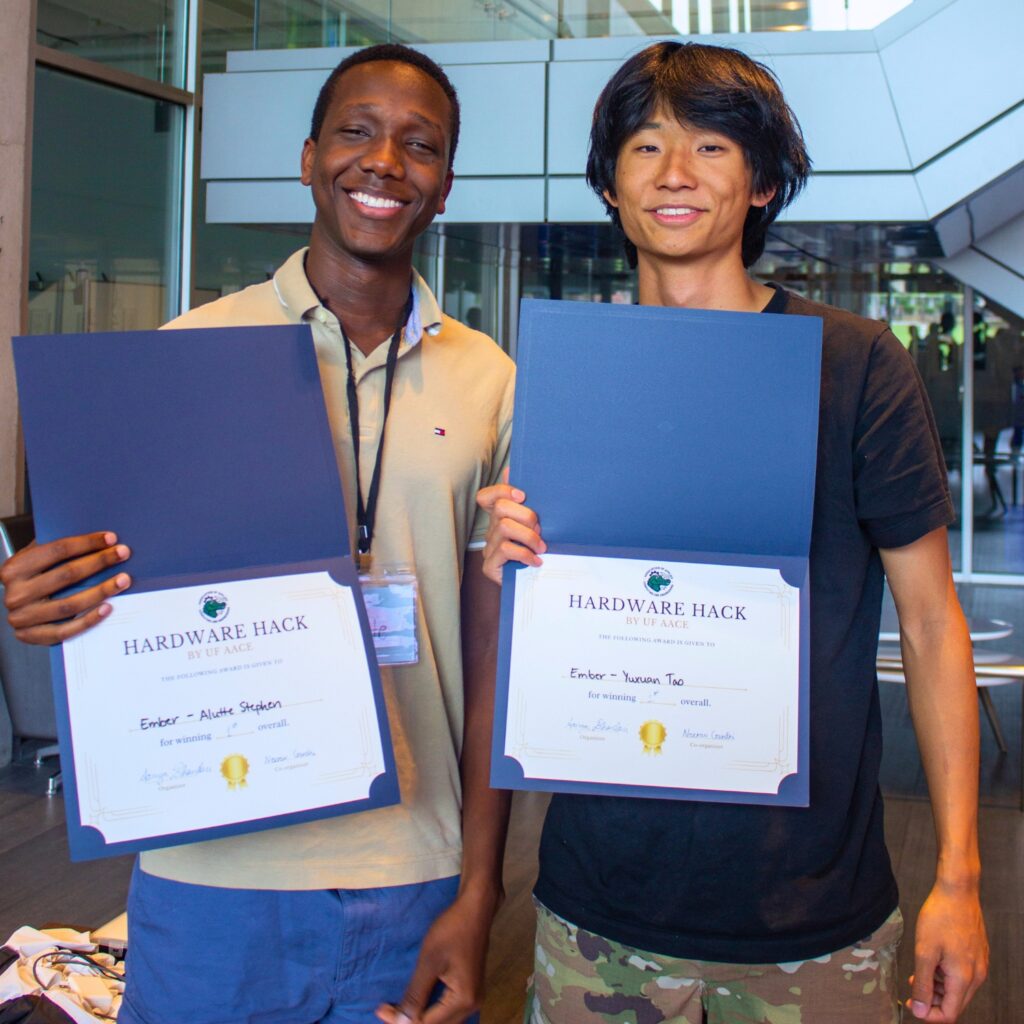
First place: Ember
- Alina Vasina
- Yuxuan Tao
- Alutte Stephen
Second place: Save Your Grandpa
- Tyler Dang
- Peter Feng
Third place: WaveLink
- JJ Scott
- Leah Habte
- Noel Clarke
- Kenneth Fluitt
Nick Anschultz is a Report for America corps member and writes about education for Mainstreet Daily News. This position is supported by local donations through the Community Catalyst for Local Journalism Fund at the Community Foundation of North Central Florida.