



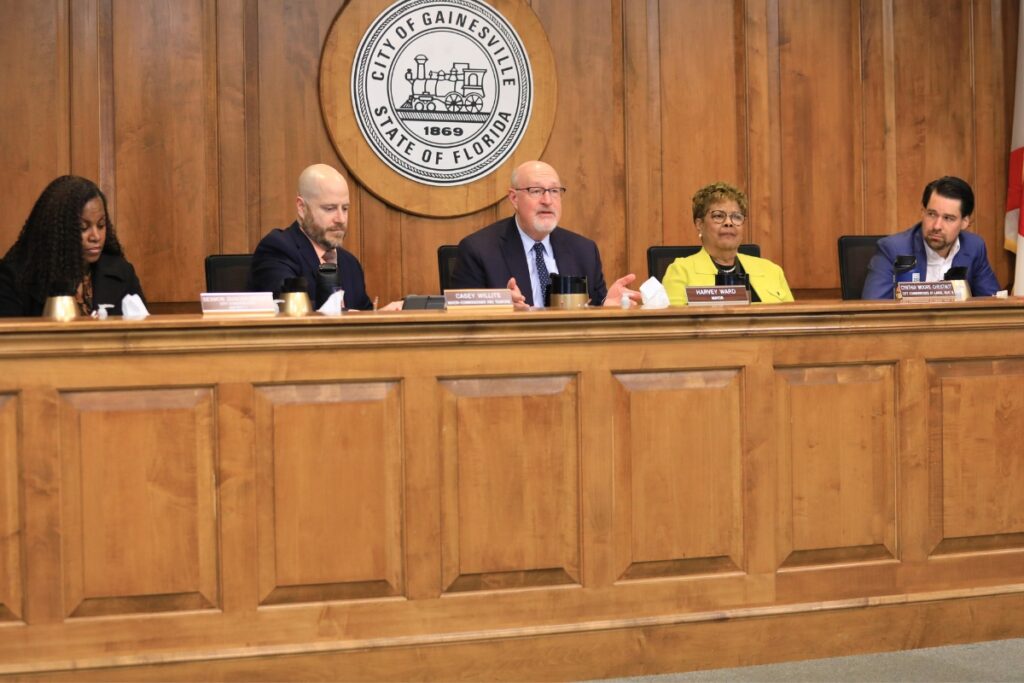
- The Gainesville City Commission unanimously approved $150 million in new debt and over $350 million in refinancing for GRU infrastructure projects and debt reduction.
- GRU's 2024 Integrated Resource Plan is incomplete, causing concern among commissioners about expensive asset refurbishment and long-term costs.
The Gainesville City Commission voted unanimously on Thursday to ratify bond documents from the Gainesville Regional Utilities (GRU) Authority to allow $150 million in new debt, along with half a billion dollars in total transactions.
The GRU Authority manages the utility, but the city of Gainesville still owns the utility even though the Gainesville City Commission is barred from impacting utility operations by a section of its own City Charter added by the Florida Legislature in 2023 and rebuffed by the city’s voters in 2024 and 2025 but not yet repealed as legal appeals take place before the Florida First District Court of Appeal.
The overall result of the above politicking: a joint custody battle for the utility that forces both the city of Gainesville and the GRU Authority to sign loan documents in order to garner the trust of the banks about to loan hundreds of millions of dollars.
“The people spoke clearly, and it has become exceedingly frustrating to much of the community to still be in these positions,” Mayor Harvey Ward said. “There’s unnecessary levels of inefficient stuff going on here that they know as they cost the people of Gainesville money to go back and forth on this stuff.”
The GRU Authority asked the City Commission to give co-approvals in 2023 as well. Those approvals concerned the sale of the trunked radio system to Alachua County and the renewal of cash access to backstop $105 million in bonds.
But Thursday’s item itself is straightforward for utilities.
Mark Benton, GRU’s director of accounting and finance, said the utility needs to go to the bond market every three or so years to fund infrastructure improvements. The utility last took on new debt in 2023 for $150 million.
Benton said the new debt this year would also be $150 million and fund water, wastewater and electric infrastructure improvements as part of its Capital Infrastructure Plan. The interest on this bond won’t exceed 6%, according to the backup documents, and will mature in less than 31 years.
GRU will add around $40 million of its own cash reserves and government grants to help pay for the projects.
The other more than $350 million approved at the meeting is to refinance debt, using new loans with better terms to buy out old loans.
The city commissioners agreed that the transactions themselves are standard. But commissioners Bryan Eastman and Casey Willits said they lacked confidence in the projects the GRU Authority was choosing to finance through the new debt.
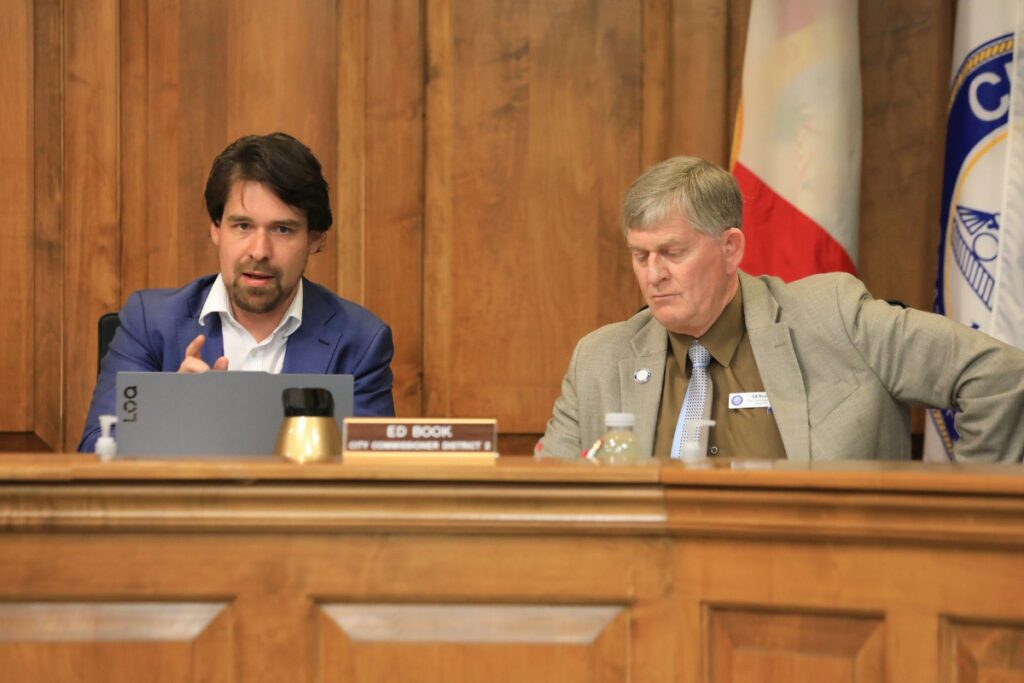
Eastman said utilities typically base capital improvements on their integrated resource plans, focused on the electric system, to determine where to invest funds and what assets should be refurbished versus replaced.
He noted that GRU’s 2024 Integrated Resource Plan is incomplete. He said he has concerns that GRU seems to be following the most expensive path forward as outlined by former third-party analysts who were hired to look over the utility system.
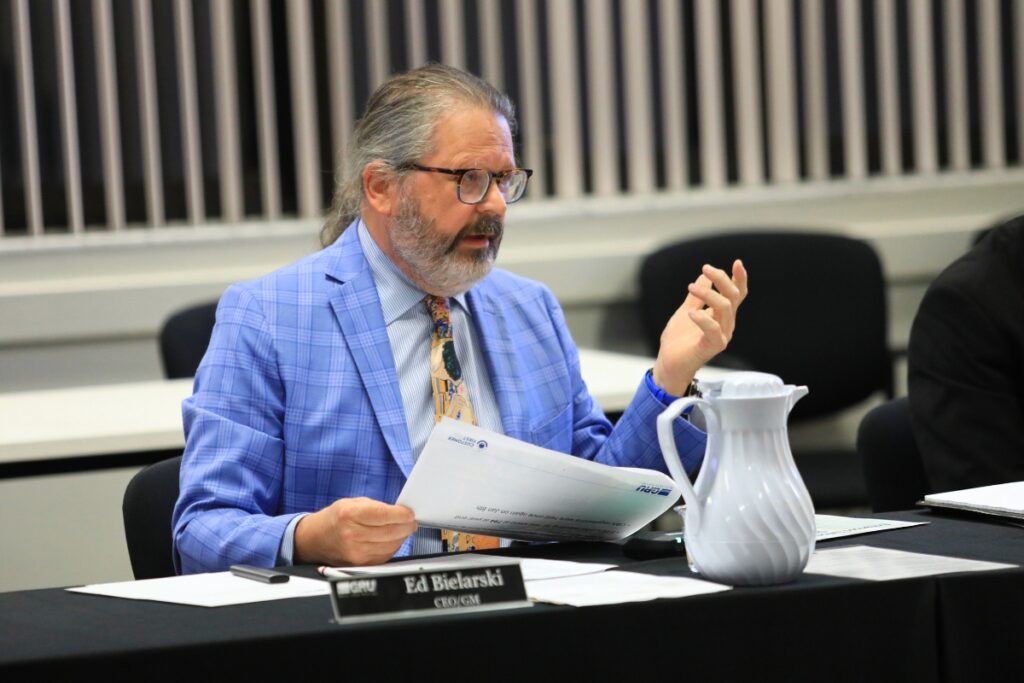
Willits said he was shocked when the GRU Authority, under the recommendation of CEO Ed Bielarski, stopped the integrated resource plan.
He and Eastman questioned if refurbishing major electric assets, already set to expire in the next decade, is the best way forward. And, if the appeal court sides against GRU, the City Commission would be stuck down that bad pathway.
The night before, Bielarski told the GRU Authority that the utility’s electric generation isn’t filthy and old; it’s been retrofitted, he said.
“It’s been maintained like somebody would a classic car,” Bielarski told the authority.
Bielarski praised the utility’s electric generation during the cold snap in early February. While other utilities told customers to reduce power usage, he said GRU continued running and didn’t need to issue those same warnings or ask people to use generators.
He said GRU was able to provide all the power Gainesville needed, and was selling some, even while the Kelly Generating Station was offline for maintenance.
Bielarski also told the GRU Authority that the overall debt reduction plan would look more like a sawtooth edge slowly going up and down but lowering over time, than a straight descending line.
At the city meeting, Ward said GRU debt would be at the exact same place after the new $150 million bond that it was before, despite all the rhetoric from the authority about massive reductions.
Willits said the utility is kicking the can down the road about how it powers the city over the next half century, choosing to refurbish 50-year-old assets and costing more money long term.
He took Ward’s debt perspective a step further. He clarified with Benton that GRU typically aims for a 50/50 match between debt and cash to pay for infrastructure projects. But Benton said the new debt would be a little more than half compared to the funds added by the utility.
“Was the GRU Authority negligent in rate setting the past two years, and that’s why the GRU Authority doesn’t have enough funds to maintain the system with the 50/50 split,” Willits said.
He then said the question was rhetorical, but Benton said he would be happy to give a strong answer.
“Since you went on the record, let me go on the record,” Benton said. “The GRU Authority is not negligent in its rate setting over the past three years.”
The GRU Authority voted to keep rates flat in 2024, going against a seven-year rate increase plan approved by the City Commission. In 2025, the authority raised water by 1% and wastewater by 1.75%.
GRU Authority Chair Eric Lawson questioned Bielarski at the time, pointing out that the rates couldn’t stay flat forever. Lawson said it’s a short-term tightening of the belt to make rates competitive before resuming a normal utility model of regular rate increases.
Bielarski confirmed Lawson’s statement.
“We are in this transition where we’re trying to resize ourselves, resituate ourselves so that we have a platform from which we can then be the utility we need to be,” Bielarski said at that May 2025 meeting.
Benton said Thursday that this new debt was anticipated in the 2023 net debt reduction plan approved by the City Commission. The plan aims to reduce overall debt—$1.8 billion at the time—by $315 million over the next 10 years.
With the unanimous vote, with Commissioner Desmon Duncan-Walker absent, the GRU Authority will move forward with its financial transactions. Meanwhile, both sides await a decision from the Florida First District Court of Appeal.
The court heard oral arguments from both sides on Feb. 10, but there’s no timeline on when a decision could come.
Attorneys for the GRU Authority said they’ve seen the court take anywhere from two months to two years at its regular February meeting.

Ward took issue with how GRU’s attorneys characterized the City Commission and its tens of thousands of citizens. The attorney said Gainesville was in the midst of insurrection, revolt and rebellion against the state of Florida—a view that one judge critiqued.
Ward also said the two sides need to work in a businesslike manner while the management issue is resolved.
“I’m frustrated with that,” Ward said, referencing the insurrection characterization. “Now I’m not going to let that affect how I vote on this because it’s good for the city of Gainesville, for the people of Gainesville to move forward.”
Suggested Articles
No related articles found.
So, new debt. Moreover, the utility couldn’t maintain the 50-50 split with cash and debt, because they didn’t acquire enough cash over the last couple of years. If the City still controlled the utility, opposition heads would explode.
But GRU was sure quick to brag about lower rates.
This has to be the first time any of the city commissioners ever considered an outside / third-party analyst to be an unnecessary expense, making excessively costly recommendations, because they do it all the time for their own pet projects. Also the first time any of them argued for staying within a budget. But if they could have, they would have already transferred tens of millions out of GRU, causing GRU to have an even harder time affording to maintain the equipment used to power our town.
With fuel expenses declining and rates held flat the only reason for floating more bond issue is to take advantage of lower interest rates to replace higher rate debt. GRU needs to stand alone and manage infrastructure with a plan that reduces costs and eliminates debt in a programmed way. The city took way too much money for their exorbitant spending on social programs above the basic requirements of city life expenses. I would love to see an outside audit of GRU and city expenses.